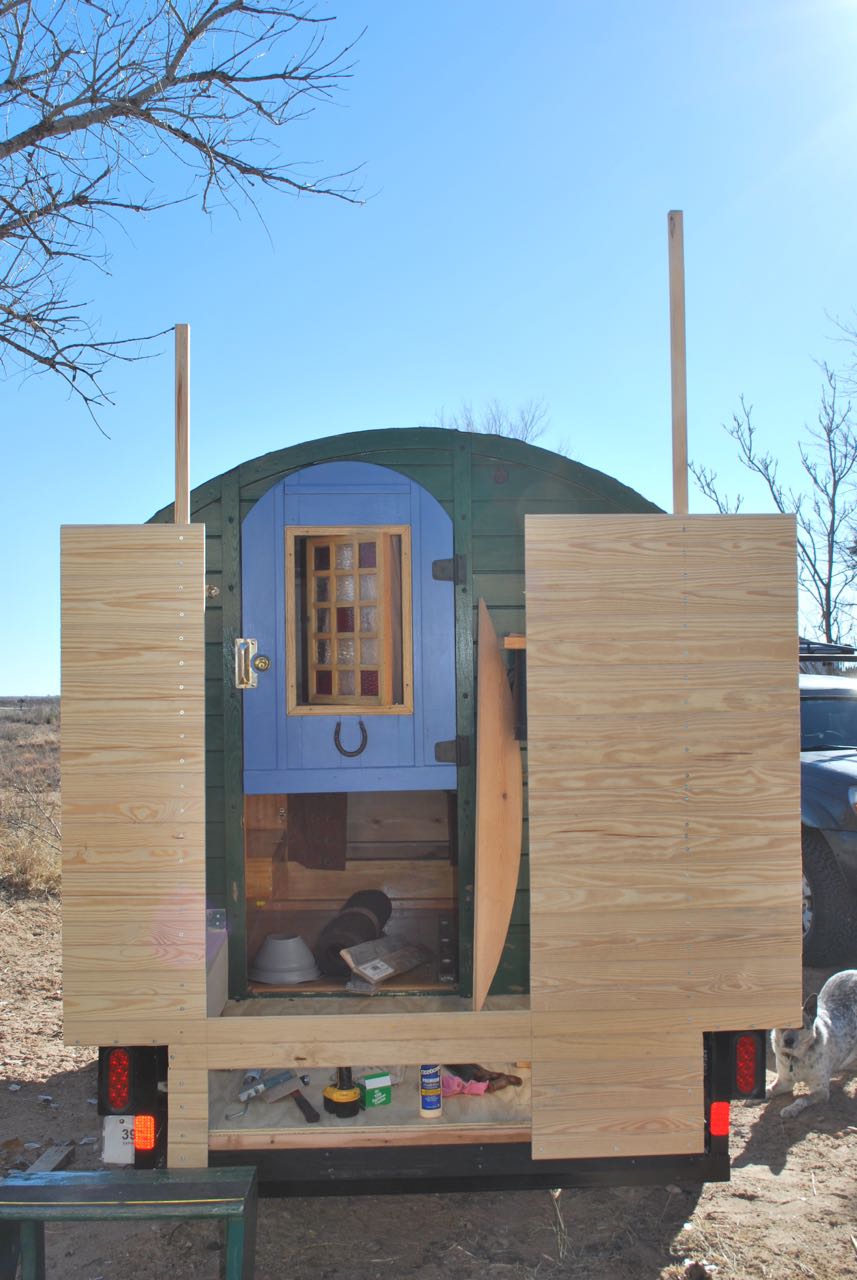
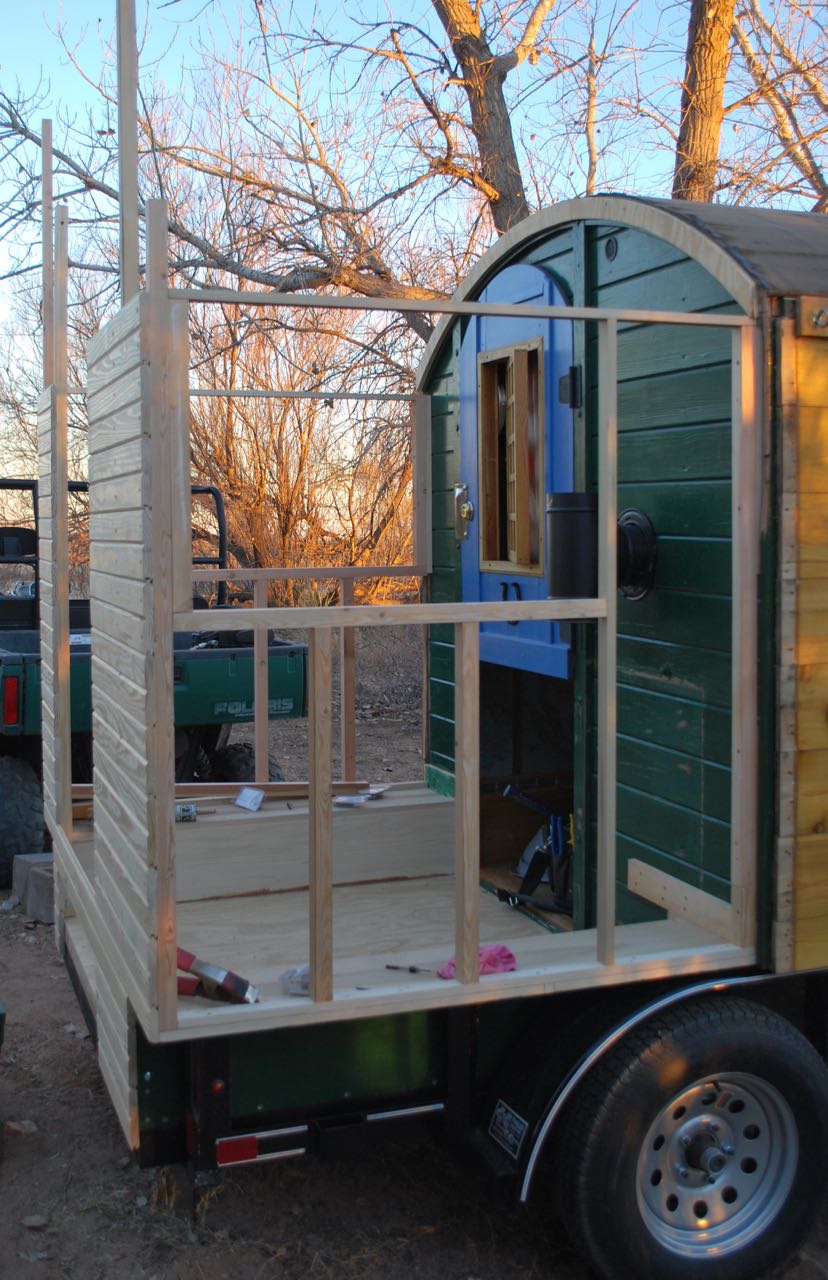
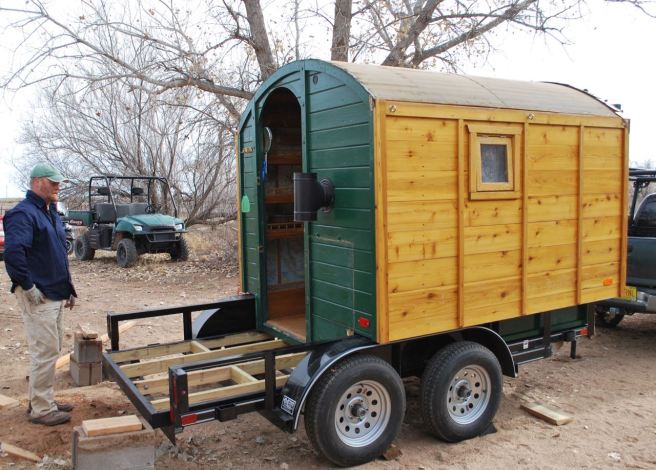
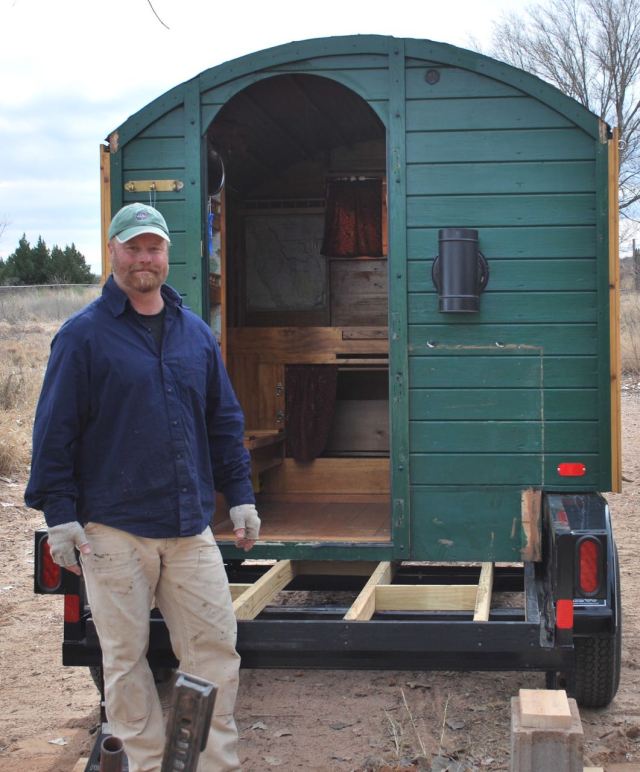
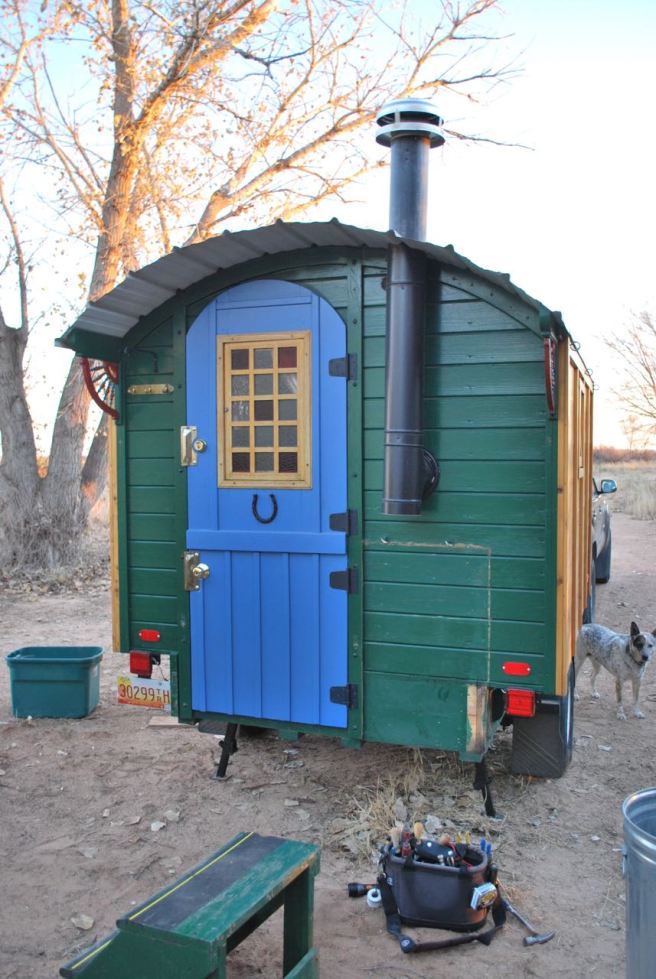
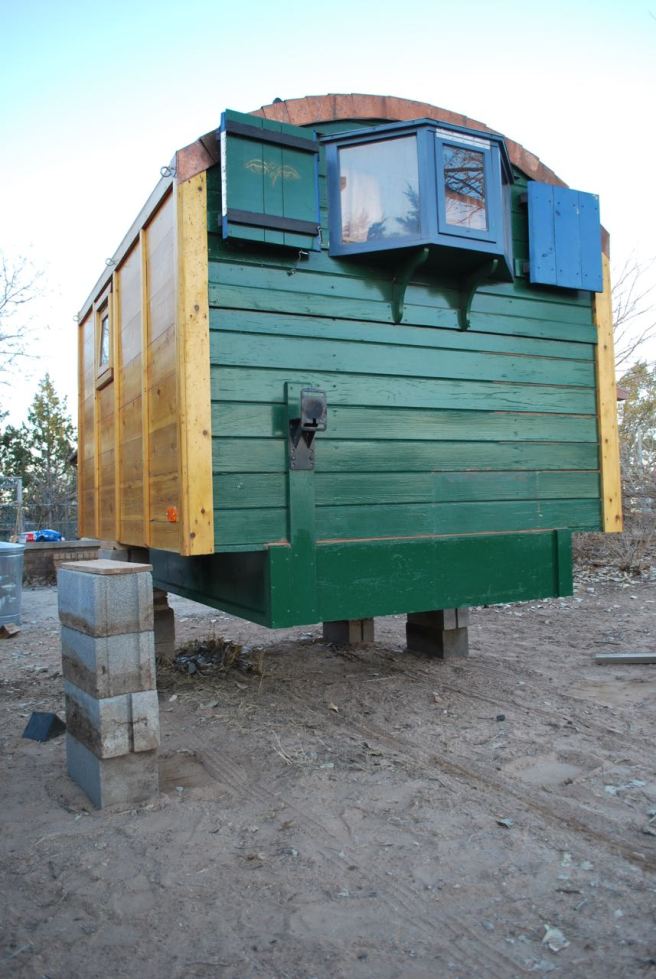
Fitting the exterior, Vardo Remodel Part 6

What follows is a somewhat terse step-by-step of the past couple weeks.

I had about a week of stolen moments before the winter holidays to dive in and make as much progress as possible, knowing that winter could bring just about any kind of weather and a 60 degree variance in daily temperatures.  My goal was to have the roof covered before bad things could happen.  Last minute unexpected issues with work severely limited my time and ability to really focus so it was difficult to stay on track, but being exposed to the elements, the roof was a pressing issue.

DSC_0003 (6)
The addition taking shape, purlins set, and roof sheathing going on.

Building the wagon from the inside out, you can see the interior tongue and groove pine and the battens that will stiffen the wall and provide a place to mount the cedar siding.  As I feared, the arc I cut on the end wall was not perfect and had to be compensated for while setting the purlins (the small beams seen above that will ultimately hold the roof structure). This was a critical phase of measuring, eyeing, and double checking everything because it would be glaringly obvious to the most uncritical eye if the roof-line was not straight.  Needless to say, I fretted and tweaked each board until I felt sure from every angle that the alignment was right.

It was about this time that we began hearing a forecast for severe weather, including substantial snow and high winds, in the coming days.  This added a real urgency to the need for roofing and wrapping up the current steps.

DSC_0014 (4)
Checking the roof-line for a smooth transition.

After tacking down the plywood ceiling, it was time to mark screw locations.  A 3/4 inch  (ca. 2 cm) purlin is a small target to hit blindly.

DSC_0018 (2)
Laying out the lines.

A couple near misses with roofing nails were required to get things lined up but once marked, things moved along simply enough.
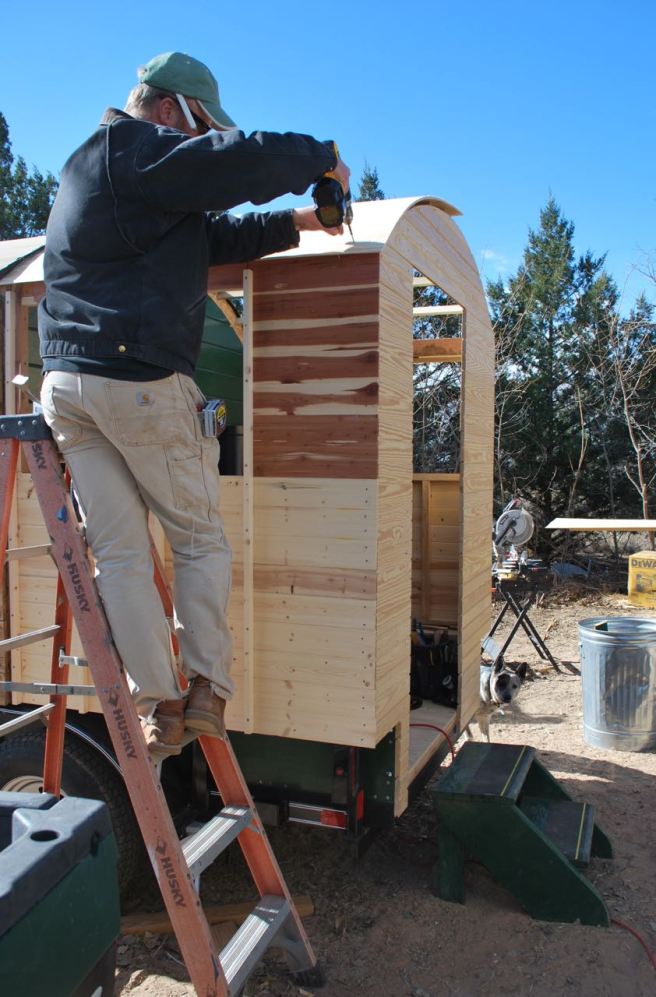
DSC_0004 (6)
Fastening down the roof.

I didn’t take photos of the roofing paper or waterproof canvas that overlays the plywood but those steps are pretty self-explanatory.

DSC_0029
Clamping the laminations that form the arch.

Now it was time to add a strengthening arch to the back wall.  After a couple of less-than-exact attempts to create a perfectly matched form from plywood I had a Eureka moment when I decided to use the wagon itself as the form.  Cutting a pile of 3/16 inch oak strips, I then glued and clamped them in place overnight.  Fortunately, the temperature stayed well above freezing through this entire step.  The metal was laid on the roof and tacked down while we hunkered down for the storm

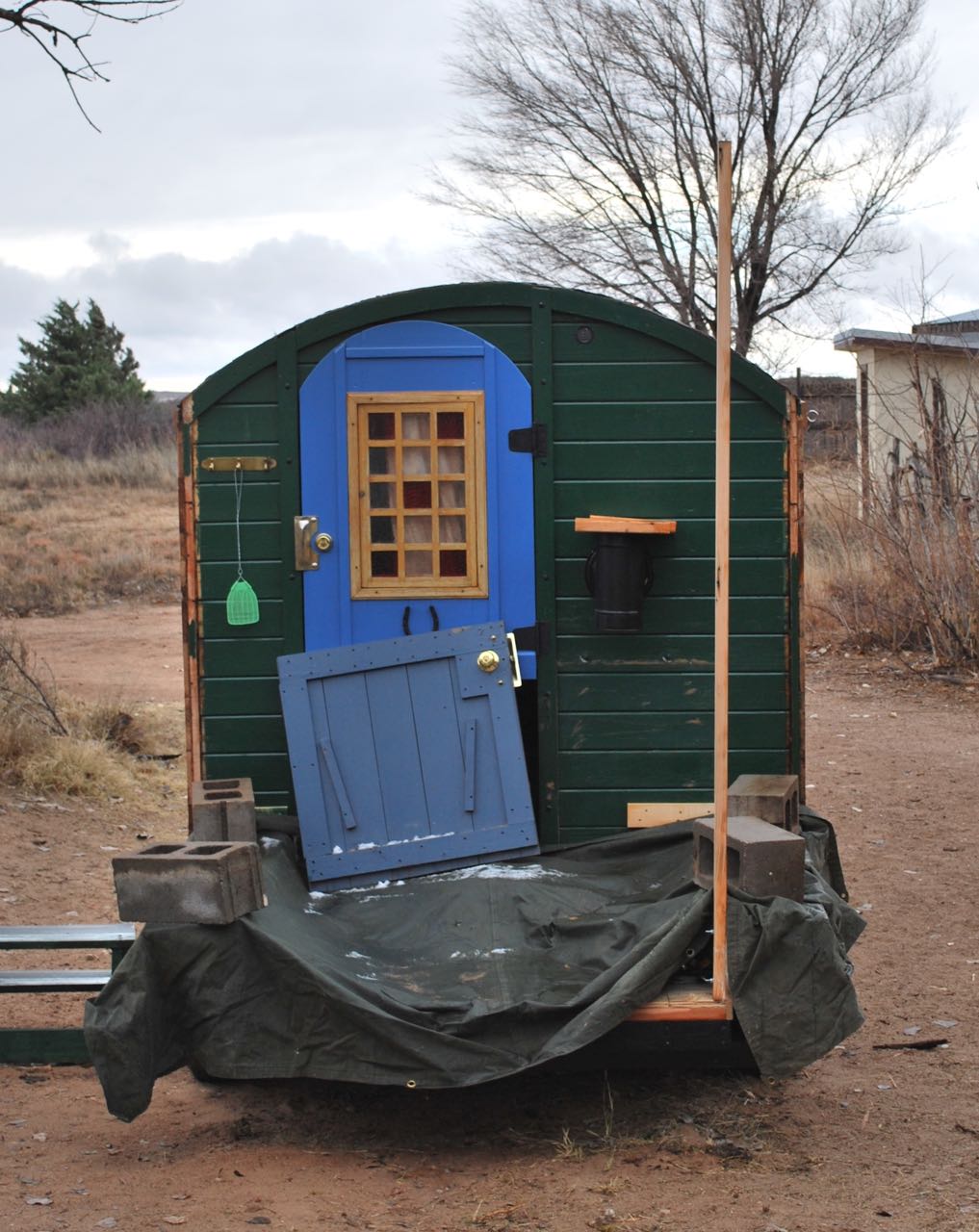
Knowing where I live, and the capriciousness of the weather here, we took the blizzard warnings seriously and wrapped up the entire back half of the wagon in an enormous tarp, attaching it with roofing nails.  It was a good thing too.  What followed was over 30 hours of straight-line winds from 50-70 miles per hour (80-112 kph) with gusts reported at the nearby Air Force base up to 87 mph (140 kph).  Thousands of cattle died in the region and we had structural damage to one of our buildings but the vardo survived.
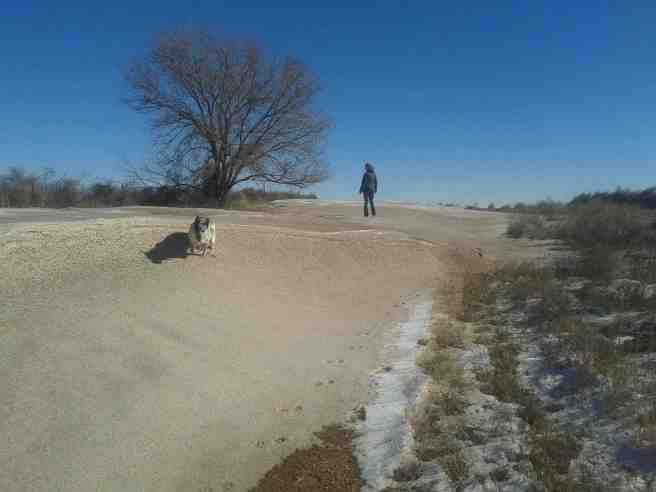
20151230sm
The 5 foot drift of snow, ice, and dust that filled our driveway.

The cold week that followed was time to take a break, eat, drink, and be merry over the holiday.

DSC_0032 (1)
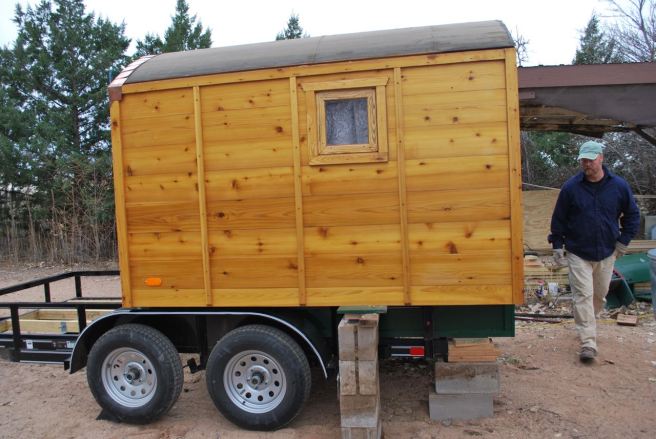
Metal attached and siding placed.

Getting back to the task at hand, the roof was finished and cedar planking added to the sides; the ends running long until they are cut into an ornamental shape.

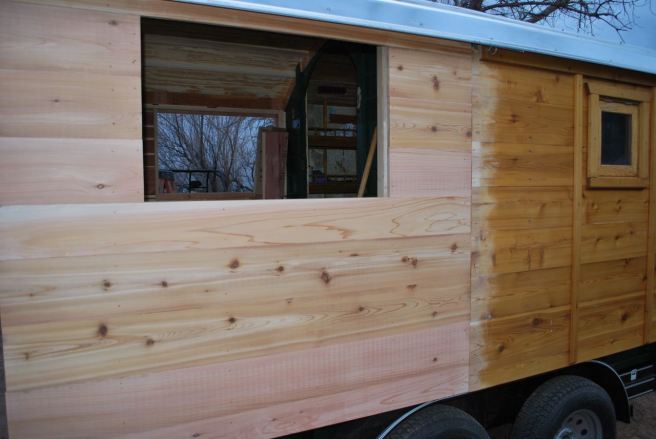
DSC_0031
Siding running wild, awaiting it’s final shape.
DSC_0033
An ugly transition beginning to be sanded.

The butt-joint will be covered with another batten to seal the joint.

DSC_0034
I can finally feel some real progress but there is a long way to go before I can rest easy.

The weather had stayed cold, limiting some of the work but the need to weatherize the exterior presses on my mind.  I’ll be back to the grind in a little while and will update the progress as best I can.  Comments are certainly welcome!

If you are looking for Part 1 of the rebuild/addition then CLICK HERE.
On to Part 7!

Revamping the Details

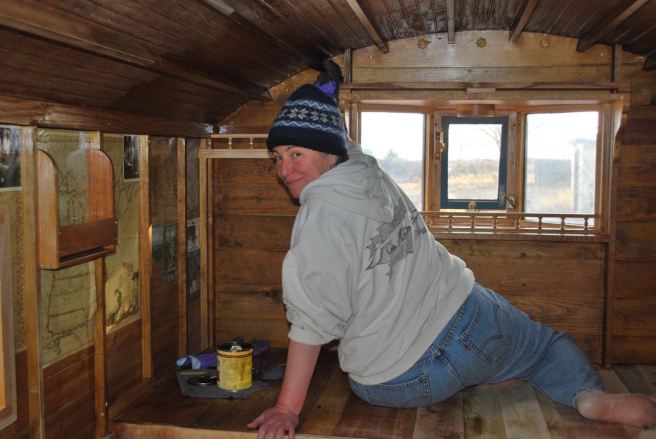
Chief of sanding, varnish, and stain department while we remodel and rejuvenate the vardo.  This was tedious and difficult job that needed to be done.  During this phase, we took the opportunity to fill holes, plug countersunk screws and rethink the interior furnishings all around.  It will be a cozy little palace when we’re finished.

DSC_0030

Perpetual Beginner Mentality

Here’s a nearly perfect little essay from Greg Merritt about amateur woodworking that can be applied far beyond our chosen hobby. It’s a great way to start off the New Year on a positive note.

I particularly like this line: “To build furniture you need three basic skills.  You must know how to sharpen, layout accurately and then accurately cut the wood to layout.  That is it. Period.”

Greg Merritt's avatarHILLBILLY DAIKU

The following is written for those of you, like myself, who are amature/hobbiest woodworkers. We just want to build things with wood and enjoy the process as well as the result.

In days gone by, when the apprentiship system was in full swing, a person knew where they stood in the hierarchy. You entered as an apprentice and worked your way up through the ranks. Crossing milestones allong the way that advanced you to the next level. Eventually working your way up until you were considered a master craftsman, or whatever similar rank, depending upon your chosen proffession. My assumption is, that as these individulas moved up in the system their attitude changed as well. Gaining both confidence and a sense of reponsibility to the profession.

That was then, this is now.

Something I have observed over the years is that amature woodworkers are almost always viewed as perpetual beginners…

View original post 1,000 more words

Tying it all together, Vardo Remodel Part 5

DSC_0002 (6)
Diving into the next stage of construction.

All earthly structures begin with a foundation of some sort, even living wagons. In our case, the trailer frame is the earth, the ledge and subfloor serve as the foundation upon which, all is built.  I proposed to attach the new section pretty much the same way and addition is connected to a house, by supplementing the structure at the joining lines and creating “nailers” to provide fastening surfaces for the new wood.

DSC_0001 (8)
With an afternoon that included a 30 degree temperature drop, an unexpected rain shower changing to freezing rain changing to snow we had to switch gears, tarp up the project, and retreat indoors. New Mexico in the winter!

Going back to the day job for the week left me with only limited work times.  No real workshop means no light and submitting to the ever-changing weather.  This became the perfect time to make lumber from the piles of miscellaneous scrap and recycled boards I have been hoarding the past couple years.  This is boring work and requires a lot of noisy time with the table saw and planer but yields a lots of free, well-seasoned lumber for building great things.

DSC_0004 (5)
Building up the back wall.

It’s satisfying to begin seeing real progress, even if it’s only just a shell going up.  Pre-cut tongue-and-groove pine makes for easy work at this stage.  The sad old door is being kept in place to help shelter the interior from unforeseen weather.  We hope to get the bedroom area cleaned up, repairs made, and some re-varnishing done in the coming weekend.

DSC_0006 (5)
Framing out the plan.

Corner posts were secured and, unlike the first edition of the build, framed walls were created and await their double layer skin.  I took this opportunity to mock-up the arch from plywood and test fitted it against the existing wall.  Finally, it feels like real progress.

If you are looking for Part 1 of the rebuild/addition then CLICK HERE.

On to Part 6!

Man Powered Vardo

A desperate man with some ambition and the gumption to not be beaten can make himself a man-powered vardo (I’m thinking of you, Jim).  An alternative to homelessness with a minimum of skills and materials.

WeatherheadCaravan

In 1935 David Weatherhead, an unemployed shipyard worker from Sunderland, toured the county (England) looking for work in this one man caravan which he designed and made himself. From the Telegraph (UK).

Picture: Fred Morley/Fox Photos/Getty Images

“Give me a long enough lever and a place to stand and I will move the Earth” Remodeling the Vardo, Part 4

I had a plan, and it involved leverage.

Taking the Biggest Step of All; Transferring the old vardo to the new trailer.

Now that I was confident that the box was going to hold up under the stress of the transfer I was ready to slip the trailer under the body.  It was a whole lot less dramatic than I was afraid it would be, and that was a good thing.

And here we are; naked, and a little afraid.
And here we are again; naked, and a little afraid.

With the vardo teetering on it’s blocks we prepared to slide the trailer under it. For safety sake, we did this by hand to decrease the chance of bumping the structure or blocks.  Because of the layout of the tail light assembly and fenders we couldn’t just suspend the entire body and make the transfer in one run.

DSC_0006 (4)
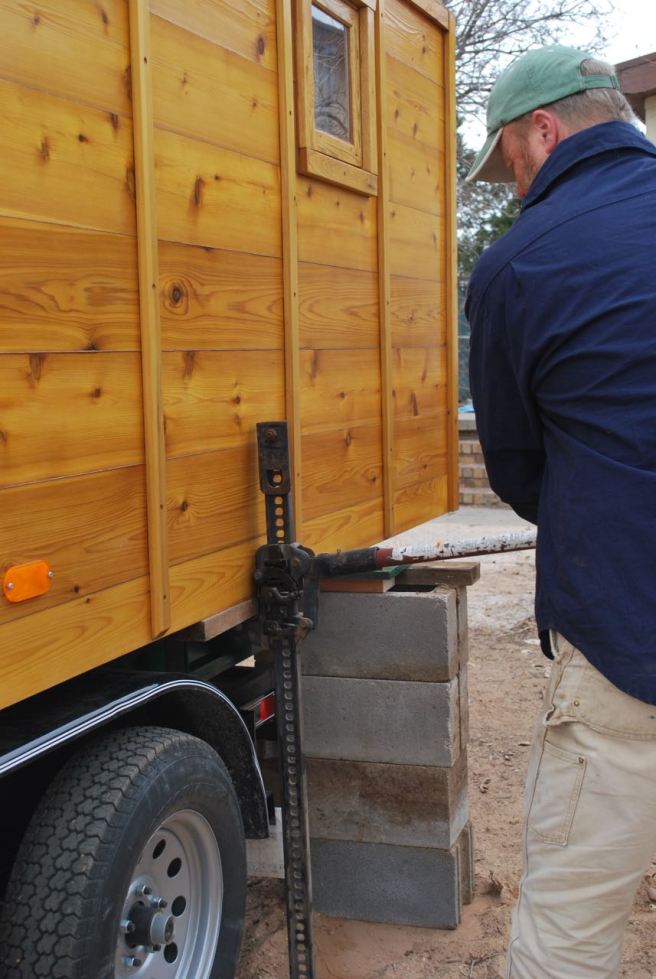
Taking the strain with the Hi-Lift jack in order to move the blocks around the frame.

I used the Hi-Lift jack to easily support the body while we shifted the blocks around.  I wanted to get the trailer as far under as possible to ease the final move.

DSC_0009 (4)
Step three, after moving the blocks around the light assembly.

I was feeling pretty accomplished at this point and we were nearly ready for the final push.

DSC_0010 (4)
As far as it goes.

Since there were only two of us, we greased the rails under the vardo body to limit the friction while pushing.  This made a huge difference and allowed us to slide it into place with relative ease.

DSC_0020 (3)
Looking on in slight amazement that it actually worked.

You can see that everything possible was stripped off the body to lighten the weight including the metal roof, stove-pipe, and door.  Bolts were used to secure the body to the frame but I’ll likely add a couple more steel straps as we near completion.

DSC_0013 (2)
Ready to move on.

I intend to make the addition look as seamless as possible and to keep the same aesthetic in the addition.  For me, it’s a modern living accommodation informed and inspired by the late Nineteenth Century caravans and Sheepherder wagons.  They were ultra-modern in their time but had a certain warmth, comfort, and hand-made quality that most modern day RVs lack.  Even on a small budget, a solid, warm, and safe home can be built by nearly anyone.

If you are looking for Part 1 of the rebuild/addition then CLICK HERE.

Onward to Part 5!

Don’t be afraid, sharpen your knives!

Talk about convergent timing … It seems that Paul Sellars was reading my mind when he put up another useful video early today.

This is a bit of a ramble I’ve been pecking around on for a while now.  Sometime in the 1980s we seem to have forgotten how to sharpen our own tools.  That was an era when the woodworking and camping gear market was flooded with jigs, guides, angle-finders, and other contraptions came in a flood to the common shop. Suddenly, a whetstone and strop were out of fashion.  I can’t even count how many times I was scolded for sharpening a plane iron by hand!  An excellent carpenter friend of mine wouldn’t even attempt a chisel without his low-speed Japanese wheel system with an automatic water drip feed.  Anything else was impossible. I was a carpenter/rigger and semi-serious college student by then and needed a knife every day.

I had fortunately learned to sharpen tools from my grandfather and expanded on this knowledge with the aide of several knowledgeable Scout Leaders throughout my youth.  There were even tests in the Scouts to make sure you learned about safety, handling, and maintaining tools.  On the home front, a dull knife was met with gentle but stinging ridicule.

CamillusBSA
My first real knife was a Camillus BSA.  A good beginning.

In our early teen years, it became a matter of some pride in my little circle of friends to carry a well-tended, razor-sharp pocket knife for everyday tasks as we camped, hunted, and fished.  For this, you had to learn your way around a whetstone.  For many years, I had only three stones in my life; a two-sided mechanic’s black stone, a small medium-hard Arkansas whetstone, and a very old two-sided razor stone.  With these few tools, and a good bastard file, there is nothing I own that cannot be sharpened; from lawnmowers to axes, chisels, or knives.  It is a skill I am glad to have acquired.

The missing element is TIME.

This is NOT a “how-to” post for sharpening but encouragement for someone intimidated by the whole process.  There are plenty of print resources and good information on the Internet as long as you know that sharpening takes time, patience, and attention to detail which only comes from practice.  Big Box sporting good and hardware stores can lead you to believe you need several-hundred dollar sharpening “systems” before you can do anything at all.  These are labor-saving devices, not magic pills.

And finally, there is more than one way to skin the proverbial cat.

There is no one way to sharpen or polish an edge onto steel and this leads to some belief in “right and wrong” ways to accomplish he same outcome.  Even recently, I had a young bushcrafter tell me he didn’t think I was “doing it right” when he saw me touching up a blade.  When I asked why he thought this it was because he had learned a different method in a half-day class and wanted to know “who’s class did I learn that in?” In an ensuing discussion it was posited that there was no way to hand sharpen a knife to an edge comparable to a modern wheel system.  This is advertising propaganda gone wild.  Think Japanese sword polishers or old-time straight razor makers; it just requires the skill and time.

Learning is an ongoing process, not an event.

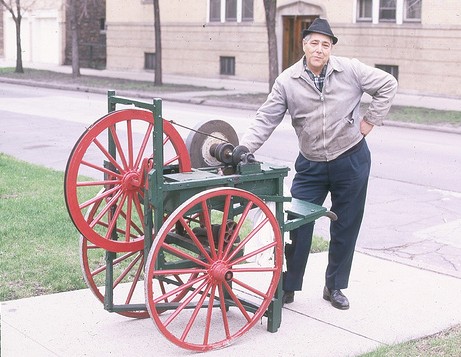
Different tools require different approaches but the essential are the same; finding the angle of the edge, direction of motion, consistency, lubrication, etc.  It becomes a real Zen thing to practice.  I’m not shooting down the contraption-based sharpening either.  They have their place, especially in a busy shop.  As I said before, sharpening takes time.  For this reason, and probably a certain level of laziness in the family, we sent things to specialists like the knife grinder.  Growing up in South St. Louis, we still had a knife grinder making a circuit around the neighborhood who got our business of kitchen cutlery and grandma’s best dress-making scissors.  This isn’t him, but I’m glad to see the business still flourishes.

knife-sharpener
St. Louis Knife Grinder.

Back to the point.

Don’t be intimidated or misled about sharpening your tools.  You can certainly do it without an expensive setup. If it becomes too much, there are sharpening services at sporting good stores and elsewhere to help you out.  It’s easier to maintain a sharp tool than it is to start from scratch so keep it sharp!  Your ancestors did it and so can you.

Now, have a look a Paul Sellars newest video.  As always, it’s excellent stuff.

Naked and Afraid! Remodel of the Little Green Vardo, Part 3

Caution – suggested nudity, implied whiskey, and some old-fashioned Scottish engineering to liven up the day.

scotch
K.O. Munson – “Just a case of Excellent Scotch” – November 1946 Artist Sketch Pad Calendar

Now that I have your attention:

DSC_0014 (3)
Last day in the “before” stage. Lucky for all of you, I’m not naked, just afraid of the BIG move.

Saturday morning came and it was time to start stripping down to the bare essentials (hence the first part of the title, suggested by SB).

After an evening of pulling everything out of the wagon (the first time it has been absolutely bare in over five years) it was time to commence preparations for the move onto the new trailer.  This afforded me an opportunity to really look over the entire structure for movement, wear, water damage, etc. and to make changes if necessary.  Happily, the structure has held up quite well considering the many thousands of miles and the extensive off-roading I have put it through.  Examining the roof, walls, and under sides, the only water marks discovered were those from some seepage through the tongue-and-groove on the front wall from several years back.  High-speed driving through torrential downpours really test the tightness of any wooden vessel.  As I already knew about this, there were no surprises.

Disassembling parts of the structure that were not meant to be removed become complicated puzzles.

The exterior ledge bracing, storage boxes, and some trim pieces had to be removed to facilitate the fit on the new trailer bed.  Stacey hunkered down and puzzled out how they were all connected and spent several hours turning nuts, removing bolts, and unscrewing screws, forming a mighty pile of wood, filling buckets with hardware, and pitching out old fasteners.

After removing the boxes and tie-downs, there were holes to be filled and a fresh coat of paint was in order.
After removing the boxes and tie-downs, a fresh coat of paint was in order.

After a thorough examination for wear and damage (we found none), screw holes were filled and a fresh coat of oil paint was applied to the nether regions as some parts will become difficult to access once on the new trailer.

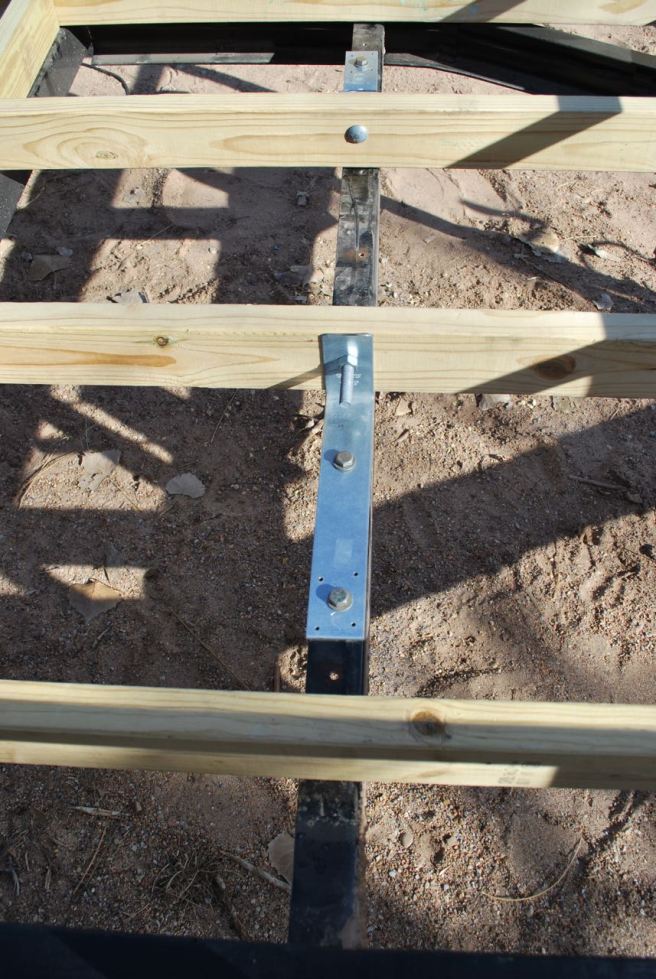
The beginnings of attachment; I sprinkled a half dozen Simpson Strong Ties around for security.
The beginnings of attachment.

I sprinkled a half dozen Simpson Strong Ties around the frame for strength and safety; all recycled from the original wagon and an old barn project.  The vardo will be fastened directly to the steel frame as well but when it comes to this sort of safety “too much is never enough.”

It was an opportune time to deal with many little scars, dings, and damaged bits.

Although no major injuries were discovered in the 20,000 mile check-up, a lot of little issues were dealt with while we had the opportunity.  It really drove home to me how much of the original build was done with salvaged lumber and recycled hardware.  I have been slowly replacing standard fasteners with stainless, especially below the water-line; this gave me the opportunity to continue this practice (expensive but far-sighted).

While Stacey continued her exterior work, I crawled around underneath disconnecting bolts and steel straps to dismount from the frame.  A handful of these could no longer be accessed from inside and had to be persuaded with a Sawzall.

Separating the rear portion of the frame.

How did I remove the frame?  Not owning a forklift or other heavy machinery I used the simplest method I could think of.  By using the tongue jack and some concrete blocks I was able to first lower the front, thus raising the rear-end.  While the rear was up high, I stuffed the blocks and wood under the body to hold it at an appropriate height.  Raising the front then disconnected the frame from the rear and allowed blocks to be placed under the front.  My only fears revolved around the overall strength and stiffness of the body; would it take the stress in places the appropriate places?  As I lowered the unit down, freeing the trailer, I was relieved to hear no creaks or see any flex anywhere.

Using the leveling jack to separate the from portion of the frame.
Using the leveling jack to separate the front portion of the frame.

Now for the Eureka moment…

Over the past couple weeks I have racked my waking brain for an easy and safe way to move the box from one frame to the other.  It was at 3:30 in the morning a few days before the move when it came to me.  Knowing my wagon fairly intimately, I knew that it was very close to neutrally balanced (i.e., the balance point was very near the center of the body) and this might be used to my advantage.  If I could load the back end with enough weight to counterbalance the structure, the body could be cantilevered by 50% or more, like a big kid on a see-saw.  The only concern I had then was the overall strength of the vardo body after the steel frame was removed.  The fulcrum point would bear a lot of strain.

physics
Envisioning weight distribution.

To sum up this rambling explanation, YES, it dis indeed work!

Voila! I felt like a stage magician levitating his beautiful assistant for an audience full of suckers; in this case, a dog, cat, and a slew of poultry.
My floating vardo body, waiting for it’s new trailer.

Voila! I felt like a stage magician levitating his beautiful assistant for an audience full of suckers; in this case, a dog, cat, and a slew of poultry.  The old trailer was pulled away to be sold on Craigslist.

And here we are; naked, and a little afraid.

I secured about 400 pounds of weight near the door allowing the front end to float while we prepared to maneuver the new gear into place.

With the early winter sunset I decided the next step would have to wait for morning.  Don’t worry, I re-jacked the front end overnight for safety sake.  I didn’t want a crushed dog should the worst occur.

If you are looking for Part 1 of the rebuild/addition then CLICK HERE.
PART 4, coming up…

Joinery Journey

Joinery doesn’t have to be a mystery or an unknowable. Have a read of Mr. Merritt’s take on joinery. I’m looking forward to more!

Greg Merritt's avatarHILLBILLY DAIKU

I love joinery.

There is something magical about fitting two or more pieces of wood together.

Before the advent of mechanical fasteners, joinery reigned supreme.  At that pre-industrial time is was the cheapest, fastest and strongest way of building with wood.  As nails, bolts and screws became less expensive they began to displace joinery for building with wood.  Mechanical fasteners required less skill and were faster. Thus the products produced became less expensive and the structural and aesthetic compromises were  accepted as “progress”.  Machines too brought an end to joinery’s reign.  Some joints that can be “easily” cut by hand are either impossible to cut with a machine or the setup is too costly.  So joinery was simplified or abandoned to accommodate mass production.

I have no intention of delving into a philosophical diatribe on the pros and cons of the industrial revolution.  My intent with the preceding was to…

View original post 612 more words