A circular saw is a tool which no workman who has once seen it at work would care to be without, for it is a labour-saving tool of the first importance, and enables its owner to do many things with an amount of ease, exactness, precision, and rapidity that cannot be attained with saws actuated by the hand and arm. When an amateur becomes the possessor of a lathe, one of the first things he will do is to have it fitted with a circular saw and the necessary appliances in the shape of table, fence, etc., to enable him to use it conveniently and with due effect. The professional workman, on the other hand, although he will not be without a circular saw to be worked on and by his lathe, wants something stronger and heavier that will save him the labour of using the rip saw, which has made many a man’s arm and shoulder ache when the absence of suitable machinery in the workshop has compelled him to keep at this kind of work for many successive hours, perhaps, if not through the entire day; and every man who seeks to save time and labour, and therefore money, either for himself or for those in his employ, will, or ought to, take care to have a thoroughly efficient machine well suited to the requirements of his business in his workshop.
From: “Our Guide to Good Things,” in Work– March 30, 1889
We live in an age of motor vehicles. Few of us could consider, for safety if nothing else, taking to the roads in a horse drawn vehicle. When the automobile seemed here to stay, caravanners in Europe adapted to the new technology.
The earliest models look essentially like their horse-drawn cousins, just stuck onto a truck chassis. In this era, I suspect they were topping out at 35 mph.
This is the earliest side-door design I have found which changes the dynamics of the interior layout. Note that in the vehicles above, the driver is still fully exposed to the elements. A far cry from our modern experience. Note the “driving coat” worn by the pilot of this beauty.
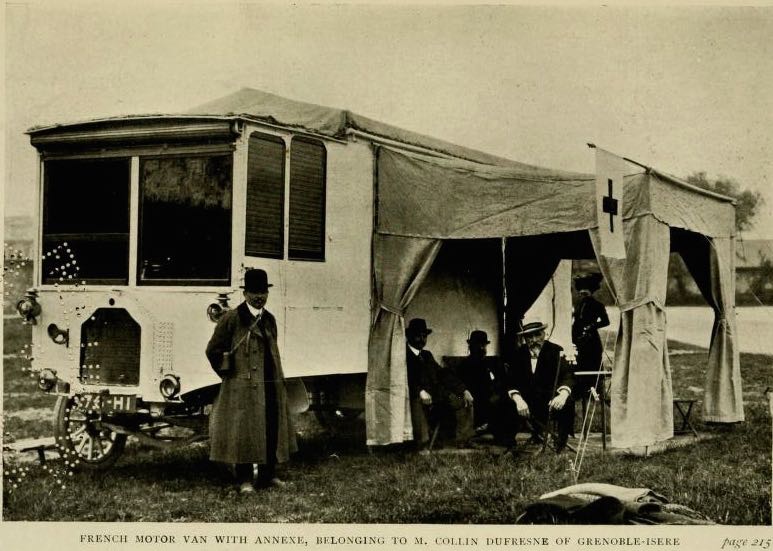
This French innovation has boxed-in the driver’s compartment making it suitable for foul weather. Still, I would be worried about those huge, non-safety glass windows.
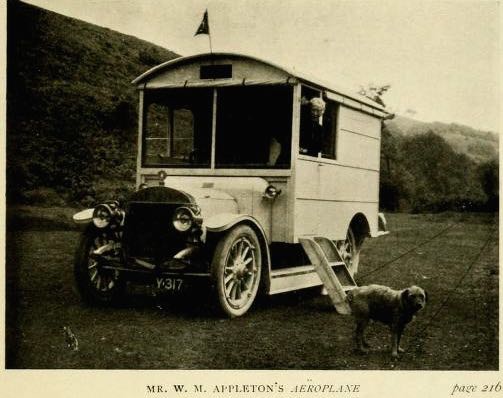
And finally, a very practical little design; the AEROPLANE. A cute little beast. I could not find the floor plan for this one but there is a section profile to help the would-be builder:
This style fold down seat/bed is exactly what I had in my first Ford pickup camper. Simple and practical. Maybe these early designs will inspire more modern builders to dive in and get their build on. Keep it simple, keep it light.
Peter at Casual Turtle Campers has come up with a great new design in a minimalist caravan. I have posted his earlier work here a couple times and this new design is worth a look.. This model looks like it would work well as a base camp for one or two people who don’t need a substantial kitchen or keep the cooking gear in the tow vehicle. The low profile will certainly appeal to people who drive lower vehicles as well.
Peter Pavlowich of Casual Turtle Campers
It has his signature roof-line as found on his other designs. The compound curved roof is a nice, artistic touch.
It reminds me of an old Ben Roy design or a Teardrop on steroids.
I wouldn’t be able to do it justice so here’s the description that Peter sent along:
The Hatchling – Here’s a new model that I’ve been wanting to build for a while. It’s sort of in the size and tradition of a teardrop, but in Casual Turtle Campers style – dead simple, cedar, domed roof, lots of windows, etc. In fact, it’s quite a bit roomier than most teardrops – and by leaving the entire trailer area as living space, the cabin feels damn near palatial! Not really, but it is a nice little space that two people and a couple dogs could be perfectly comfortable in. As an unsolicited build, I had planned to insulate and finish out the interior myself – but then I thought it might appeal to someone looking for either a dead simple, lightweight little camper, or someone looking for a project. One could add nothing to it and have a very comfortable, capable, simple camper – or features could easily be added to their desires – storage, gear hooks, bed platform, etc. And I’m perfectly happy to discuss building out an interior for someone.
Here are some of details… It’s built on a very nice, custom 5’x8′, fully boxed trailer frame with 13″ tires from a great manufacturer here in northern Colorado. The cabin’s frame is mostly western Hemlock, with Western red cedar siding. The bottom of the cabin has a 90 mil PVC membrane covering, and the roofing is a fully adhered, 60 mil, ivory-colored TPO membrane – thermally welded at the seams. It has four opening windows with screens, and two large fixed windows (forward bulkhead and door) for pretty good through-visibility. It weighs 840 lbs, with about 110 lbs of tongue weight. There are more specifications/details on the website –casualturtlecampers.com.
I really like this camper, and I can see using it just as it is – or with a more developed interior. Either way, its a great platform for someone looking to get into a very easily towed, comfortable, unique little camper. At 840 lbs, this model could work with a wide variety of tow vehicles. The forward bulkhead is short enough (66″) to tuck in well behind most crossover and small SUVs. I even towed it around town with our little Subaru Impreza.
I’m 6’2″ and 195 lbs, for scale. As a shell version, the walls and roof assembly are left open, showing the OSB roof deck’s bottom side – though it could easily be insulated and closed in. If anyone has any thoughts/ideas/questions please email me at casualturtlecampers@gmail.com. I’d be happy to discuss this camper or something similar/different that you might be interested in. And I’m also happy to discuss full or partial delivery from Fort Collins, CO for a rather nominal, mileage-based fee. Thanks for having a look – and please share it with anyone you think might find it interesting. I’m tentatively calling this model the Hatchling, but any other ideas for a model name would be welcome, too!
Price – $6,250
And he obviously has good taste in literature:
“I had to go alone…a kind of casual turtle carrying his house on his back.” – John Steinbeck, from Travels With Charley.
A post I’ve been hanging onto; a bit off-topic, personal, and possibly without any point.
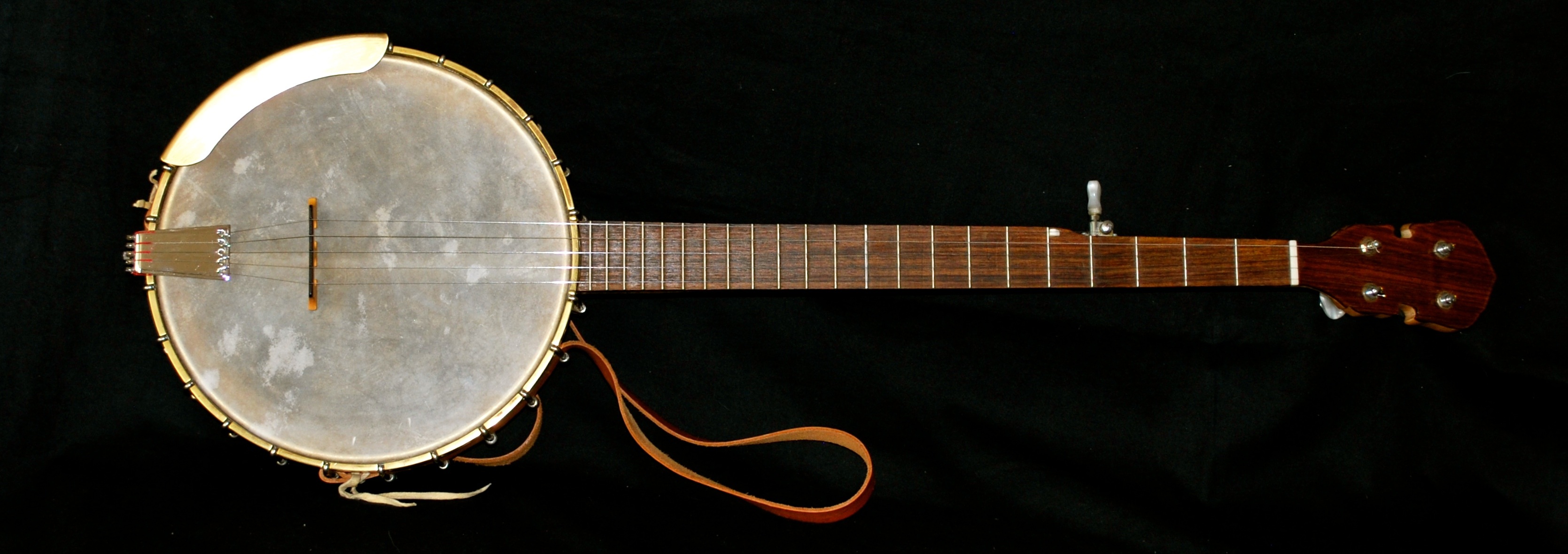
My most recent banjo polished up and fitted with a new calfskin head.
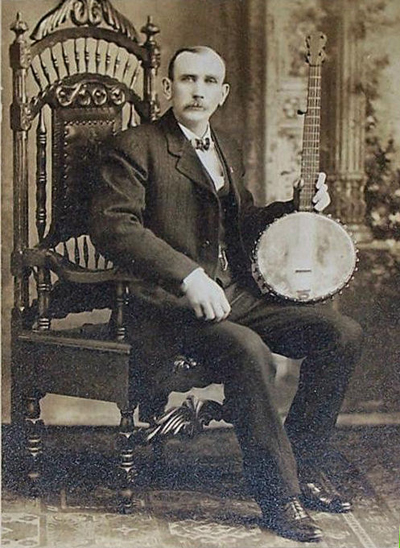
I am an unlikely banjoist. I got a very cheap banjo when I was 14 years old but didn’t find a teacher. I took a couple lessons from uninspired twenty-somethings but didn’t get much from them. Fortunately, this didn’t stop me. There was even a old neighborhood guy who offered some help but it turned out he only strummed a tenor-jazz-banjo. He may as well have played a ukelele for all that it mattered to me. So I learned by listening and from the few books I could find that suited my interest.
I don’t even know why I picked banjo particularly, but I did. I was fortunate to be a latch-key kid from and early age, so when it wasn’t sports season, I cherished my solitary time after school. I would often sit in the kitchen or on the back porch and plink around, playing old folk tunes. I discovered Cecil Sharp and Francis Child and learned what I could about folksong of Western Europe and the British Isles. I found this very old and diverse instrument adaptable to lots of styles of playing having found it’s way from 18th century plantation shacks to Victorian concert halls.
My college instrument. Oh where are you now?
Coming from a classical music background helped. My dark secret is the I spent three years in college as a music major. I could read music and understood a little about musical structure so I spent time in the library digging through old folk music books and journals. I never became great but good enough to not be ashamed to play in front of people and had about an hour-long proficient set of Irish, Scottish, Appalachian, and Ozark tunes in my repertoire. Then life happened. I gave it up (mostly) for over a decade while traveling and working like a dog and trying to be a good father but without playing an instrument, I think I lost a little of my identity.
So the short story is that I’m back. Making time to do something I love has helped my mind immensely. I’ll never be Tony Trischka, Earl Scruggs, or Bela Fleck, but at least I have some music back in my life.
View of the backside to show off the beautiful maple figure.
For those few who may be interested in the technical details of this machine. My most recent instrument is roughly a Vega design with a White-Lady tone ring. The tension hoop and arm rest are plain brass and the head is genuine calfskin. The neck sports a Mastertone-style peghead taken from the diagram in Earl Scruggs’ classic banjo book. The fingerboard and peghead cover are cocobolo. The tuners are scavenged off my first banjo and are Keith planetary-type except one. The D string tuner is a replacement as someone actually stepped on my old neck and broke one! The replacement is a 5-Star from Stewart-MacDonald’s lutherie shop. These days I could get online and order one instantly, but back in the mythical pre-internet era this actually took some phone sleuthing.

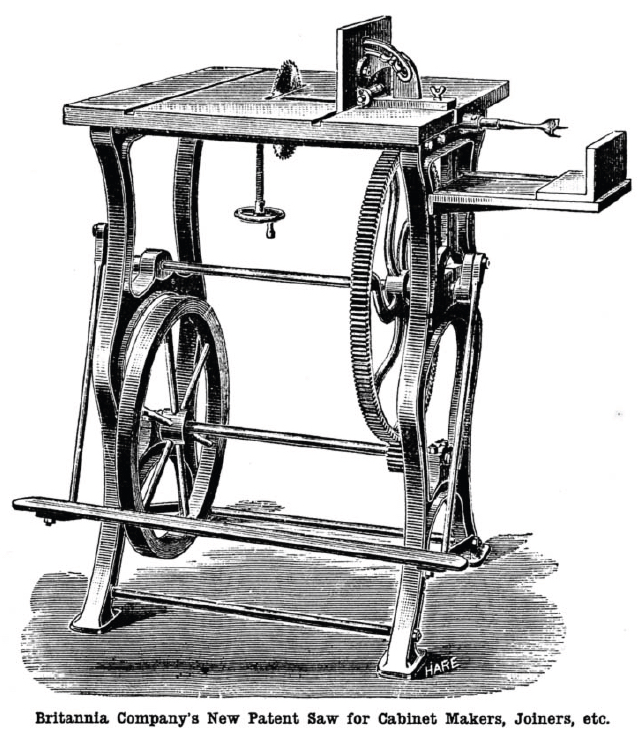 A circular saw is a tool which no workman who has once seen it at work would care to be without, for it is a labour-saving tool of the first importance, and enables its owner to do many things with an amount of ease, exactness, precision, and rapidity that cannot be attained with saws actuated by the hand and arm. When an amateur becomes the possessor of a lathe, one of the first things he will do is to have it fitted with a circular saw and the necessary appliances in the shape of table, fence, etc., to enable him to use it
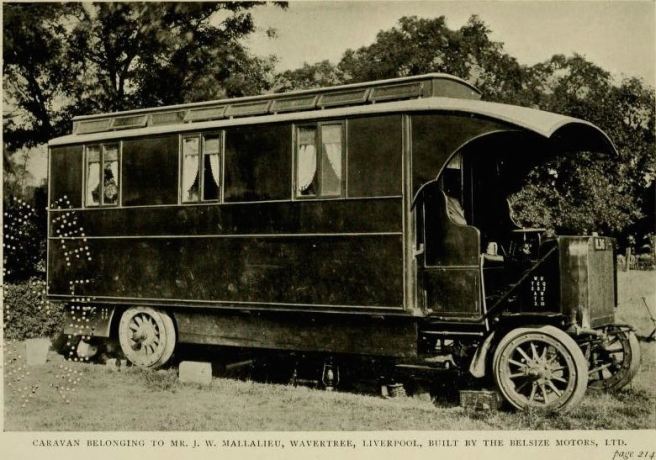 The earliest models look essentially like their horse-drawn cousins, just stuck onto a truck chassis. In this era, I suspect they were topping out at 35 mph.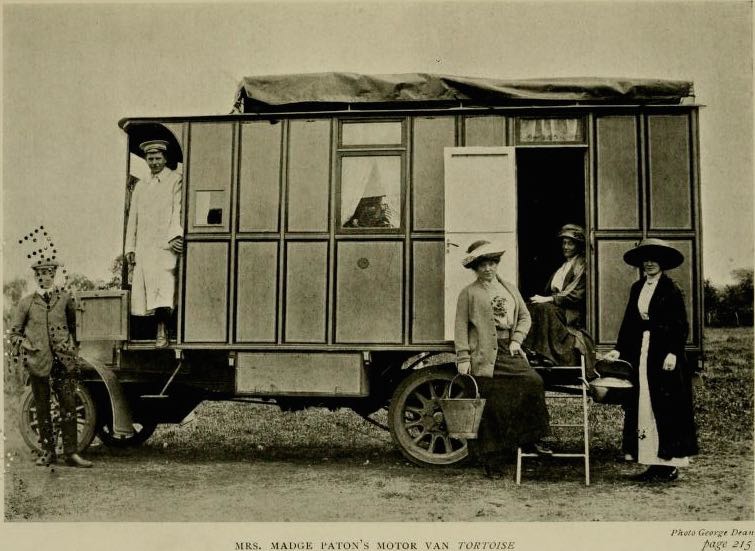






 Preindustrial Craftsmanship