As usual, an interesting old find posted on the Lost Arts Press. It’s worth a read.
“It is doubtless the timidity of woman which restrains her mending instincts. She dreads the saw and the chisel as treacherous tools that inevitably inflict wounds on the user… Moreover, she can never grasp the difference between a nail and a screw, and regards the latter as an absurd variety of nail which can not be driven with a hammer unless the wielder of the hammer has the muscles of a man.”
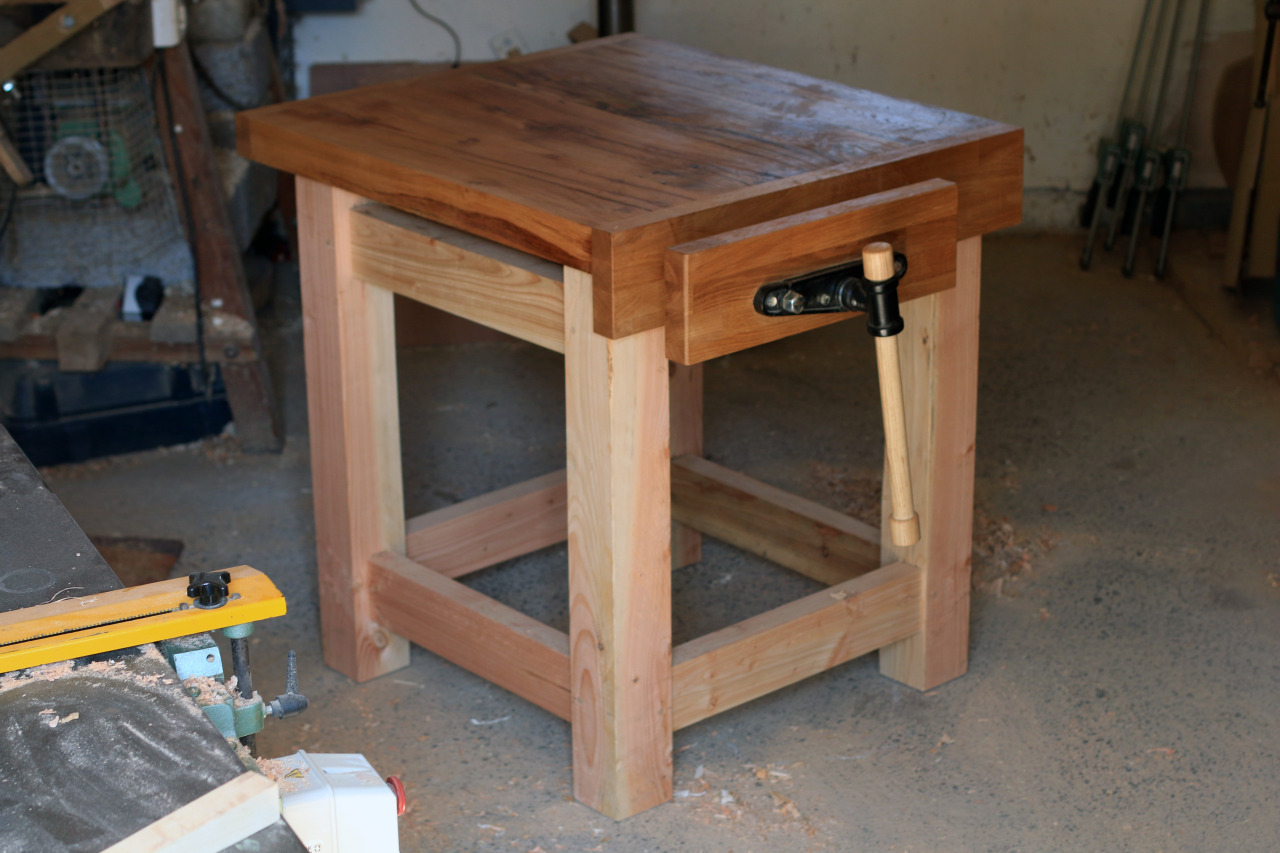
I saw this beautiful and sturdy chairmaker’s work bench on AMBROSE VEVERS’ Tumblr blog early this morning and wanted to share it. It is a great example of a purpose-built and appropriate sized benched for a craftsman. Not every bench needs to look like an 18th Century Diderot drawing or Roubo bench. That sets the bar prohibitively high for so many woodworkers, especially those with limited space.
Roubo-style bench.
When I first left graduate school, I went back to work as a woodworker-carpenter and I was living in a small apartment. Needless to say, my work space was extremely limited and most of the sawing was actually done on a small balcony to keep the dust outdoors. Prior to this, I shared an 1,800 square foot work shop, and though it was not perfect it was extremely spacious. Moving to the apartment really began my thinking about spaces and portability which has influenced me ever since. I am always on the lookout for workshop solutions and I am a huge fan of recycled lumber.
“Chunky reclaimed Oak top with Douglas fir frame and a York spindle vice.”
To see more of Ambrose’s work, head over to his Tumblr page. Here’s his description from the website:
“Ambrose’s workshop is nestled in the Ancient Stannary town of Ashburton, within Dartmoor National Park. Each piece of furniture is skilfully crafted by hand from locally sourced materials.”
Thank you Paul Sellers for stating an obvious but nearly lost truth. There are far too many needless and complicated gizmos, devices, and “new technologies” for a 2,500 year old task. Clever marketers have figured out that we can blame our laziness and impatience on our tools and not ourselves.
Maybe I am speaking out of turn as my tools are always for from perfect.
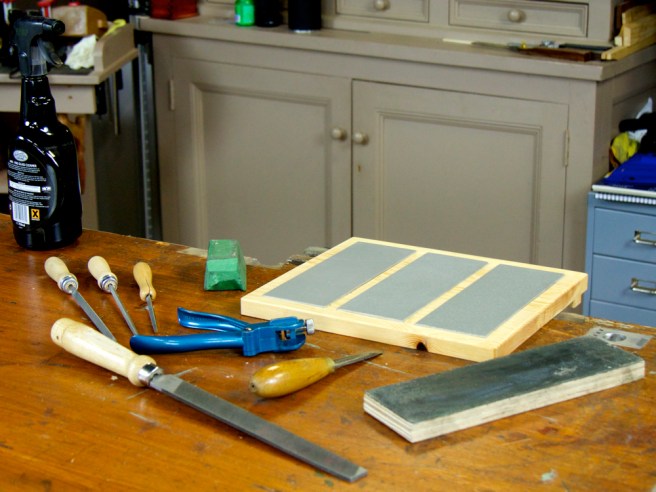
Catalogs are full of overpriced specialty devices designed to do the seemingly impossible; polish a sharp edge onto a piece of steel. I realize now that I was very fortunate. I learned to use a file and whetstone as a very young child. I even learned about setting saw teeth and how to use the hard straight razor stone. Before there were special stones to resurface a stone, we simpletons used a hard, sandy, and flat concrete surface before graduating on to sandpaper stuck to a sheet of glass.
Some of the best sharpeners I know still do virtually everything with Arkansas whetstones and some very-fine emery paper. One thing to remember though; you have to actually do it. If you don’t regularly keep things sharp, it only becomes more of a chore and takes more time. I think the old idea of spending a few minutes before you begin work of sharpening and stropping is a wise idea.
If you use tools, consider a real pair of Arkansas whetstones. Here’s a couple of sources to try:
In the mean time, head over to Paul Sellers’ excellent as usual blog for his take on sharpening as well. Notice his very simple set-up.
“I believe I was fitted by nature to become a woodworker, and had my father been a wagonmaker or millwright, a carpenter or cooper, I would have been taught by my father the trade that he knew. He saw that I would whittle something, for when I was even smaller and lived in the woods I would ask for his knife whenever he came home. He always demurred, saying, “You will cut your fingers,” for a woodworker’s knife is always sharp.
I would tease until he would hand it out with the remark, “Now you will cut yourself.” I invariably did, and it was generally the fore finger of my left hand. That finger is just covered with small scars of every possible shape. I was bound to whittle something. Father knew it, so he calculated to give me a trade where I could whittle away and bring in a little money thereby.”
Chris Weeks
Wood Craft – December 1905
At least that is what it is purported to be. It’s beautiful to see such sharp tools in the hands of masters. And to think, they accomplish this without a Moxon or Roubo bench.
Tiny Green Cabins has some pretty nice and well thought-out designs. I find their website a little difficult to navigate but their blog has some interesting stuff on it. I am very much a traditionalist and a form-follows-function kind of guy. However, I think they have some new and innovative designs as well as some very nice features for comfortable living.
Check out this house tour of one of their recent builds. It’s worth the 13 minutes.








 Preindustrial Craftsmanship