Despite how much I like this photo,I have held off posting this image here because I couldn’t find any attribution or further information about this gentleman and his fine bicycle. I came across it several years ago and stuck it in my image files until I could find out more; alas, I have not.
“Portrait of Allen Hastings Fry, with his photographic equipment strapped to his bicycle. An illustration taken from the magazine ‘The Professional Photographer”, June 1916.” (Thank you Patrick for the information and link).
My first interest was in the excellent baggage he’s carrying; a very modern looking frame bag, a tool roll or similar, nice front and rear bags, and what appears to be a wooden box along the top tube. His haversack is not visible although the strap is in this image. Any thoughts on the bike or image itself are welcome.
The rest? Maybe you can tell me…
Click the card for more information about Allen Hastings Fry.
(UPDATE: Thanks for the corrections sent by Luc and Patrick. Updates were made to reflect the new information.)
In Britain and Ireland, the Romany Gypsys and the Traveller community are often associated with low-skilled work such as scrap dealers, horse traders, musical entertainers, or more nefarious activities outside the societal norms. However, there were plenty of skilled craftsmen and craftswomen providing goods and services to people around the country.
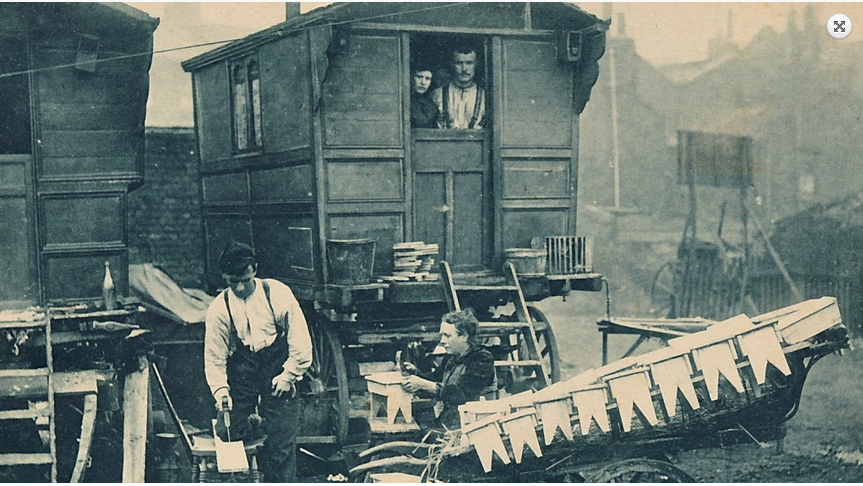
Below is an image of a couple, working together making footstools outside their vardo while another couple looks on from the comfort of their wagon.
Gypsy carpenters making small and large stools for market. From an early 20th century postcard. Source: Romany and Traveller Family History Society.
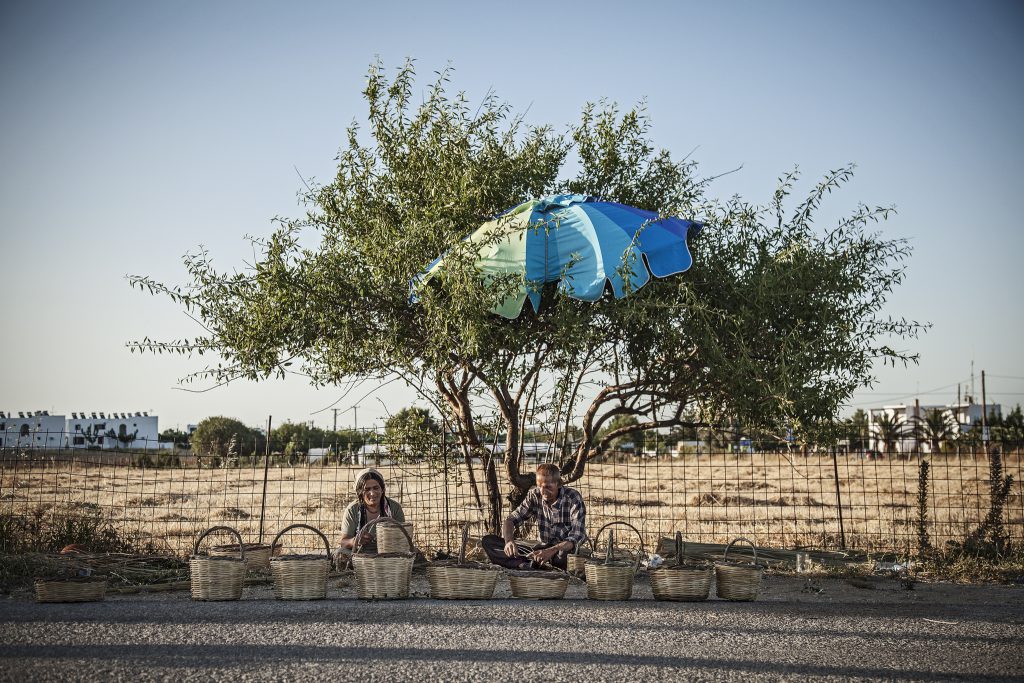
Other Gypsy families were blacksmiths, basket weavers, or similar occupations that could be taken on the road, required little stock or overhead, and could be performed independently or with a minimum of family help.
The bender tent provides shelter from the damp while keeping the living space outdoors.
Travellers in Europe and Britain have always been associated with a style tent called a bender. This comes from the construction technique of cutting saplings and bending them into a dome, elongated dome, or half cylinder shape, These frameworks were then covered with tarps and made watertight in the temperate damp. The origins of this design are lost in the mists of time and are believed by archaeologists to be one of the earliest style of recognizable tent structure used by humans.
This size bender can more than double the living space of a vardo in a matter of minutes.
Even after a certain level of affluence allowed some Romany and other Travelling folk to own living wagons, the bender continued (and continues) to be a way to extend the living space without the need for a lot more gear.
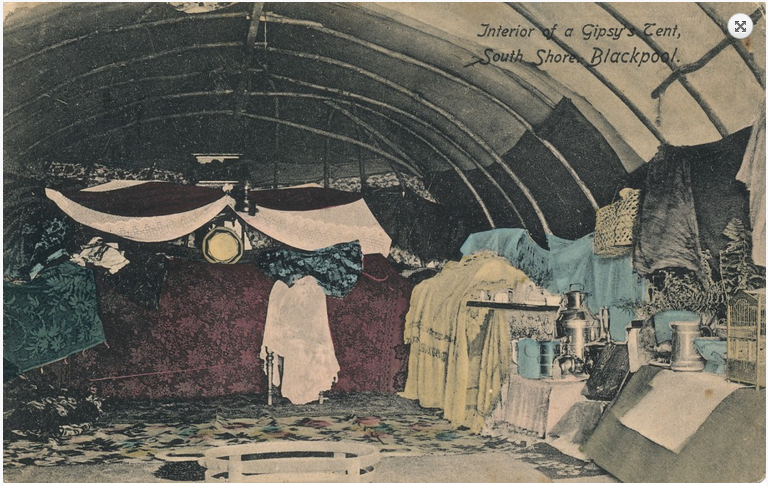
In England, Gypsy women often used their homes for fortune-telling, especially around the Gadjo (non-Gypsy) vacation centers. Image, early 20th century. Source: Romany & Traveller Family History Society.
The fact that a tent becomes the subject for a Blackpool post card shows the ongoing fascination with “Gypsy Culture,” especially in the British Isles where Travellers are simultaneously suspect and romanticized.
The front or vestibule provides a place to do business in relative privacy. Source: Romany & Traveller Family History Society.
If you have family that me be Romany, Traveller, or Fairground folk in Britain or just want to learn more, check out the Romany & Traveller Family History Society at http://rtfhs.org.uk/.
Near Boglehill in Midlothian, Scotland, n.d. late 19th century. Source: Romany and Traveller Family History Society.
I really like everything about the image above. We see three very different types of wagon-home-conveyances and a family, wearing clothing of the time. Travellers on the margin of mainstream society have been shunned, persecuted, and culturally dismissed while at the same time romanticized for their freedom and seeming lack of attachment to a more mundane life. I am glad to see a revitalization and pride from reconnecting with family roots.
Legal Documents.
People who have lived “off-grid” so to speak often have few documents or any official standing, making family histories more difficult to trace. Hospital records, cemetery documents, or government permits, such as the Pedlar’s Certificate above, are the only way for many to trace their ancestry.
Diaper Family Portrait.
Fortunately, there is a concerted effort in Britain by the Romany & Traveller Family History Society (RTFHS) to create a clearinghouse for descendants of those often overlooked by the mainstream.
About the RTFHS:Back in the early 1990s, a group of keen family historians with British Gypsy ancestors first met at a Gypsy family history conference organised by the historian and author, the late David Smith. Until that moment we’d all thought that we were pretty much alone in trying to trace our travelling ancestors and that there was no-one out there to learn from or share our experiences, trials and tribulations with.
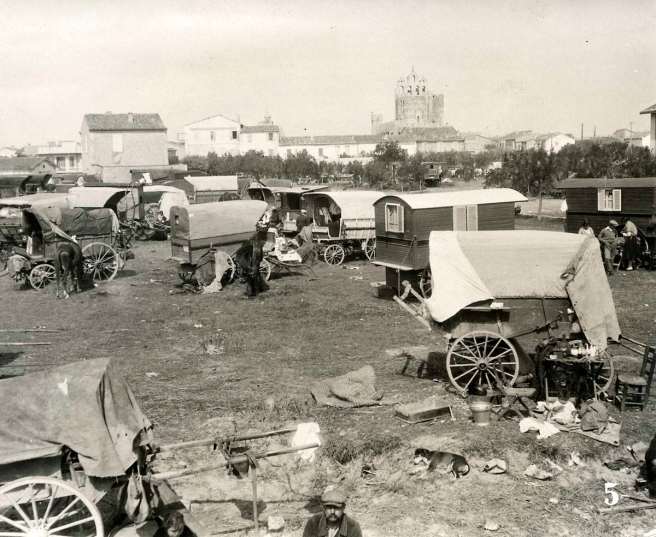
Here’s another excellent photo of a pack of vardos (caravans) in the wild. It looks like everyone came out and maybe even spruced themselves up for the photo. I couldn’t find any metadata on this one but it looks fairly early, probably late nineteenth century. These appear to be high-end models in great condition still.
I keep a couple tool rolls for specialty fixes but I really like this setup from over a century ago. I think I need to make and “essentials” kit like this for general travel to keep the tings I truly need in need place and handy. It might be a little heavy for the rambler on foot but could be invaluable on the cycle or in the truck.
From The Army and Navy Co-operative Society Store, London 1907.
I think I would need to make an image of each tool in its place as I have found in my other bespoke tool kit that the loops and pockets all start to look alike when there are too many empty ones at once. The only potential problem with tool rolls is that they can get thick and bulky in a hurry if you aren’t careful with what you put in them.
Duluth Trading Company’s tool roll available for about $50 US.
I find that tool rolls aren’t that valuable when working from the home shop as they take up a lot of surface but are a very handy way to travel and stay organized on the road. I use four tool rolls myself currently, one for holding large brace bits, one for wrenches (mainly for working on the scooter or truck), one for chisels, and one for carving tools.
With a little forethought, I think a traveler’s kit like this could be very useful.
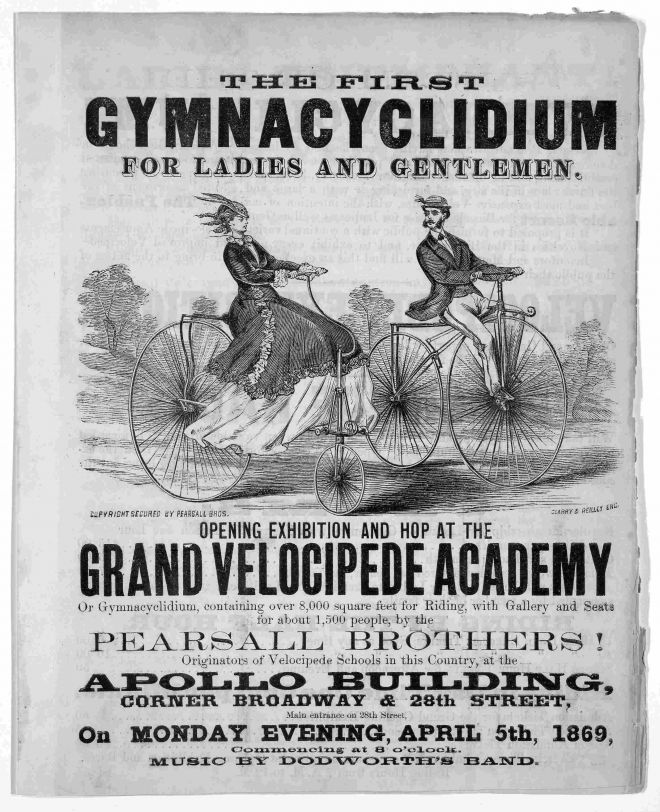
Gymnacyclidium– This sounds like something for which you could be administered a shot to clear it up. I thought these monstrosities worth looking at for the danger factor if nothing else. Let’s hope the young lady is wearing adequate undergarments as it seems certain she will be taking a spill or two in the very near future. I do like the curly cue fender thingy on the front though.
A bit of history about the bicycle: Invented more-or-less as we know it around 1817 with various propulsion systems added from about 1839 through the 1860s when bikes became more like what we know today. A major step forward occurred in 1888 when Dunlop developed the pneumatic tire, making cycling more comfortable and practical.
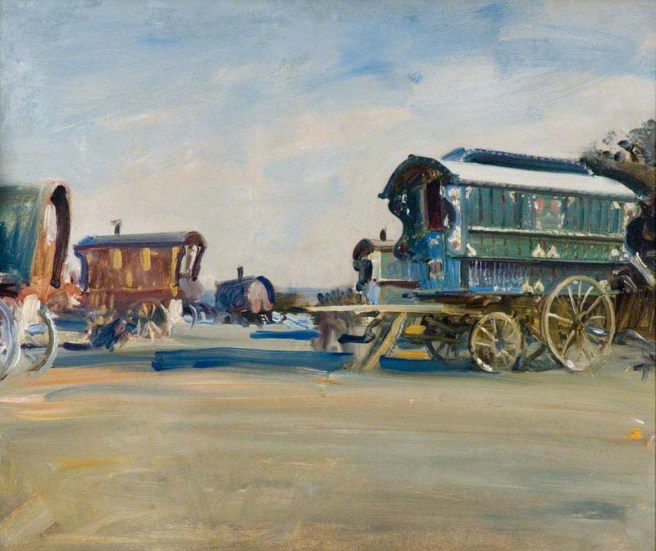
Copyright The Munnings Collection at The Sir Alfred Munnings Art Museum.
Here are a couple final Alfred Munnings images of Romani caravans in an English countryside. As a keen observer, he definitely caught the important details of each type of caravan and the essentials of camp life. The watercolor above is somewhat unusual for Munnings as it shows no animals, people, or campfire.
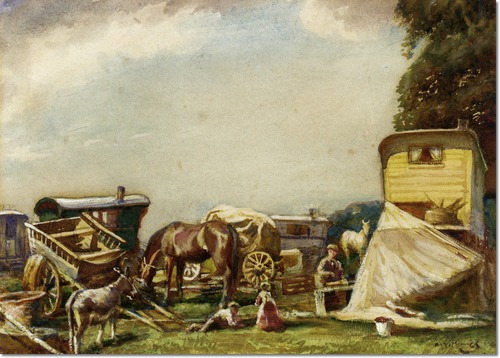
Alfred Munnings.
Above is a rarely shown rounded square-top among other carts and caravans with livestock milling about. The variety detailed in these historic images should be helpful for those desiring to design and build a similar living accommodation. The previous post gave a glimpse of Laura Knight’s work on the subject and her subjects are remarkably detailed and informative.
Gypsy Camp, ca 1938, Dame Laura Knight.
This is one of my favorite scenes of a camp in the countryside; two beautiful ledge wagons and a marquis tent in a field. I could picture this in a high parkland of the Rocky Mountains. Many people don’t know that the outlier tent, awnings, and tarps are almost ubiquitous with the old caravans. This allows for a very flexible and expandable living arrangement or a sheltered kitchen area.
Young Gypsies 1937, Dame Laura Knight.
If you look closely at the sketch above, you can see that this is the same encampment from another angle, focusing on the kids at play. It looks like a fine way to grow up.
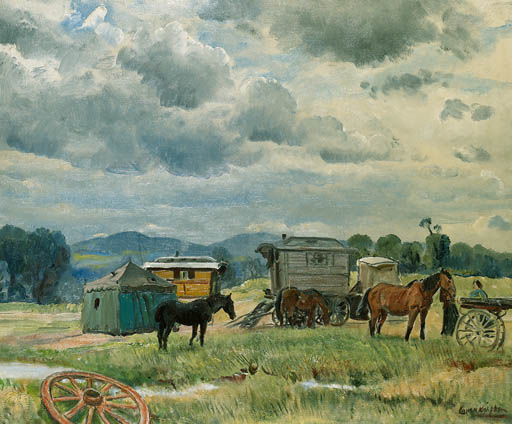
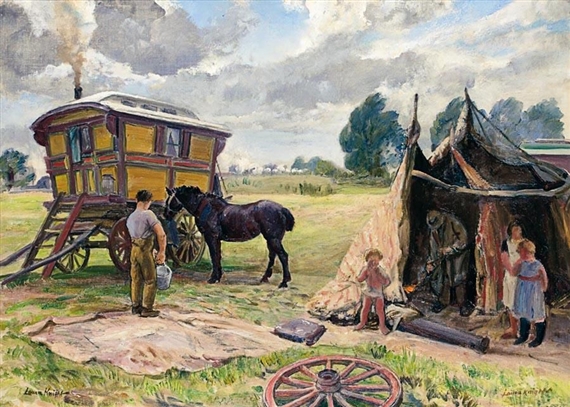
Gypsy Wagon and Tent, Dame Laura Knight, 1962.
And finally, another favorite of mine. I suspect it’s the same little yellow wagon next to the sketchiest bender tent ever. Probably a makeshift shelter for work or cooking. A wagon wheel in the foreground seems to await repair while the kids look on. Note the size of these caravans relative to today’s “needs” and remember that whole families lived and were raised this way.
If you missed the previous post about historic caravans in art go HERE or check out a whole page of images I have curated HERE.









 Preindustrial Craftsmanship