Visit the Huarache Blog.
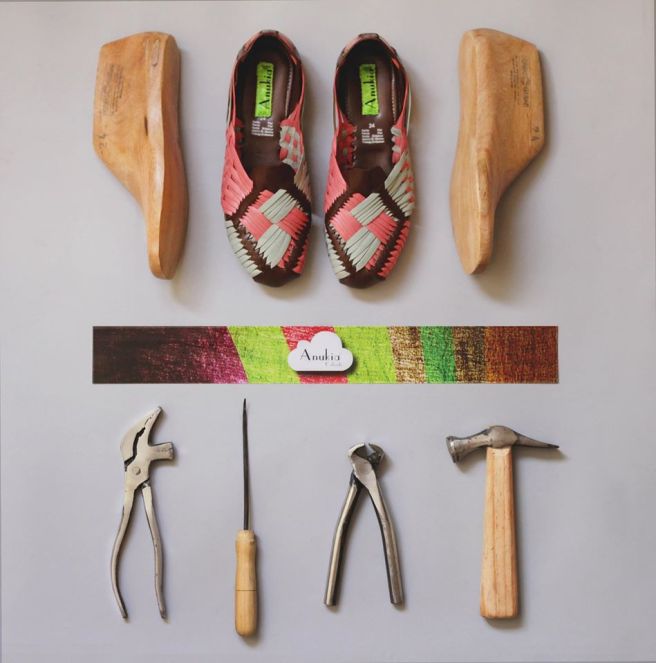 A tradition I hope remains alive and vibrant.
Adventures of an Imperfect Man In Search of a Handmade Life

Visit the Huarache Blog.
A tradition I hope remains alive and vibrant.
I am considering calling my custom footwear “Mayhem Shoes” (at least until Chuck Palahniuk’s space monkey lawyers make me stop).
I teach a couple classes about low-tech shoemaking a few times per year in the primitive survival skills community. The designs I focus on are styles that can be made by one person in one day; a popular theme in early historic examples. Some require a lot of cutting, some require sewing. There is an off-grid, dystopian attitude about making your own shoes. In fact, I think I will register the name Distopian Leather Works as my new business. I’m considering a small business venture to go into custom production of the shoes I teach people to make as well as expanding the custom leather work I currently produce.
 The kinds of people that take these classes are from all walks of life, not just survivalists, historical nerds, or experimental archaeologists, but folks who want to make things for themselves for whatever reason. I’m finding that there are others who might just want the handmade product without the labor of making them.
  In a day, an attentive student can produce a wearable (and good looking) pair of serviceable shoes like the carbatana (ghillies) above.
 For those looking for a more modern look a fine pair of sandals can be made with just a few hours, cutting and sewing. These are easily re-solable and should last the better part of a lifetime. Look familiar? Chaco and Teva didn’t exactly re-invent the wheel; just updated the materials and outsourced the work overseas.
  Even in the wilds of Canada, tradtional ghillies can be a useful part of the wardrobe. Mike made these two years ago and they still protect his sturdy peasant feet.
 There is something very satisfying about taking a piece of nondescript, vegetable tanned leather and creating a lasting and useful object with your own hands.
 The beauty is truly in the details. Serious students often bevel and burnish edges to give their shoes a “finished” look, suitable for public wear.

Above, a student trial fits the uppers before attaching the outsole. In my classes, the outermost sole on any of these shoes may be a durable Vibram material, a softer but grippy Soleflex, or natural leather. The latter option is popular with those who are interested in treading lightly on the earth or those who are concerned with earthing or grounding.
 Learning as community. It is always a very social event to teach these courses. No matter the variety of backgrounds, we are sharing an ancient craft in common.

As in all leatherwork, neatness counts. A good hand with a knife is a great asset for shoemaking.
 Test fitting the straps for buckle placement and strap length.
 This style sandal may be tied or buckled but I have found that a 3/4″ center bar buckle is about the easiest to work with and adjust.
 Bowing to modern convenience. For the classes, we use contact cement to adhere the insole, mid-sole, and outsole. This insures a good connection and will hold up even if the stitching doesn’t last forever.
 The author demonstrates the wrong way to rough out a pattern. Cutting out oversize pieces for the sake of time-savings.
 Tough rubber soles will make these sandals last years and are easily replaced.
 Trial fitting a ghillie after soaking in water. They feel ridiculously thick and stiff for the first hour or two but tend to suddenly relax an become a part of the foot after a soak in the neatsfoot oil.
 Ready for staling the game or dancing at a cèilidh
 Sometimes it helps to take a hammer to the leather when it is stiff and wet.
 It is important to leave the channels free of glue so that the straps may be adjusted in future. You never know when you might need to wear some black socks with those sandals.

 Helping a student skive out some particularly stiff areas.
 Mom tries on her new shoes before going home to make some for the whole family.
  Even an old shoemaker is interested in this ancient design.

 Happy and diligent students show off their newest creations.


Above are few photos from previous classes. Thanks to all who come and make!
These are beauties.
Tuxpan in Southern Jalisco is a small town well known for its Tacos “Tuxpenos” and less known for its unique Mid-Cut Huarache style.
That being nowadays said their is so little demand for the Tuxpan Huarache “Tejido con Talonera Alta” that it can only be made on to order by the only remaining Huarachero in Tuxpan, Armando Ortiz, whose other styles can also be seen in The Huarache Directory HERE


Check out Uncommon Cate’s stuff here!

Lovely warm and soft, these shoes (or perhaps slippers) began as an accidentally shrunken wool sweater. These poor, shrunken, often high quality wool sweaters end up in thrift and consignment stores on a regular basis. They also tend to cost next to nothing, so all in all they make perfect material candidates for any felt related project. These shoes are a quick and fairly simple project.
I began with two wool sweaters that had been washed in a washing machine until they were fully felted. Both were good and thick which makes for a warmer and more durable material.
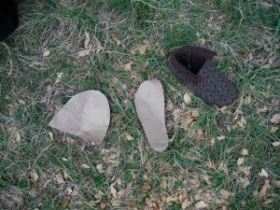

The Pattern: The mid-sole is simply a tracing of a foot. The front upper is made by laying a piece of paper over the foot and tracing around the edges. I cut the sole out of the slightly thicker of the two sweaters because the sole gets more wear, and then…
View original post 246 more words
It’s time for new shoes. After a soon-to-be-finished commission for a leather satchel, I intend to dive into a brogue-making project in the style of 19th century Ireland. This basic design certainly dates back much further than this as shown by archaeological finds in bogs throughout Europe. Don’t confuse these brogues with the more modern usage such as:
 This is a brogue in the Scottish/Northern English semi-formal fashion with decorative holes reminiscent of the drains left in old field shoes. Nor is this to confused with the type of shoe that some modern-primitives call “ghillie-brogues” or more properly, just “ghillie”:

These earned their proper name from Scottish Ghillies; a term used to denote game wardens, hunting and fishing guides, and sometimes, even poachers. A simple shoe style that probably goes back several millenia in Europe.
What I decided to shoot for was a shoe that is relatively simple to produce, is closed for winter use, and can be regularly worn in public without arousing too much comment.
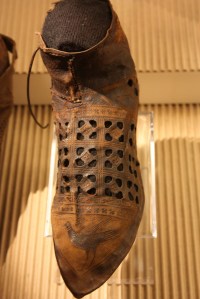
To me, something like the “bird shoe” above is very cool but not really acceptable in an unforgiving office environment. I would gladly hunt elk in these but for some reason, modern work culture has a fairly standardized and limited uniform. This style tends to be cut from a single piece and sewn around three-quarters of the sole. This one is punch decorated, probably to show off the stockings inside, a sign of wealth. This is a form of “turn-shoe” or soft-sole sewn inside-out then “turned”. A sturdy high top 12th century Dutch example with a center-seamed upper is seen below. In my opinion, these would make a fine winter shoe.

I can’t help but see the similarity between these and North American center-seam moccasins.
 The style above is a well-documented Irish “Type 1” dating anywhere from the 1st centuries A.D. through the Middle Ages. A little more complex in construction, especially to get a perfect fit, it has been argued that these may be the result of craft specialization in the early Christian period of Northern Europe. I plan to make a pair of these and contemplate them as a possible design for teaching simple shoemaking. There is some real sewing involved, but not enough to intimidate most beginners.

For those who know American moccasin styles the pattern above seems very familiar as a one piece, side-seam shoe.
So, this brings us to the “Irish Brogue” or Type 5 shoe. These are known well up into the nineteenth century and I wouldn’t be surprised to find them in even more modern contexts, especially amongst the poorer populations. There are similar shoes depicted in Colonial America, probably made in the home for lack of money or access to a cordwainer.

The above brogues appear to be a “built” shoe, having separate soles, multi-pieced upper, and a heel lift; the only difference between these and others from the period is the lack of ties or buckles. Although difficult to tell from the image, they are likely constructed similar to those below:

Hopefully, updates will soon follow to track the creation of a new pair of shoes.
Unlike almost all of mainstream footwear, Huarache leather is still vegetable tanned using wood. Few tanneries in the world still offer vegetable tanned leathers because of the slower tanning process and higher raw material costs.
Not only are the wood and organic matter used to tan the leather renewable, but the vegetable tanning solution doesn’t create toxic carcinogenic bi-products such as Chromium IV to which tannery workers and waterways can be exposed to.
The natural benefits of vegetable tanned leather are that the organic tanning process has a much lesser environmental impact and the leather maintains some of its natural quality to stretch and adapt to your foot shape.

Jesús and Antonio González the father and son tanners still practice this traditional and centuries old tanning method and unlike modern tanneries still tan by hand.
They are considered by many local Huaracheros to be the best vegetable tannery in the Mexican state of…
View original post 247 more words

I like the closed, round toes on this one. From http://huaracheblog.wordpress.com/.

18th century tools of the bootmaker’s trade. Click for the source.
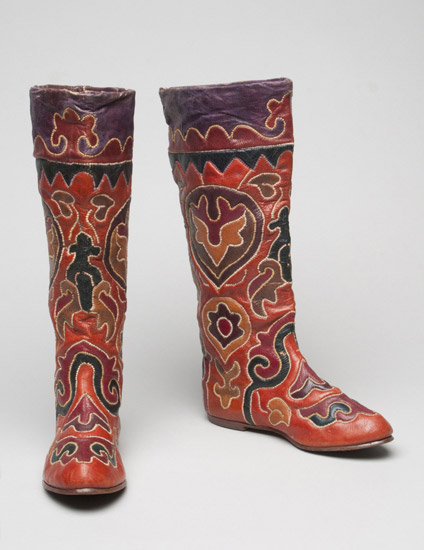
Uzbekistan boots. I need to make something like these.
An interesting and excellent business idea. Maybe this will help keep the huaracheros’ tradition alive.
For the past 3 years Huarache Blog has been documenting and promoting the craft of Mexican Huarache footwear. This year I will also be developing a specialty e-trade business to offer more immediate support to the craft of Huaraches.

Introducing úkata, an online Huaracheria selling only the best Huaraches in Mexico. Rare designs crafted by the most talented Huaracheros. Timeless Huarache styles that have been made the same way by the artisan and his family for generations. Footwear with a low environmental impact, made with naturally processed and recycled materials.
Click back in February for a more detailed post on úkata and to visit the online store.
_____________________________________________________________________________________________
Durante los últimos 3 años Blog Huarache ha estado documentando y promoviendo la artesanía de los Huaraches Mexicanos. Este año voy iniciar un negocio de comercio internet para ofrecer un apoyo más inmediato a los Huaracheros y a la artesanía de los Huaraches Mexicanos.
View original post 53 more words


 Preindustrial Craftsmanship