Burns Night, a Dirge

On this day before the coming Burns Night where we celebrate the Bard in virtual lockdown I invite you to pull up a chair, pour a tall drink of something potent, and enjoy a few poems from the master of Scottish vernacular. This evening, I strongly recommend you find a copy of Tam O’Shanter and read it as it will be done all across the globe. Happy birthday Rabbie.

Winter: A Dirge

The wintry west extends his blast,
And hail and rain does blaw;
Or the stormy north sends driving forth
The blinding sleet and snaw:
While, tumbling brown, the burn comes down,
And roars frae bank to brae;
And bird and beast in covert rest,
And pass the heartless day.

“The sweeping blast, the sky o’ercast,”
The joyless winter day
Let others fear, to me more dear
Than all the pride of May:
The tempest’s howl, it soothes my soul,
My griefs it seems to join;
The leafless trees my fancy please,
Their fate resembles mine!

Thou Power Supreme, whose mighty scheme
These woes of mine fulfil,
Here firm I rest; they must be best,
Because they are Thy will!
Then all I want-O do Thou grant
This one request of mine!-
Since to enjoy Thou dost deny,
Assist me to resign.

Robert Burns 1781
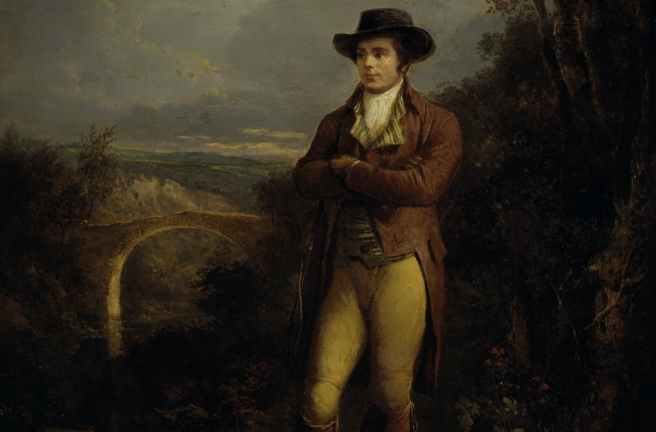
The Scottish Bard.

Happy Saint Andrew’s Day!

With an excellent video with music of Clanadonia.

St-Andrew's-Doo-Chris-Close-ed.previewLet us begin the winter feasting season in the old north.  Not just a Scottish or Christian holy day, much of Europe is tied to animal slaughter and feast days to kick off the long dark season.  From and anthropological and historical perspective the feast itself is thought to be a Christianisation of Saturnalia and Samhain festivals.  Give a Scot an excuse to eat, drink, and be merry, and let the fun begin!

And finally, I leave you with Clanadonia and the excellent montage and music from www.scotland.org. I certainly hope to visit again someday soon.

“The Travelling Tinker” by John Burr

The Travelling Tinker

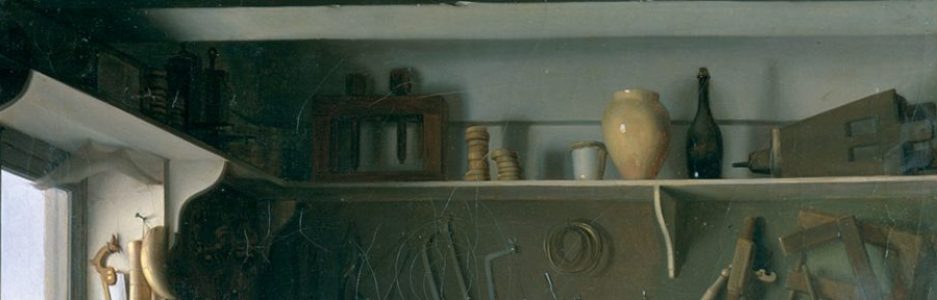
A painting by the Scottish artist John Burr (1831-1893).  Tinkers were originally tinsmiths or “tinners”.  One of many itinerant jobs pursued by a class of casual laborers.  These were mostly skilled and specialized crafts like basket making, shoe repair, leather work, and metal work but many poorer workers were migrant farm labor picking hops and tending the market gardens during the peak harvest.  The fellow in the image above appears to be a fairly well-off repairman mending a seam in a pot.  This from a time when new items were a rare purchase.

I love deciphering images like this for the details of domestic life.  Unlike most photos, there is real intention in what the artist chose to include or not in the painting.  The house is clearly a poor one but a freshly killed chicken hangs from a nail on the wall by some dry roots.  A handmade broom leans against the wall next to a basket that has the tradesman’s coat lying across it.  The oldest daughter tends the infant while the mother stands by the laundry basin with a toddler behind.  All the children look on while the novel worker plies his trade in a waistcoat and hobnail walking shoes.

Wandering Minstral

A Wandering Minstral
A Wandering Minstrel

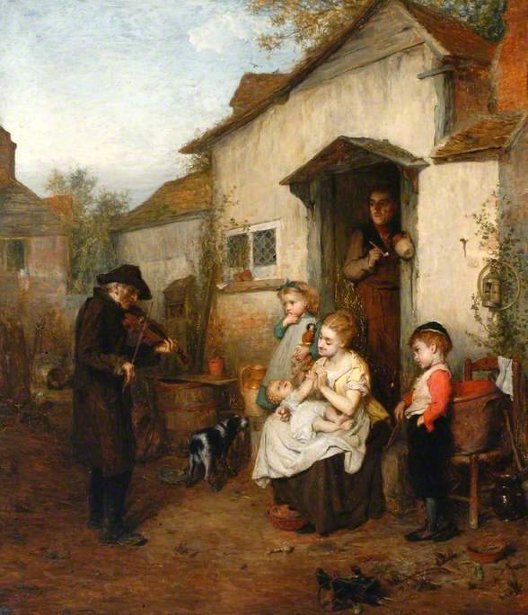
Here is a painting by the Scottish artist John Burr (1831-1893) of an itinerant fiddler playing for a family in a Scottish lane probably trying to make enough money to eat or maybe even receive some food for his entertainment.  I can’t help but think the father looking out has a skeptical look; possibly wondering what this will cost in the end.

Music and storytelling were a very different commodity in an age of widespread illiteracy and 24 hour media.  It’s hard to even imagine a time when all music was handmade and intimate and not an item to be mass marketed.

Tinker Family in Scotland

Tinker1920s
Tinker family. Estimated date : 1920 – 1929 ©The Wick Society,

Here’s a wonderful old photograph of a “Tinker Family in Scotland.”  It is believed to be taken sometime in the 1920s but the location was not identified.  The wagon could just about pass for a western American sheep camp.  Even thought they had the wealth to own a wagon it was still a pretty tough life, often unwanted in non-traveller (sic) communities, these people have been marginalized for centuries.

I found this one while perusing the Johnston Collection on the Document Scotland webpage.  Have a look if you are interested in great images of a beautiful country.

Banished to New York:

… an interesting historical post about the fate of traveling folk in 17th century Scotland

Scotland had draconian laws against travelling folk. Hostility towards “Egyptians” took off under King James VI, who was also famously opposed to Border Reivers, Gaelic-speaking Highlanders, alleged Witches, Protestant religious dissenters and tobacco smokers. Edinburgh, 13 May 1682: ‘His Royall Highnes his Maties heigh Comisioner and lords of privie counsel being informed by the Earl […]

Read the rest of this interesting but seldom taught piece of history by clicking the link below.

via Banished to New York: Seven Gypsies in 1682 #History #Scotland — Jardine’s Book of Martyrs

Sunday Music

A beautiful and sentimental song by Dougie MacLean, a Scottish artist.  If you’ve never heard of him you probably know at least one of his tunes.  MacLean’s most famous piece is probably  “The Gael”, from his 1990 album The Search, which was adapted by Trevor Jones as the main theme to The Last of the MohicansYou know: dumm dumdum dumm  dumdum dum dum dumm, dumm dumdum dumm dumdum dum dum dumm … anyway, you get the point.  Enjoy.