
When people appreciated hand made archery equipment. No training wheel, gizmos, releases, or sights. Click the image to access the British Museum page for this item.
Adventures of an Imperfect Man In Search of a Handmade Life
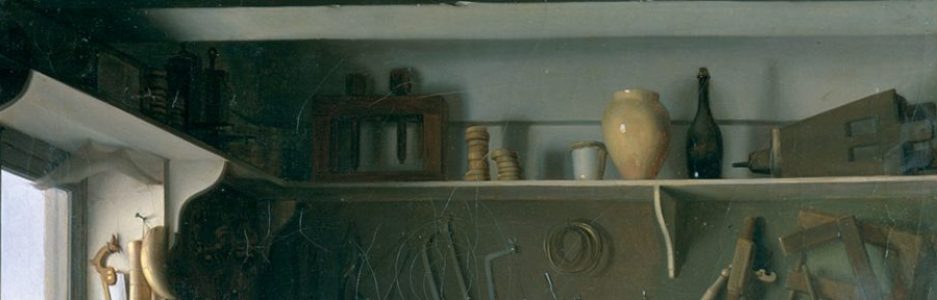
When people appreciated hand made archery equipment. No training wheel, gizmos, releases, or sights. Click the image to access the British Museum page for this item.
Believed to be a Yup’ik quiver, bowcase, bow, and arrows from the late 19th century.
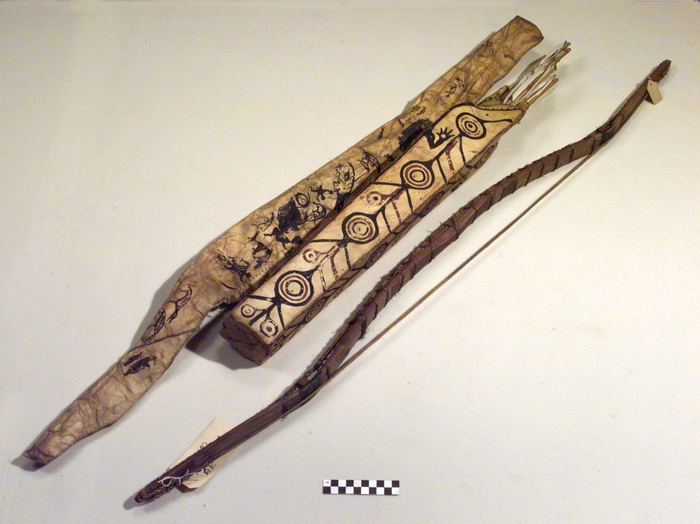 Click the image to learn more.
Chiricahua Apache, Arizona ca. 1880
 Click the image above to see more about these artifacts at the National Museum of the American Indian.
Detail photo of some fletchings and points from this collection.

I am very interested in the European Upper Paleolithic. There are many amazing artifacts of antler and bone known from good archaeological contexts. Having lugged a load of antler and bones around over the last several years, it seemed to be time to make some new goodies. I went through a phase 15-20 years ago cutting and shaping using only purely traditional means, so I know it can be a long, slow process. For these tools I used steel saws, files, and sandpaper to speed up the process but even with these conveniences there are many hours in these points.

I’ve always liked the look of these points and it seems clear to me why these were effective weapons used from 25,000-30,000 years ago across Eurasia to almost present day in parts of the Arctic. However, until I made a few, I didn’t really appreciate how deadly and functional these points are. As each barb is carved and sharpened, there becomes nowhere to hold the point safely while working without wrapping it in buckskin. Not just a thrusting weapon, harpoon, or spear; I can imaging thrusting this into a rodent or badger den, using the barbs to pull out a good meal.
 The plastic nature of antler will give these tools long life and resistance to breakage and can be re-sharpened many times.
 The scraps are becoming arrow points like the one above. Some will be made to modern legal specifications so that they may be used for hunting in the coming seasons.
My new quiver. Re-worked from one I made earlier in the winter but was just not quite right. I like it a lot now. It’s a little smaller, hangs either vertically (Medieval style) or from a shoulder strap which is removable. Made from oak tanned leather and so far, just washed down with yellow saddle soap.

It’s a simple and not very interesting design really but suits me well.

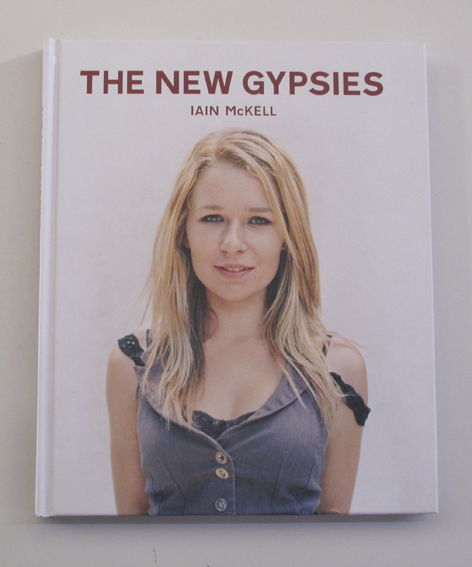
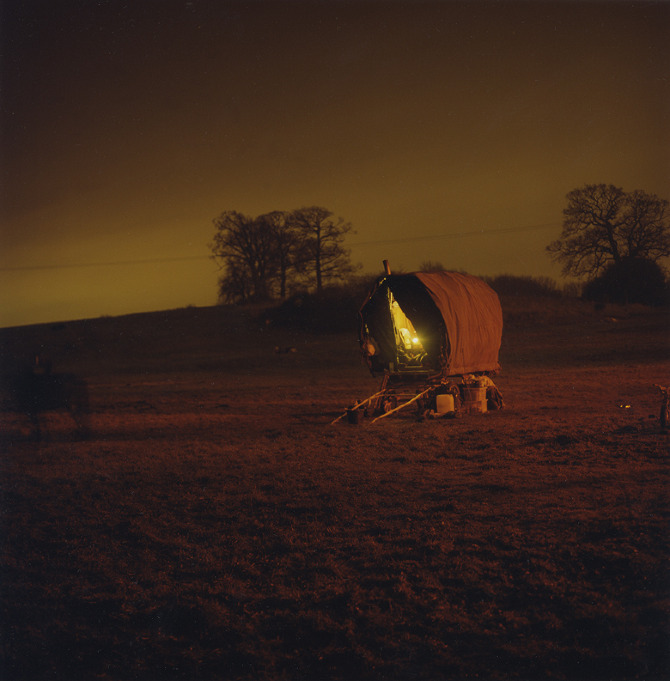
I have seen photos from this book around the web for a while now. A fair number of “hippie” Brits are living mobile, a difficult thing to do in the U.S. Iain McKell has done a wonderful job of photo-documenting the unique, beautiful, sometime spartan accommodations used by these folks on the move. If I get back to Britain I will try to track these people down.
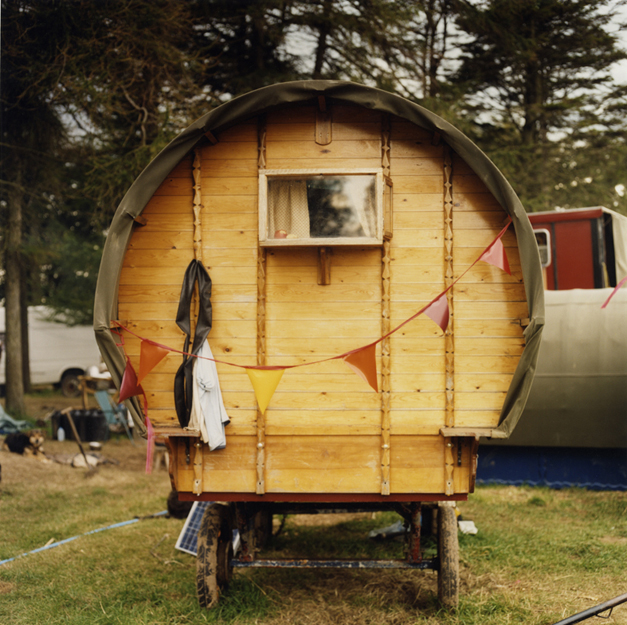
I have to admit, I’m mainly in it for the wagons. None of these look like high-speed movers, but who really needs that when it is home?
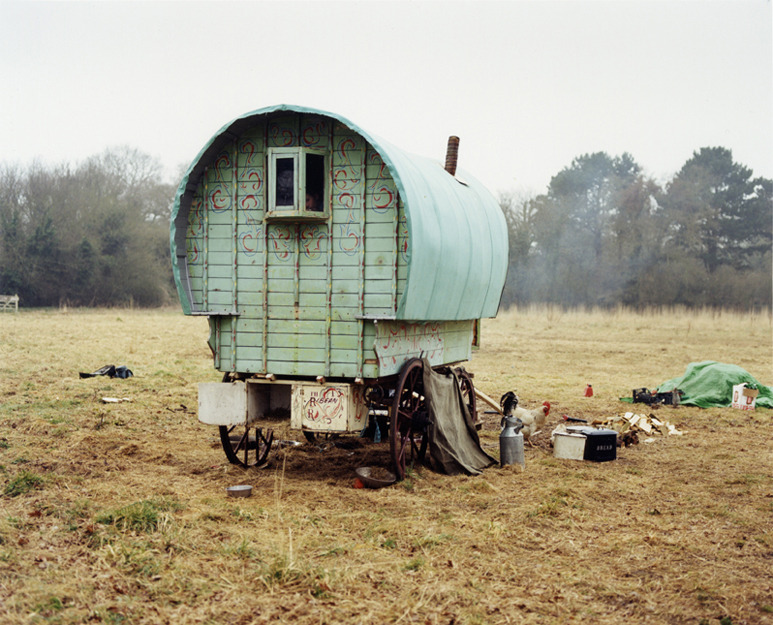
Most of these clearly appear to be restored (more or less) original horse-drawn wagons. Bow Tops, Open Lots, a Showman or two, but others look to be a bit more home-grown.
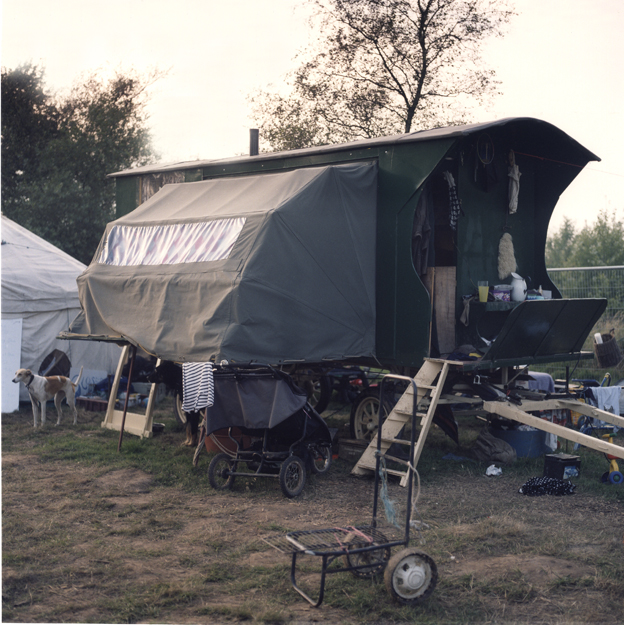
A close examination of the photos show some interesting clues to life on the road. I particularly like the “tip out” on the above wagon. I suspect it is for sleeping more people but I can imagine an outside space protected like this for cooking or storage. Hmmm, next project?
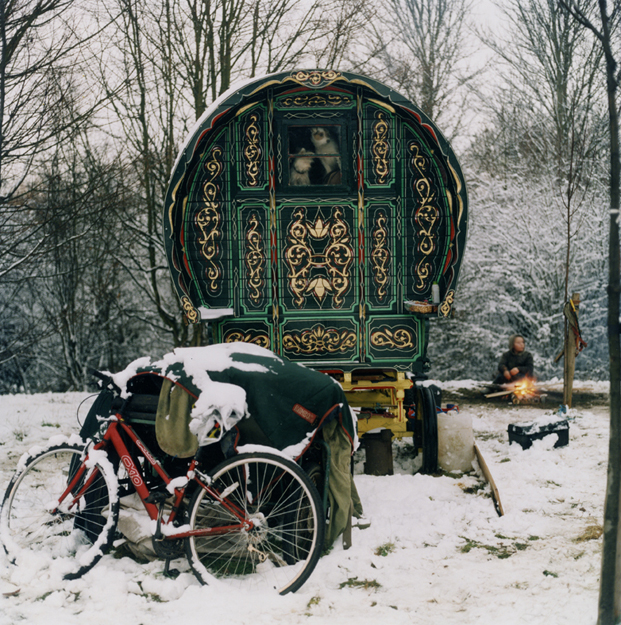
In my opinion, wagons like this are a great alternative for the modern nomad, as long as one can find a safe place to settle for the night or week or month. As with the Romani gypsies, modern travelers, living outside the norm of the greater social group are likely always to face fear and suspicion from the mainstream culture. Unfortunately, this will probably always be the way of the world.
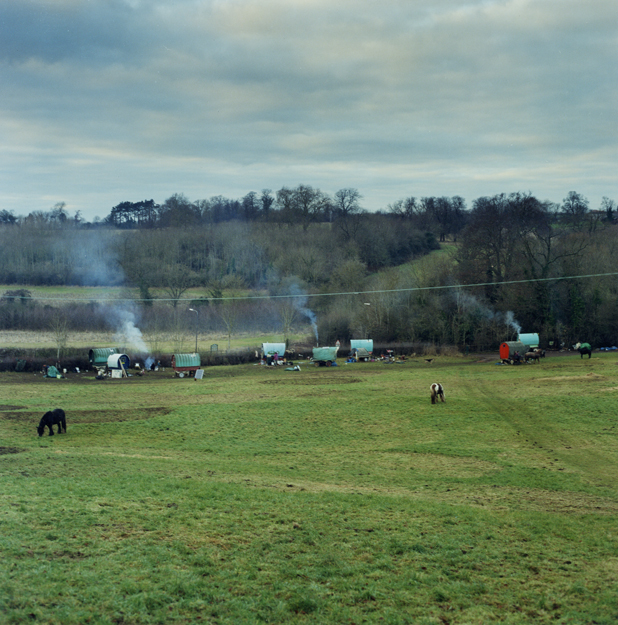
I think there will always be some of us who are okay existing outside the “normal”, expected behaviors of our peers. In a case such as this, or other fringe social groups (e.g., the Society of Primitive Technology) we can find kindred spirits who may understand our outlook in ways not found in more mainstream lifestyles.
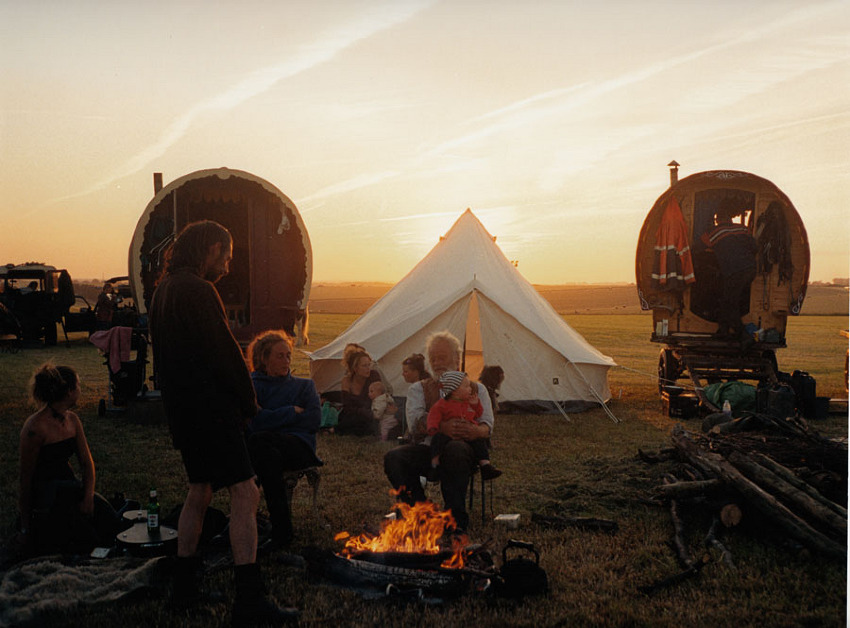
Please have a look at the art of Iain McKell and be sure to scroll down the left side of links to see more of his photos, including some fine shots of traveler’s wagons.
Thanks to those who participated in our bow making class this year. I failed to get many photos so if anyone would be willing to share theirs with me, I would be most grateful. Email me at zcoyotez (at) yahoo.com.

We made very traditional flat bows. This is a straight-forward, predictable design that is easy to tiller and makes a fine shooter.
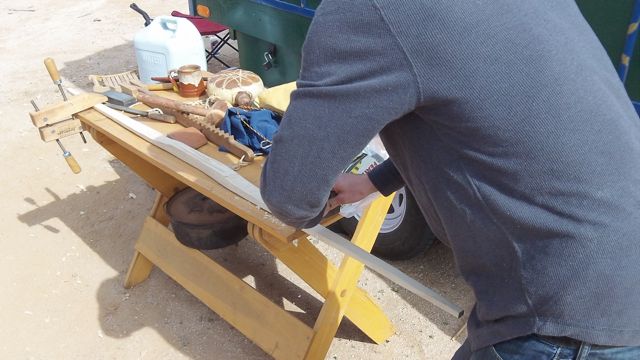
I use a minimum of tools, relying primarily on the axe, drawknife, and spokeshave for the heavy work with rasps and cabinet scraper for finishing.

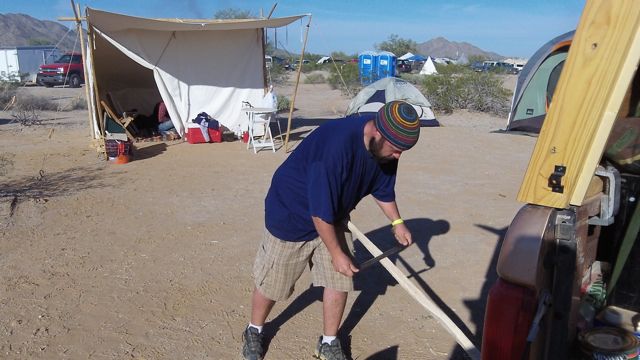
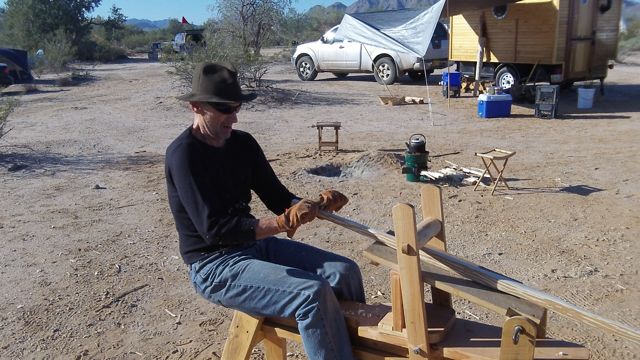
It is a little more difficult to teach such a hands-on skill to groups, as opposed to individuals, but the class seemed to go very well. The point was not to just make a bow but to learn enough of the concepts that everyone in the class should be able to go home and make more without much guidance. A key to the success is using good staves to begin with. There is enough to learn without added problems of twists and knots in the raw material.
All of the bows were successful and I hope will bring happiness for years to come.
Sitting on the couch late in the evening, drowsiness coming on when a nearby gunshot pierces the air. The dogs go on alert and I am up on my feet. Probably neighbor poachers, but I need to have a look around anyway. My nearest neighbor is more than half mile away. The road is several hundred yards from the house, so I don’t get a lot of extraneous noise. Walking out onto the front porch I see the lights from three police cars lined up along the highway about 100 yards apart. Spotlights and flashlights were scanning the area, both toward and away from me. Weird stuff happens and I seem to be a magnet for crazy so my first thought was some sort of manhunt. Very awake now, I drive up the driveway toward the police. It would normally be a walk but I didn’t think it wise to come out of the dark toward a bunch of cops in the grass.
Luckily, I was completely wrong. It turned out that two cars traveling in the same direction simultaneously hit two bucks crossing the highway. The gunshot I heard was an injured buck being put down. The spotlights and police were looking for other possible injured deer. When I got to the road, one of the officers recognized me and said the magic words, “would you like one of these deer?” The only right answer is “hell yes, let me get a knife.” I was tired, it was late, but even a damaged deer is a gift of food.
I don’t like to butcher beat up meat. And this was the first road kill I did on my own. A cleanly killed animal is much easier to disassemble as you don’t have to work around bruising and broken bones. That stuff is edible but not very good. Survival food only for me.
However, dogs aren’t picky. They like it nasty. Good dog food is expensive so I decided to harvest as much meat that I couldn’t butcher cleanly into stew meat for the dogs. They love me.
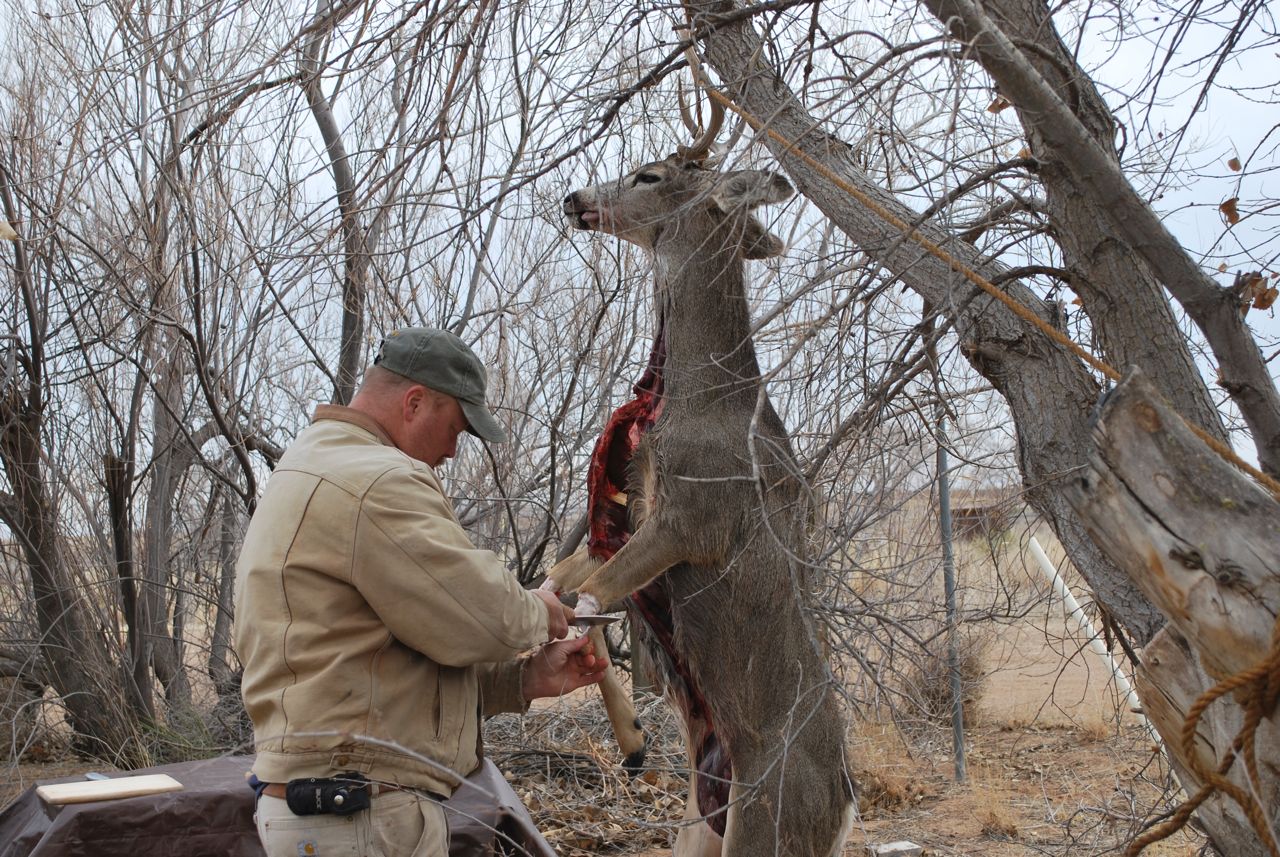
Now the bad part was that I had to work my day job and the light is still a bit short this time of year. I worked as I could, letting the carcass hang about 15 hours before butchering. In the end, we maybe got 30 good pounds of human food including two beautiful tenderloins, a few small roasts, and a lot of stew meat. As a bonus, the hide was in excellent condition and I was able to pull it off with only a few small cuts at the neck, legs, and tail. Although not large, the antlers are beautiful so I sawed off the top of the skull to deal with them later.
I am of the school of thought that it is everyone’s right to make his or her best effort to feed themselves and family. Due to many reasons, including the stupid human factor, this needs to be regulated in the modern world. This makes it difficult to hunt, especially in places like New Mexico with less than easy hunting regulations. After living on either home-grown cow or wild game for quite some time, the last few years have been a let down, having to buy commercial meat. I’ve seen the feed lots and I don’t want to contribute to those companies any more. Luckily, some free food came our way last week.
The winds slowed, the killer dust settled and I was able to get back to the bow. A few minutes with the power planer took the rough shape down to a nearly finished product. The calipers are useful and can save a lot of guesswork when making the same style bow over and over.
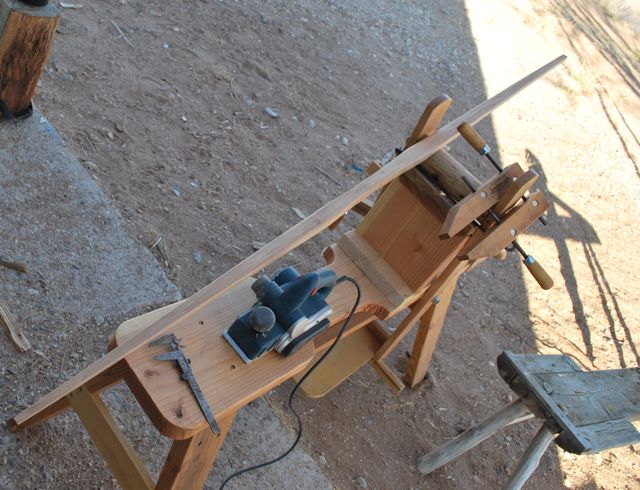
Above, the bow seen in its near-final form.

Despite the great labor savings that come from the power tools, wood is very organic and has character therefore need some finer, more controllable tools. These are the two draw knives I use the most.
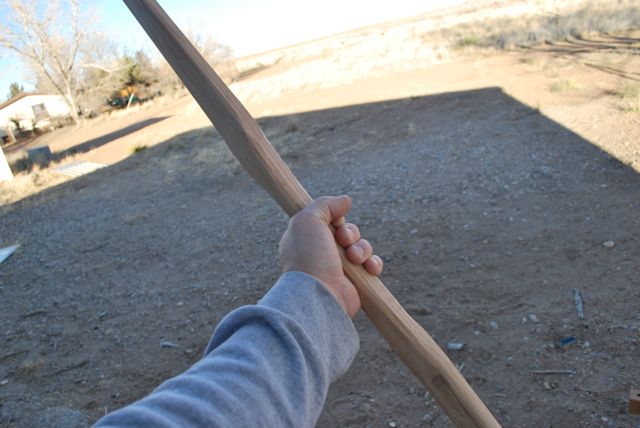
I took the limbs down til there was some little flexibility. Probably in the 100 pound range but still too sketchy to put a string on. As the day was drawing late I decided to rough out the grip and central riser area. Surprisingly, this takes quite a bit of time as it needs to fit the hand well, and look pleasing. It is difficult to get it “just right” in all dimensions as a tiny variance takes away from the symmetry of the piece. This part is purely about looks.
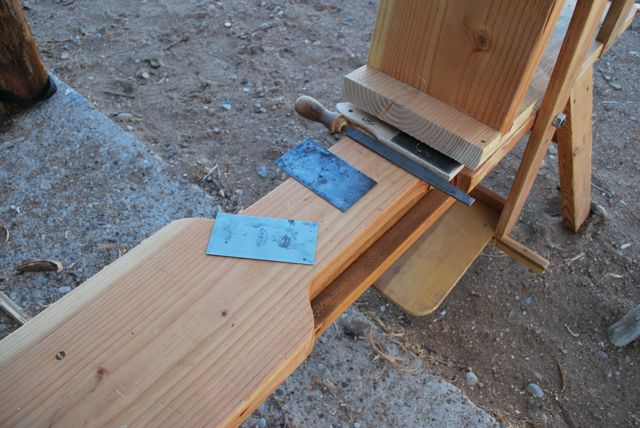
Once the knife work is done, its time to move to the cabinet scraper. Here are the two I use. To keep a good sharp edge I switch between the two as one dulls. The larger one is a standard Stanley cabinet scraper and the smaller is a Garlick of England. The English one is much harder steel but more difficult to get a good edge when sharpening. With them are the bastard file and file brush used to touch up the edge.
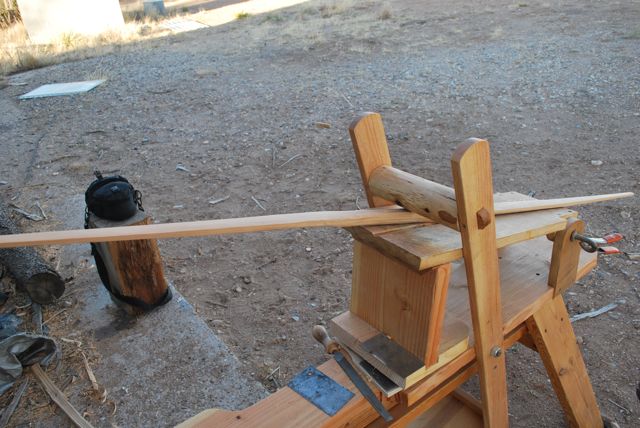
I hope to find time for the finish tillering sometime this week.
The next hickory bow. I have a barn full of aged staves languishing that need to be made into bows. Today the weather was good and I had some free time so I jumped on the opportunity to get back into production. Over the last three years I’ve only made about one bow per year as commissions. That’s the result of abstract (albeit interesting) work cutting into an honest living.
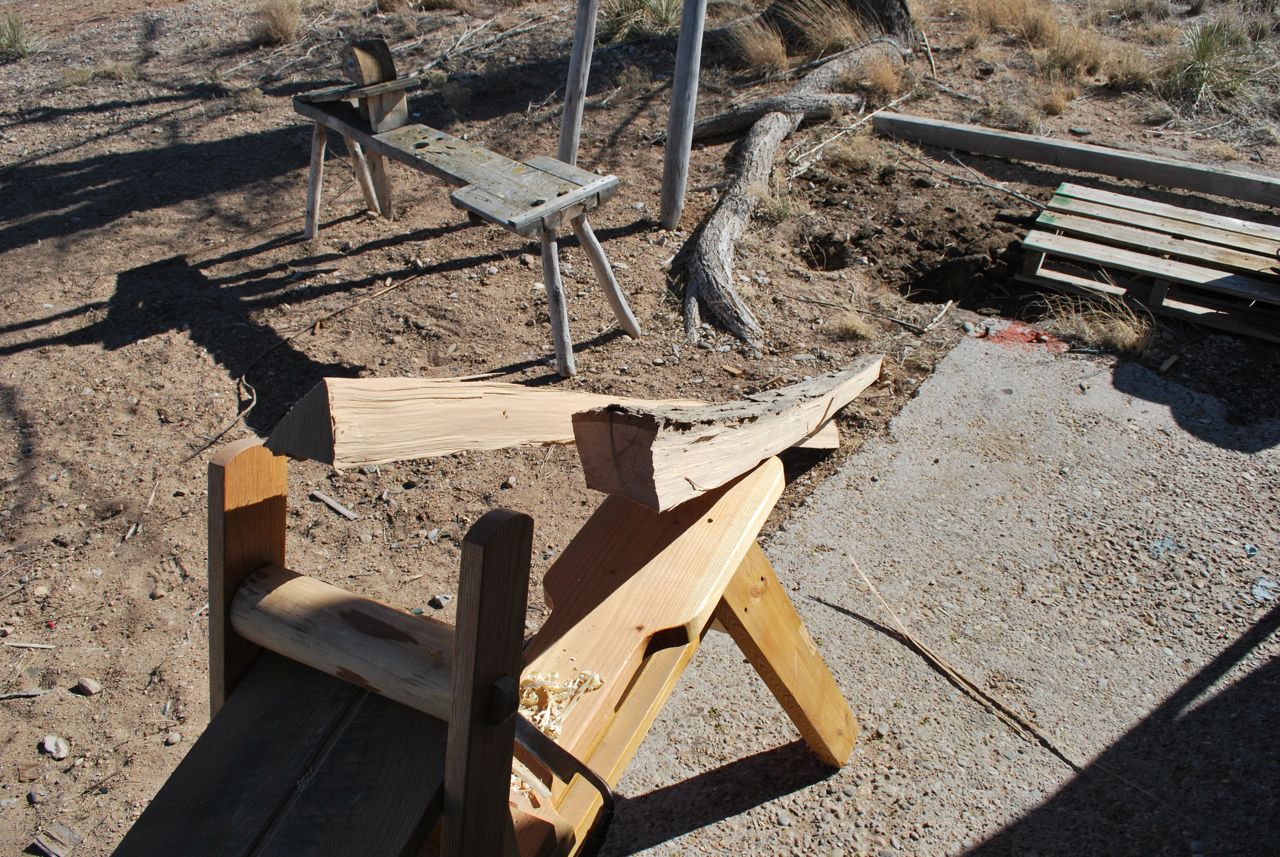
Above are a couple hickory staves cut from the old tree farm in Missouri. This tree was as near perfect as possible so I intend to get bows from both inner and outer portions of the trunk. The few bows made from this tree already are fine shooters so my hopes are high.
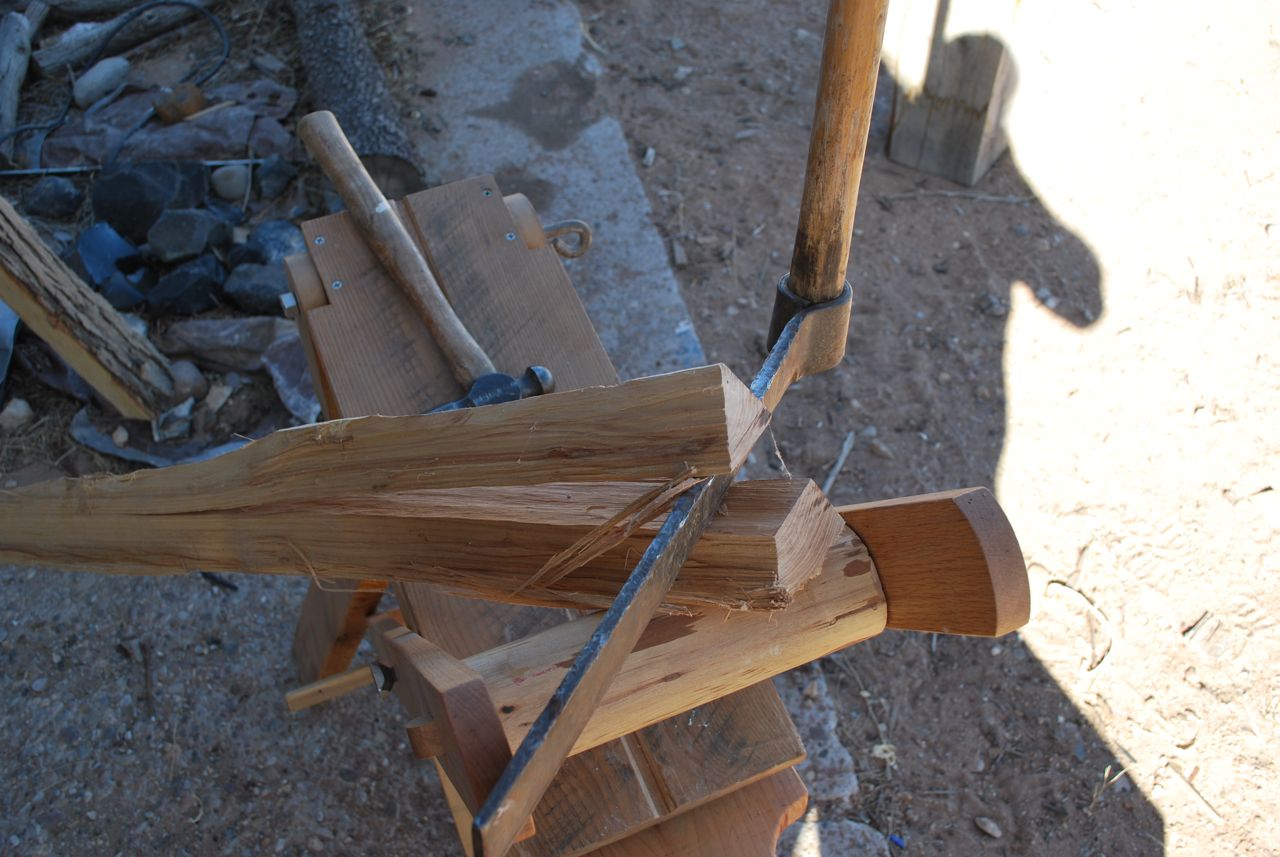
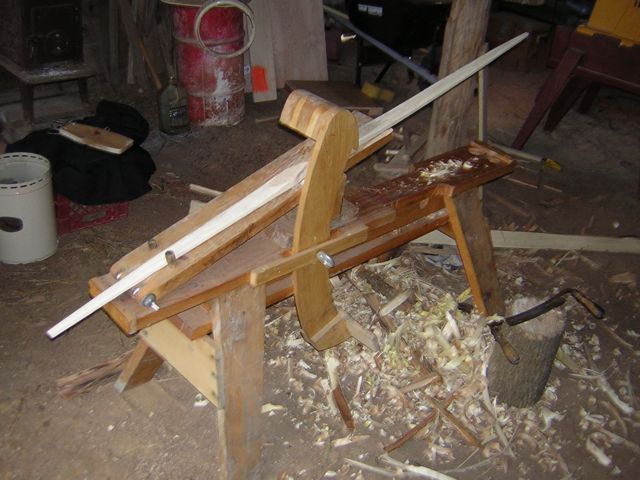
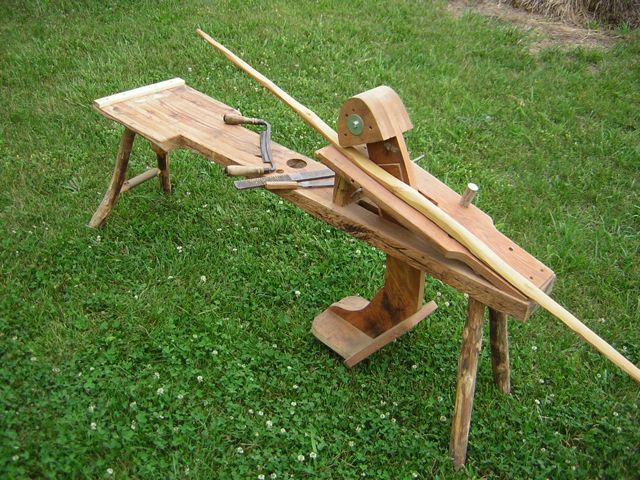
Although I will be using power tools for much of the roughing out, old-fashioned methods are at least as fast at this stage. The froe is a handy tool that any green wood worker should have.
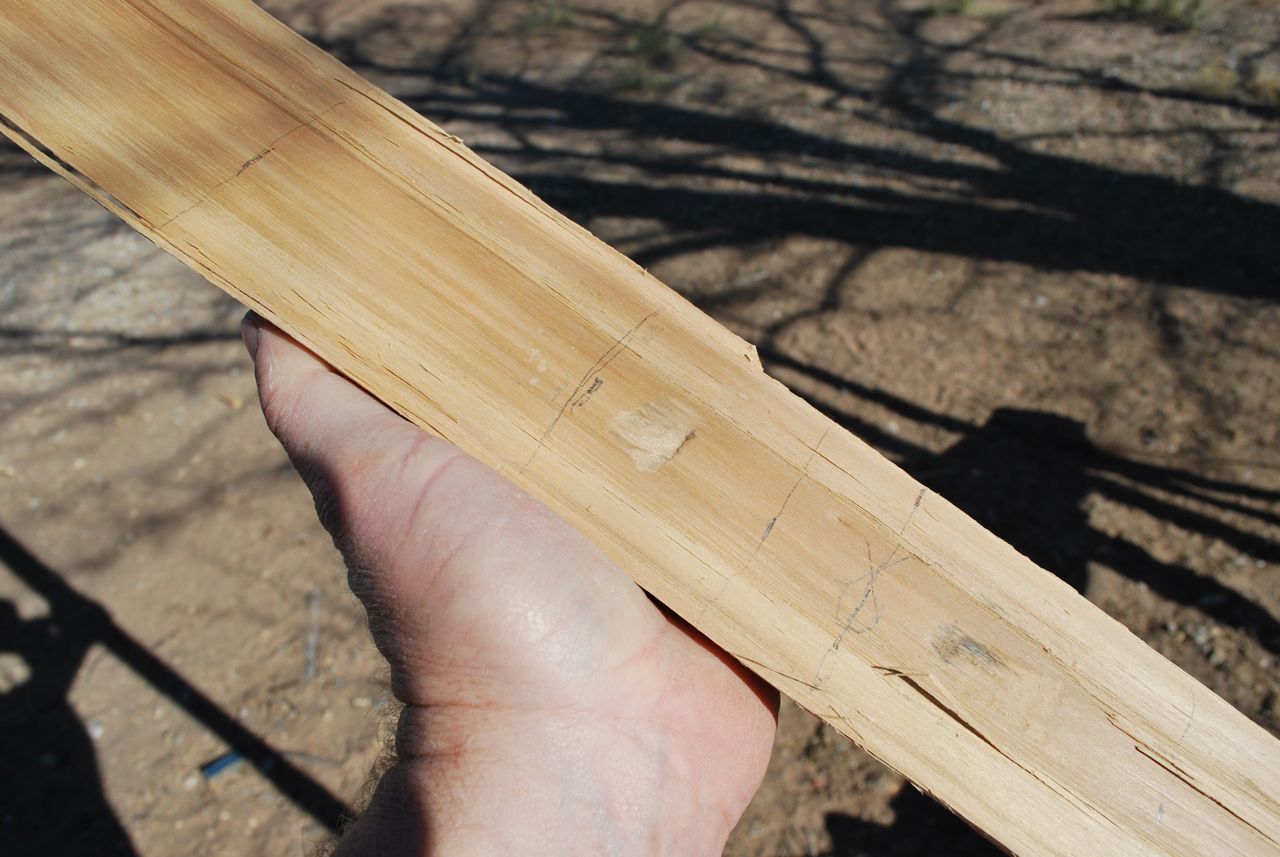
This stage is a bit of a break from tradition for me. This bow is sort of a test in speed and efficiency as I don’t have a lot of leisure time in my week currently. This stave was split from a larger piece and, as consequently there is some tear-out between growth rings. The rough back is the cross-over between rings that will need to be smoothed to a single, perfect growth ring before finishing. As it was very close to perfect, I skipped this normal step and began to roughly mark out some landmarks of the final bow such as the center of the bow, handle, limb width, etc.
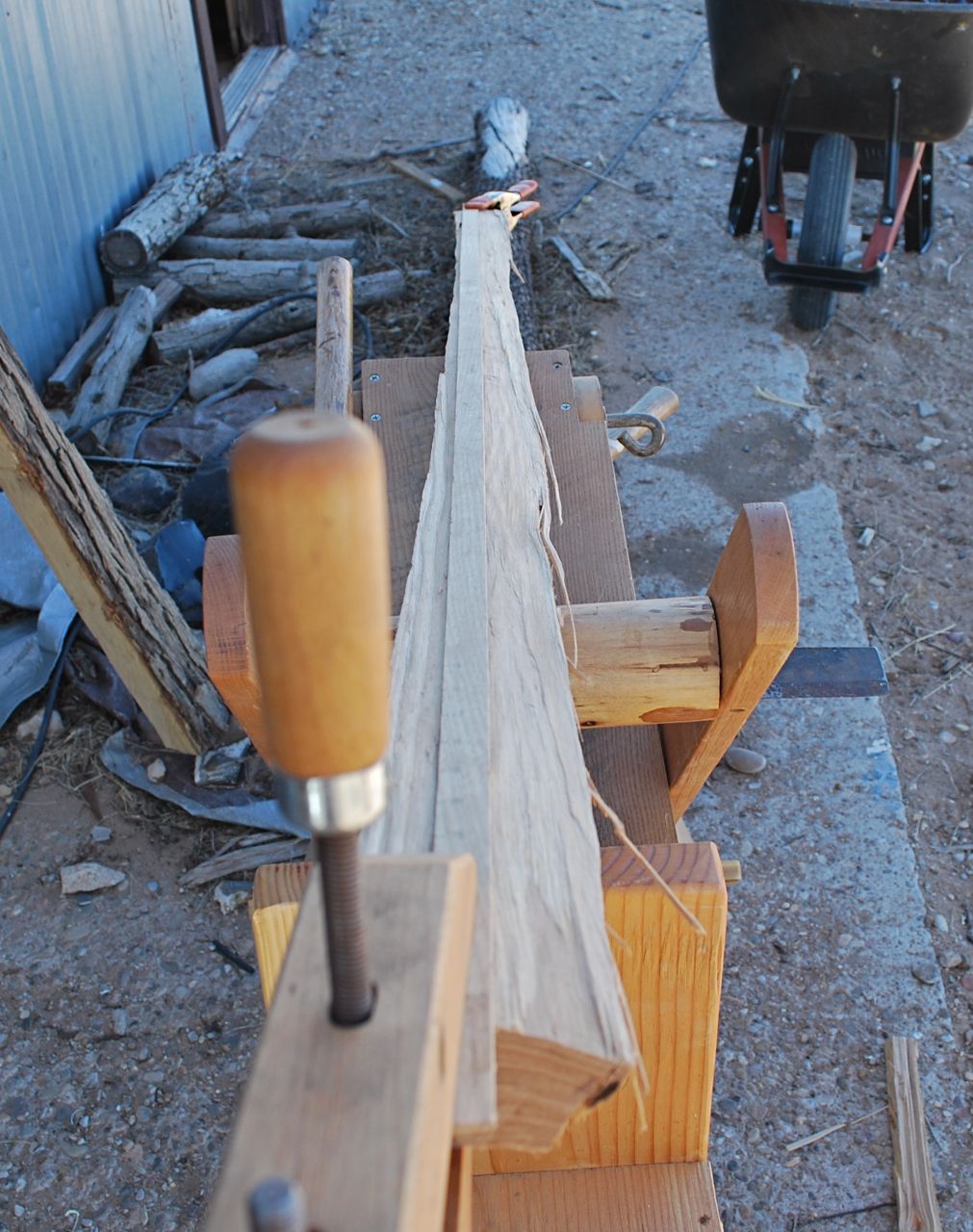
The lath I use to mark a clear center line. I have markings and distances marked for various length bows. I find a flexible lath and a good eyeball to work better than a chalk line on the curved and undulating surface of rough wood. This stave is an excellent teaching example as it has almost perfectly straight grain. The sketch on the bow back is an idealized version of the finished product. During the shaping process, knots, wavy grain, and twists are taken into account.
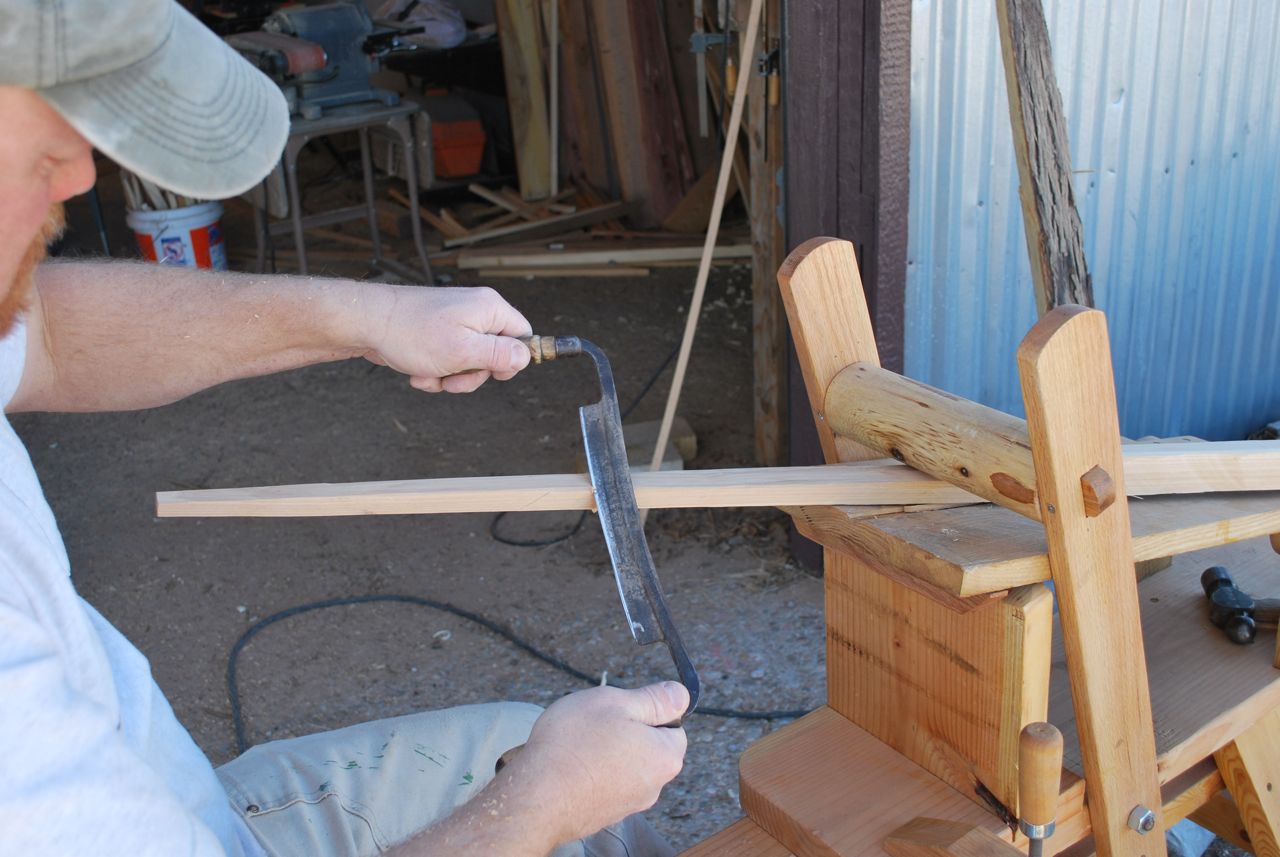
It is apparent here that the bow has progressed. To speed the process, I sawed away much of the excess down to an approximate shape for the finished bow. Final shaping a tillering commence. Most of this will be done with a draw knife, spoke shave, scraper, and rasps.
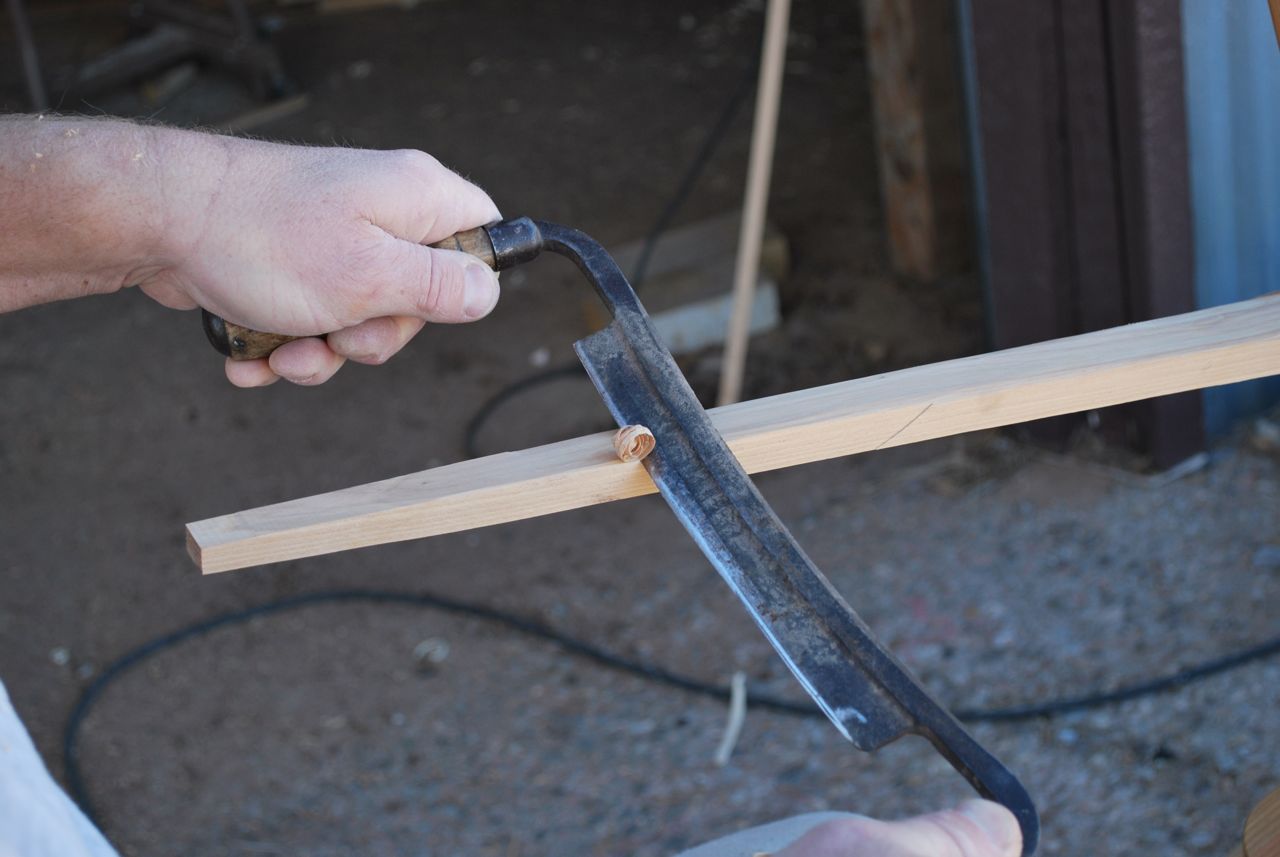
This hickory has been air dried on the high plains of New Mexico for much of the last seven years (damn I’m old) and is extremely hard and dense. Sharp tools are essential at this point for precision and control.
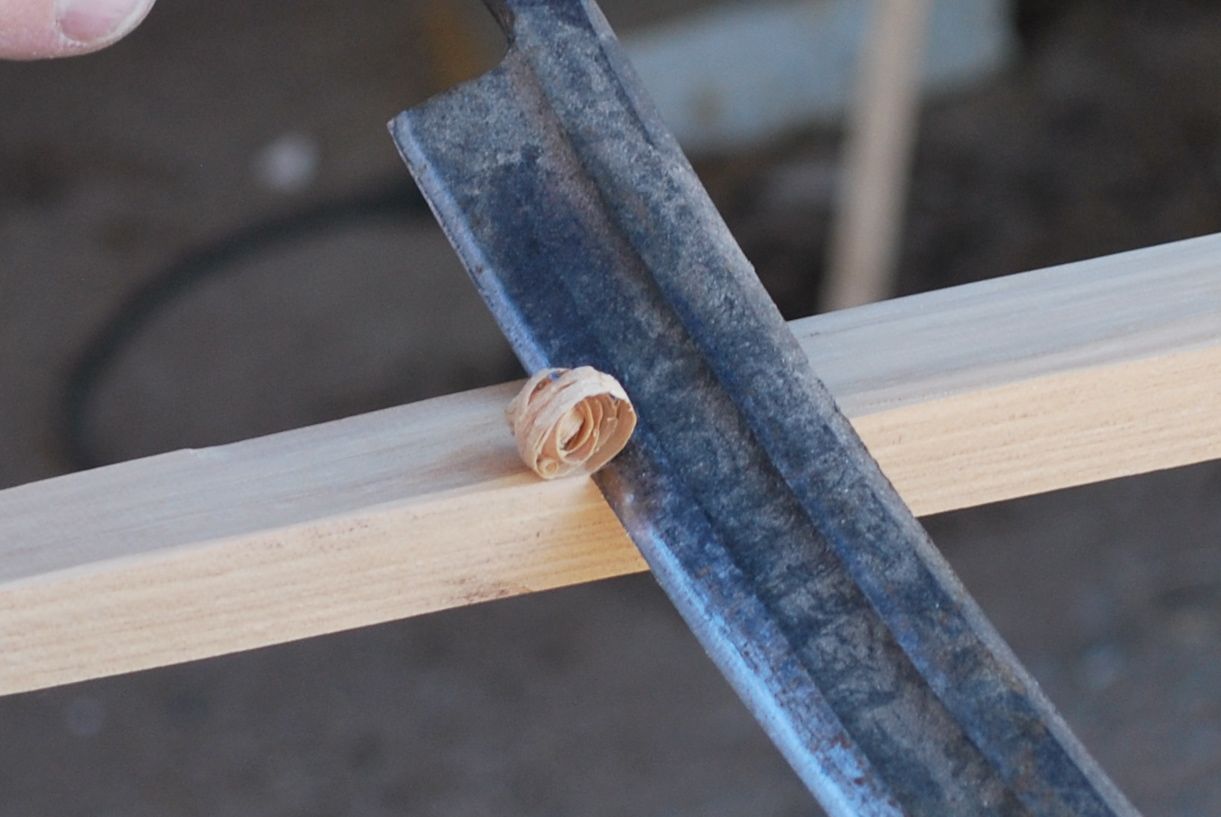
Lots of shavings like the one above will be generated tomorrow as I ran out of light today.
A note on the the bow itself. The design is a classic flat bow with consistently tapered limbs. Although, like many bowyers before me, I experimented and tried many designs over the years, I am returning to basics for the present and a design that has worked for thousands of years. More to follow tomorrow.
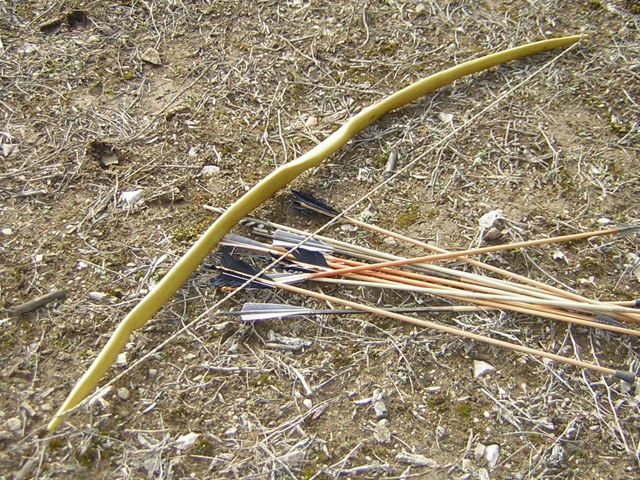
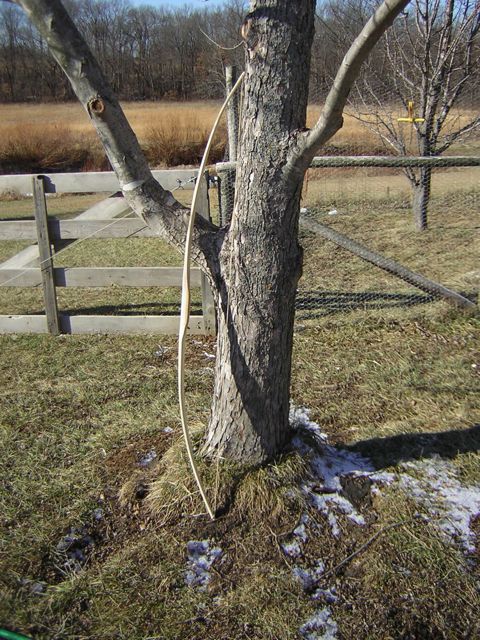
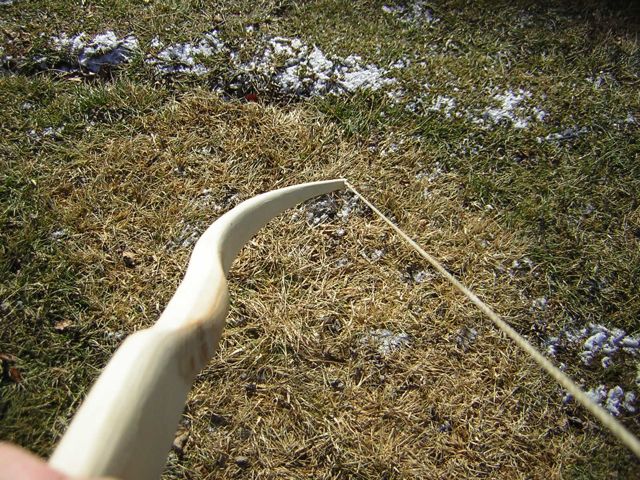
In the mean time, here are a few other more recent bows I’ve made. Most of these are are probably posted around the site already.


 Preindustrial Craftsmanship