“I don’t own many things. But everything I own adds value to my life.
Each of my belongings—my kitchenware, furniture, clothes, car—functions either as a tool or gives some sort of positive aesthetic value to my life. That is, as a minimalist, every possession serves a purpose and/or brings me joy.
Over time, though, situations’ll change. They always do. And so I’m forced to ask the same important question over and over and over again: Does this thing add value to my life?
And but it’s not just material possessions at which I posit this query. I ask it, too, in regard to relationships, social media, and any other potentially superfluous matters in life” emphasis added.
Good things to ponder as we just absorb everything, new and old, around us.
Read the whole post here or, better yet, check out their other writings:
I never really classed myself as a “nomad” when I was young and traveled a lot. It was more like I was just traveling to see things. I was fortunate. Though not wealthy, I was able to spend a lot of time in the American Midwest, camping and canoeing much of the Ozarks, bicycling southern California, and drifting around parts of Western Europe, even slipping into North Africa for some exciting adventures. By luck, my college career sent me back to Europe and my early career as an archaeologist lead me around the western United States into some pretty amazing little corners of wilderness I would never have seen otherwise.
With the far-sighted perspective of time, I can see than I have been on the move much of the time since I left high school. Being tethered to other, more sedentary people, gives a sense of having a base that may really be a false reality. Having let go of things has opened my eyes to the freedom that having few possessions can provide. It’s a big world out there, and it’s always an education to experience it.
Here’s another interesting documentary about modern American Nomads produced by BBC4 in 2011 based on the book by Richard Grant. They come from all walks of life and choose some very different paths; “Among them are retirees in RVs, teens hopping trains, hitchhikers and rodeo cowboys.” Check out his other books if you get a chance, they are certainly interesting reads.
Richard Grant is a British writer currently living in the Mississippi Delta. He is the author of three books, Crazy River: Exploration and Folly in East Africa (Free Press, 2011), God’s Middle Finger (Free Press, 2008),published in the UK as Bandit Roads, and American Nomads (Grove Press, 2003), published in the UK as Ghost Riders. In addition, he writes articles for magazines and newspapers, publishing regularly in the Telegraph magazine (UK), and Port. He is the writer, presenter and narrator of the television documentary American Nomads, broadcast on BBC4 in November 2011, and currently working on a documentary about tribal life in Ethiopia.
Here’s another excellent video of Robin Wood, wood turner and traditional craftsman. Visit his website to learn more about this remarkable man and his admirable career choice. As he explains, his job is easy to describe while so many careers are just about impossible to explain what one does and we create fancy titles to describe what we do all day.
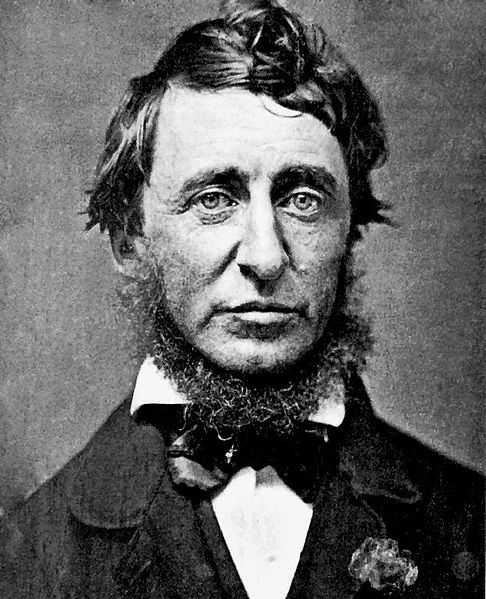
Henry David Thoreau – A man who’s writings have so influenced my thinking over many years. Died at age 44 (July 12, 1817 – May 6, 1862). Land surveyor, author, poet, philosopher, abolitionist, naturalist, tax resister, historian, and transcendentalist.See also the Anarcho-Naturism movement. Sometimes referred to as Green Anarchism.
Try to learn to breathe deeply, really to taste food when you eat, and when you sleep, really to sleep. Try as much as possible to be wholly alive with all your might, and when you laugh, laugh like hell. And when you get angry, get good and angry. Try to be alive. You will be dead soon enough.
It seems that minimalism is the word du jour around the internet these days. Tiny houses, the 100 Thing Challenge, Non-Conformist work strategies, and urban homesteaders are filling blog-space with ideas and adventures outside the old consumerist norm. Many people are looking for something more in their lives and realizing that Stuff is not the answer. There is often an epiphany in someone’s life when they come to the realization that humans are not just professional consumers or targets for marketing strategies. Shopping is not a valid pastime. Hopefully there is more to our short existence than reality TV. Having lived without regular television for quite a few years I feel very lucky to miss out on political soundbites, sit-coms, and mass marketing of sports-watching. Unfortunately, even with my relative isolation, I know about these things from reading the news on the Internet almost daily.
Choosing to not buy into most popular-culture lightens my mental load a lot and (hopefully) allows time for deeper and more elevated thinking as well as crafting a better life. Daily walks, exercise, building things, cooking good food, and reading make for a calmer mind and a lower stress level. These are intentional activities not the imposed sedation of consumer culture.
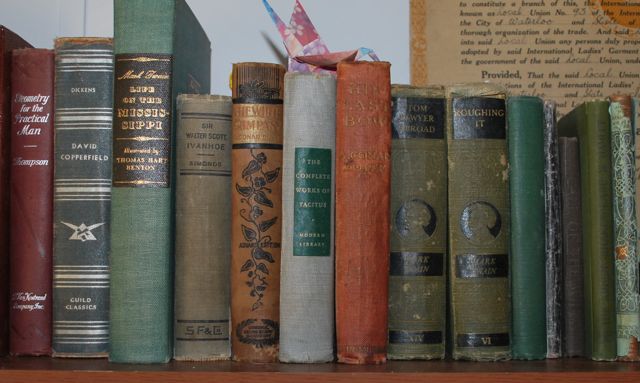
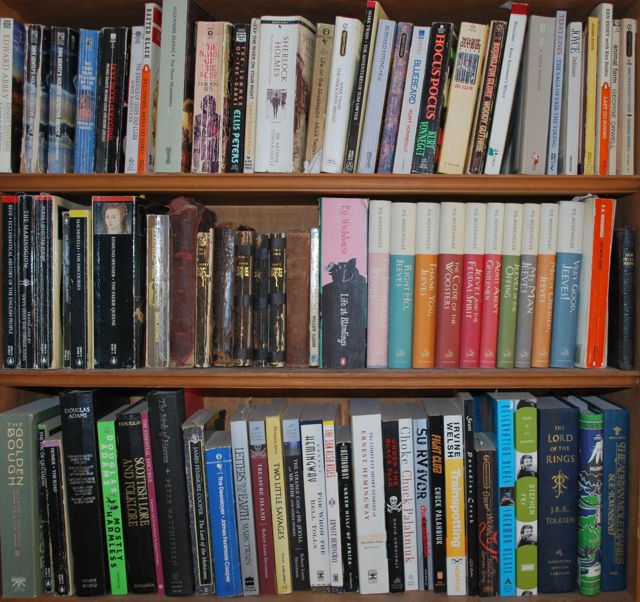
When I had to leave Flagstaff about eight years ago, I began uncluttering my belongings. I don’t think of myself as a collector, but I had amassed an enormous library of books. This is what people on an academic path do … right? Who did I think I was? Some nineteenth-century English aristocrat? Why would I possibly need a personal library? It hit me one day that this was crazy. I have hauled books around since I was a teenager until it became truckloads to move while nearly always living within twenty minutes of a large, academic library.
Sure, as a person who researches writes for work there are certain references and sources I need to have on hand and could not adequately perform my job without, but I had fallen into the trap of keeping books around “just in case” I wanted them again. That’s not to say that there aren’t recreational books I would never want to be without and I hope to read or reference many more times before I die.
I was able to sell a fair number of books and make a few dollars from them but, in the end, found that there isn’t a high monetary value on most books. These I gave away. I gave away even more to the local library and to the Goodwill store. I still have far too many books, but now its really just the one’s I love or have a need for. The ones I may not need but can’t quite part with are: a few rare antiques, first editions, special editions, and expensive academic tomes.
I’m still giving away books but I’m still buying them as well. Being far from a real bookstore actually makes it easier, not harder, to shop, read reviews, preview and purchase books. Without getting up I can order a book and expect it in my post office box in a week. Such is the Amazon.com culture.
I still read voraciously, but now, when considering a book, I really try to consider how much I want to own it and do I want to lug it around? Another anchor holding me down. Can my local library get it? This has been a difficult addiction to overcome. I’ve bought books since I was fourteen and, on some level, prided myself on having such an extensive collection at my fingertips. It felt good to put another dozen or so hardbacks in my Goodwill box this morning. Just a few hundred more to let go (but a few more are on their way to my post office).


 Preindustrial Craftsmanship