Rules of Conduct – From the Pen of Thomas Jefferson

Thomas Jefferson wrote reams of good advice, important political philosophy, the Declaration of Independence, and many other things (which is why we know so much about him).  To some of his younger relations he sent his favorite “Rules of Conduct” to help the people he cared for better and more insightful humans.  These thoughts evolved over time so versions vary slightly depending upon the source.  Here is a facsimile of the ten point “rules” with a slightly different version spelled out below.
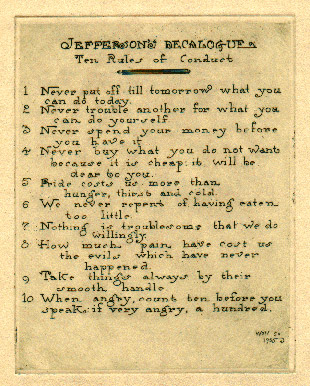
Thomas Jefferson's Advice.
Thomas Jefferson’s Advice.
  1. Never put off to tomorrow what you can do to-day.
  2. Never trouble another with what you can do yourself.
  3. Never spend your money before you have it.
  4. Never buy a thing you do not want, because it is cheap, it will be dear to you.
  5. Take care of your cents: Dollars will take care of themselves.
  6. Pride costs us more than hunger, thirst and cold.
  7. We never repent of having eat too little.
  8. Nothing is troublesome that one does willingly.
  9. How much pain have cost us the evils which have never happened.
  10. Take things always by their smooth handle.
  11. Think as you please, and so let others, and you will have no disputes.
  12. When angry, count 10 before you speak; if very angry, 100.
T_Jefferson_by_Charles_Willson_Peale_1791_2
Portrait of Thomas Jefferson by Charles Peale, 1791.

Despite some obvious flaws that glare in the light historic hindsight, Jefferson was steeped in classical philosophy and was a great thinker in his own right.  If we all could live by these rules the world would be a better place.

And finally, while providing an outline for his daughters’ education he suggested while he was away on business:

“With respect to the distribution of your time, the following is what I should approve:

From 8. to 10. o’clock practise music.
From 10. to 1. dance one day and draw another.
From 1. to 2. draw on the day you dance, and write a letter next day.
From 3. to 4. read French.
From 4. to 5. exercise yourself in music.
From 5. till bedtime, read English, write, &c.

..I expect you will write me by every post. Inform me what books you read, what tunes you learn, and inclose me your best copy of every lesson in drawing. Write also one letter a week either to your Aunt Eppes, your Aunt Skipworth, your Aunt Carr, or the little lady from whom I now enclose a letter. . . . Take care that you never spell a word wrong.  Always before you write a word, consider how it is spelt, and, if you do not remember it, turn to a dictionary. It produces great praise to a lady to spell well…

If you love me, then strive to be good under every situation and to all living creatures, and to acquire those accomplishments which I have put in your power, and which will go far towards ensuring you the warmest love of your affectionate father,

Th. Jefferson”


He was known, like most of us, as a far-from-perfect father but his advice was sound.  Three hours of music per day, be good to all living creatures, draw, dance, and read. Obviously, this advice applies to the wealthy and elite who do not toil all day but even in the modern world there are worse ways to spend an idle day.

It sounds like a wise path.

Raised With Wilderness Skills

Don’t leave the kids out of the things you find important…

Nota bene! The following ramble was written at three in the morning and may contain sentiment, ramblings, and a bit of opinion. I don’t want this to sound preachy.  What was intended as a few childhood pictures from primitive technology events ran away with itself in the dark hours between sleeps.  ~G


Learning to shoot at an early age. Skills like this build coordination, confidence, and an understanding of the greater things in life.

There is a certain amount of balance that can become of the unique skills we gain along the path of our lives.  Some people come to events, take classes, and return to the ‘normal’ life at the end of the week relatively unscathed by the learning they paid for and the time spent.

The first brain-tanned shirt and wearing it with pride. It was a hand-me-down from a friend’s daughter.

To closely paraphrase a linguistic anthropologist I knew long ago,

“Some things we love are embraced the way most people embrace their religion, they take away some message, feel strongly about it, but leave it for Sundays. When we find the thing that is our passion, we embrace it like a lover; it encompasses all our thoughts and becomes our entire life.”  ~L.F.

This is how I feel about primitive skills, wilderness living, and pre-industrial craftsmanship.  Without consciously trying, it just became a part of life growing ever stronger from teenage into full adulthood.  While living in the consumer world, this alternative floated in the background of the mind and continued to influence activities when our child came along.

We were not perfect parents.  Far from it.  But we were consciously better than our own.  We really tried.  We learned.  I sometimes wish I had it to do all over again.  Overall, I think we did pretty well and were lucky in many ways.  We encouraged exploration, learning, and self-reliance.  By not child-proofing everything or creating needless prohibitions, we were forced to be more aware and in the present.  Yes, it is probably more work and yes, it can be exhausting but children should learn their most valuable lessons at home from family, whatever ‘family’ may mean to you and yours.

Every kid and every family is different.  They aren’t robots and it is clear to any observer that they have a mind and ideas of their own from a very early age.  We can only steer them as best we can, present them with our ideas and beliefs, and provide the types of opportunities we think will give them a good grounding for their future lives before setting them free to try their skills in the world.

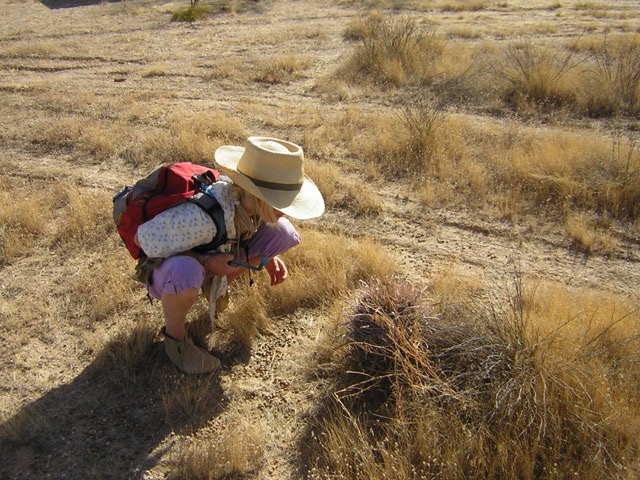
Examining a fish-hook cactus in the Sonoran desert.

It makes me sad hear or to read in social media that parents that I actually know are so down on the next generation.  Complaining that they don’t go outdoors, have useful lifeskills, proudly hitting them, or even ridiculing them for using the technology they themselves provided.  If that is the case, the blame is only ours!  We cannot place the blame on media and movies and video games, schools, government or a general millennial malaise.  It is not anyone else’s job to raise our children well.  We are, to a large degree, culpable.  When I hear a parent complain that their kid watches too much TV, or plays too many video games, I am baffled.

None of us are perfect, but we can give the following generations the values and ideals we may only cherish in the abstract.

DSCN2530
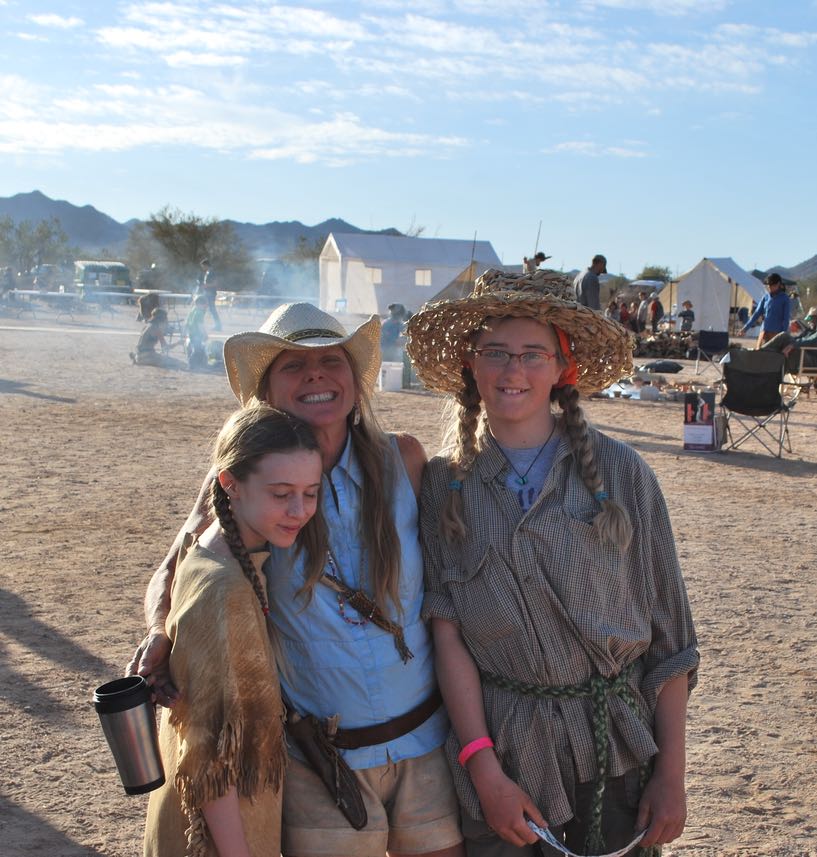
Modelling the yucca fiber skirt with her buckskin shirt.  A monumental amount of yucca processing.

The intended descriptions have strayed into a hopelessly sentimental post, but anyway, enjoy some of my favorite photos I dug out recently.

Winter Count 2009 - 67
Making fire in the Arizona desert 2009.

I leave you with this broad paraphrasing of Edward Abbey:

Give them the skills and encouragement to get out there and hunt and fish and mess around with friends.  Let them ramble out yonder and explore the forests, climb the mountains, bag the peaks, run the rivers, breathe deep of that yet sweet and lucid air.   And at the end of the day, sit quietly for a while with them and contemplate the precious stillness, the lovely, mysterious, and awesome space we call earth.

We are fed by those that surround us. Choose wisely.
Blacksmithing her first knife.

I hope to see a few of you in the great outdoors very soon.  And don’t forget to bring the family if you can.

Save

Save