Work from the Leather Shop

  • Long, cold nights in the Midwest. 
  • Limited mobility due to injury. 
  • A need to create new things
  • A desire to fund my trips later this year…

This is a recipe for high productivity in the workshop.

dsc_0106
Hot off the workbench.

Fortunately, I have a fairly large stockpile of leather and supplies to see me through my projects as I find inspiration in different projects.  I am leaning toward things that have been popular in the past years but if anyone has ideas or suggestions, I will gladly consider them.

dsc_0107
Sam Browne button in solid brass.

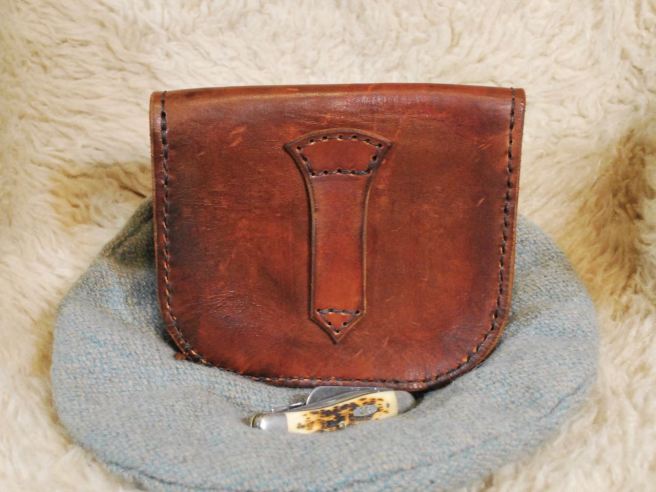
This is my travel wallet design.  It’s a simple clutch-style document case to keep things safely stowed when you want more than a card wallet.

dsc_0109
Simple, rugged design.

No frills but elegant in its own way, this one was left natural color and rubbed with dubbin (a mix of neatsfoot oil and beeswax).  Full-grain veg-tanned leather like this ages beautifully and takes on a golden brown patina.  This wallet should outlive its owner.
dsc_0108
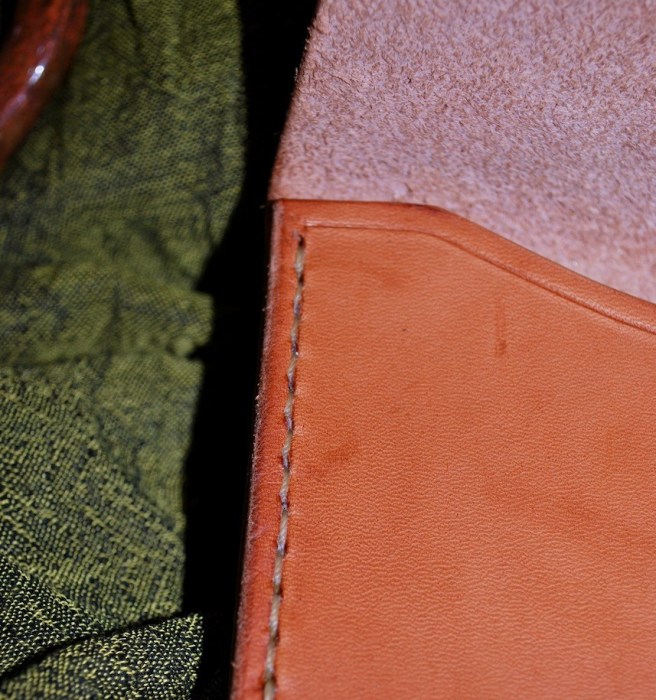
Hand stitching.

As always, the stitching is double-needle saddle-stitch for strength and hard-wearing.  If you are interested in this or similar goods, please check out our new Etsy shop at https://www.etsy.com/shop/LostWorldCrafts or just click the banner below.  We hope to have the site fully running and stocked with new goodies in the coming weeks.

lostworldcrafts


Sporran in Progress

I have been wanting to make a few sporrans based on the classic 18th century style.  This type, often referred to as a Rob Roy style, is a fairly simple, single pocket design that can have a number of variations.  The one I’m making here is from 6 oz full-grain hide and should outlive it’s owner, even under hard use.  A versatile belt pouch like this was originally intended to be worn with kilt or trousers as built-in tailored pockets are a rarity in history.

At 6.5 inches wide by 6 inches tall it can hold a fairly complete fire and survival kit in a handy position on almost any belt.

As with most of my leatherwork, this bag is hand sewn using a double-needle saddle stitch for strength and longevity.

The dye is wet in these photos, looking a bit uneven, so I’ll try to shoot a few more in better light when the weather improves.

The bellows design I chose stays flat but will expand to fit more gear as needed.  Look for a follow-up soon.  It is listed on my Etsy page so it will, hopefully, be finding a new owner in the near future.

https://www.etsy.com/shop/LostWorldCrafts

Bike Trekker – Allen Hastings Fry

Despite how much I like this photo, I have held off posting this image here because I couldn’t find any attribution or further information about this gentleman and his fine bicycle.  I came across it several years ago and stuck it in my image files until I could find out more; alas, I have not.

“Portrait of Allen Hastings Fry, with his photographic equipment strapped to his bicycle. An illustration taken from the magazine ‘The Professional Photographer”, June 1916.” (Thank you Patrick for the information and link).

My first interest was in the excellent baggage he’s carrying; a very modern looking frame bag, a tool roll or similar, nice front and rear bags, and what appears to be a wooden box along the top tube.  His haversack is not visible although the strap is in this image.  Any thoughts on the bike or image itself are welcome.

The rest?  Maybe you can tell me…

Click the card for more information about Allen Hastings Fry.

(UPDATE: Thanks for the corrections sent by Luc and Patrick.  Updates were made to reflect the new information.)

Early Car Campers

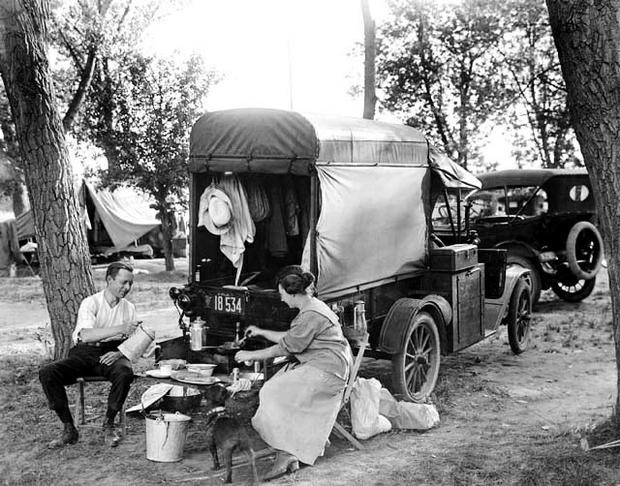
A little car camping in 1918. No attribution found.

In the heady days of 1918 while the German threat was being finished off in Europe Americans began to take leisure time in a new direction.  Automobiles were almost commonplace and Yankee ingenuity was applying itself to this new platform of creativity.  Patents were being filed to sell improvements on the original designs while pioneer camping technology was far from lost.  Money was tight for the average person and the economy was devastated world-wide encouraging frugal holidays.

There is a little stove on the pull-out, a hurricane lamp on the side shelf, and just enough of the comforts of home under the wagon cover to make for an easy vacation.

Romanian Gypsies

By Peter van Beek
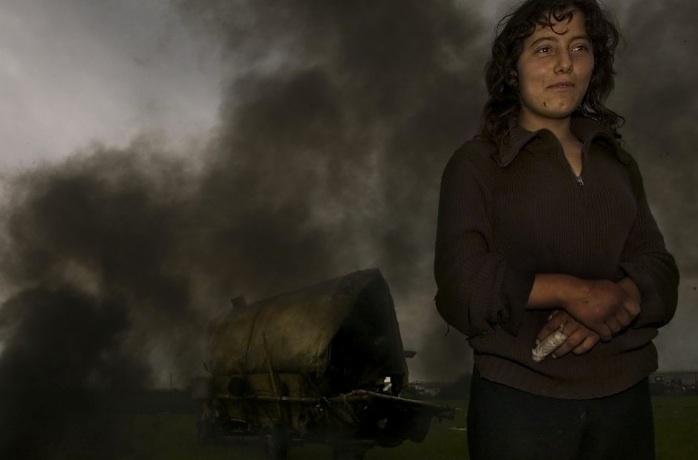
A mix of old and new technology.  Horse power on modern running gear.  Photo by Peter van Beek.  Click the image to view the photo album.

Peter van Beek has documented the difficult life of nomads in a modernizing Europe.  Fear, stereotypes, and unfamiliarity dominate their way of life and place them into a partially self-imposed, marginalized portion of society.  Although there is terrible poverty, he documents family life and survival of these remarkable people.

Untitled
Simple shelter as used by our ancestors since the beginning of time.
Untitled 2
It isn’t easy being a nomad in a modern technological world. There is easy place for this lifestyle.
Untitled 3
The world has changed but many traditions have not.


Untitled 4
There are certainly exceptions to nomadism. Many Romany cling to their traditions and morph them into a new lifestyle. All of our people have done this.

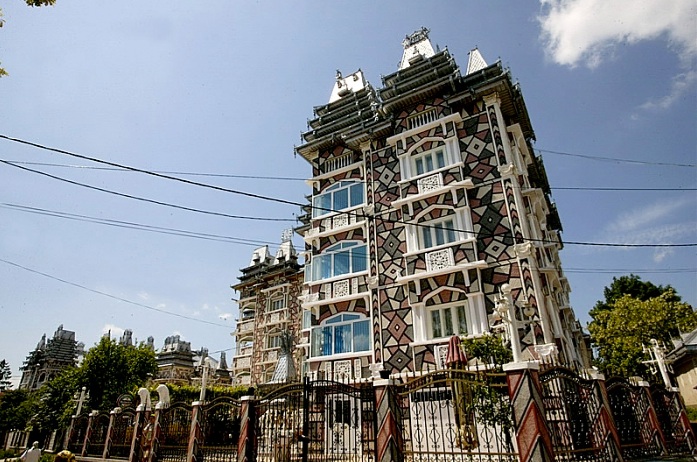
But it isn’t all oppressive poverty “By collecting and selling iron they get very rich and build their own village with huge palaces where they started living.”  While settling down, the community keeps it’s own unique sense of style.

Untitled 5
Hard work and some flexibility can make assimilation slightly easier.
Palace
Ethnic identity shows in this vernacular style.
Kalderash
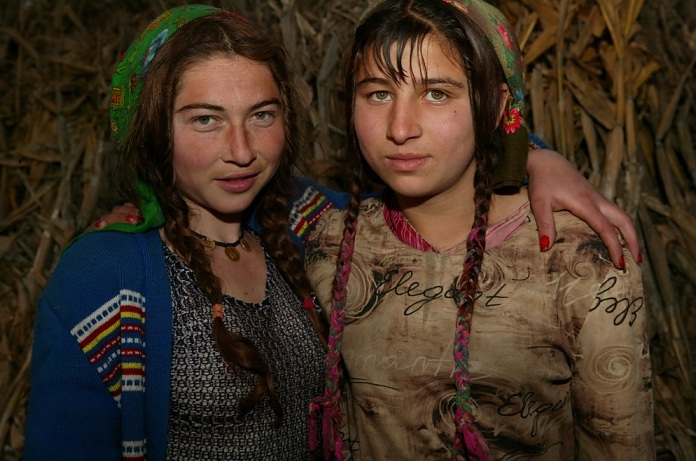
Beautiful young women with a foot in both worlds.

“Many Kaldarash people (the coppersmiths) still wear colorful clothes, living in a beautiful traditional way.  In some villages, time seems to stand still.”

From Peter van Beek’s website:

“The only nomadic gypsies in Europe live in Romania, the country that joined the European Union in 2007. Living a hard life in Romania these semi-nomadic people hold on to traditions and rituals. Amongst them are story-and fortunetellers, musicians and coppersmiths. Despite a law against nomadic life these gypsies still live in their harsh and remarkable way.”

Images found at Peter Van Beek Photography.  Check out his beautiful work and consider buying his book about the Roma:

140105_Metropolis_Roma_adv.indd

Campsite Life

Scenes of life on the road and around the campsites.

october-1951-mrs-robert-matthew-an-mps-wife-campaigning-at-a-gypsy-encampment
October 1951: Mrs Robert Matthew, an MP’s wife, campaigning at a gypsy encampment.
Kidsatthecampsite
Kids at the campsite.
landing
A classic image of Traveller children.
couple
Modern gypsies (Romany) in their simple accommodation.
caravanandbender
I really love these little bender tents.
Family Life
A fine caravan for a successful traveller.
This is part of a series of images, mostly Romany, Irish, and Scottish Travellers collected from around the internet.  Many of these historic images found on the web are without citation.  When a clear link to a source is found, I try to include it.  If a source is known, please pass it on and I will gladly include it or remove it if necessary.

Paris Travellers

Paris, around 1900.
Paris, around 1900.

A tiny accommodation, side entry single horse style.  It is documented that the adults with this style wagon generally slept outdoors except in very bad weather.  It was a good way to confine the children and the valuables.

This is part of a series of images, mostly Romany, Irish and Scottish Travellers collected from around the internet.  Many of these historic images found on the web are without citation.  When a clear link to a source is found, I try to include it.  If a source is known, please pass it on and I will gladly include it or remove it if necessary.

“The Travelling Tinker” by John Burr

The Travelling Tinker

A painting by the Scottish artist John Burr (1831-1893).  Tinkers were originally tinsmiths or “tinners”.  One of many itinerant jobs pursued by a class of casual laborers.  These were mostly skilled and specialized crafts like basket making, shoe repair, leather work, and metal work but many poorer workers were migrant farm labor picking hops and tending the market gardens during the peak harvest.  The fellow in the image above appears to be a fairly well-off repairman mending a seam in a pot.  This from a time when new items were a rare purchase.

I love deciphering images like this for the details of domestic life.  Unlike most photos, there is real intention in what the artist chose to include or not in the painting.  The house is clearly a poor one but a freshly killed chicken hangs from a nail on the wall by some dry roots.  A handmade broom leans against the wall next to a basket that has the tradesman’s coat lying across it.  The oldest daughter tends the infant while the mother stands by the laundry basin with a toddler behind.  All the children look on while the novel worker plies his trade in a waistcoat and hobnail walking shoes.

Wandering Minstral

A Wandering Minstral
A Wandering Minstrel

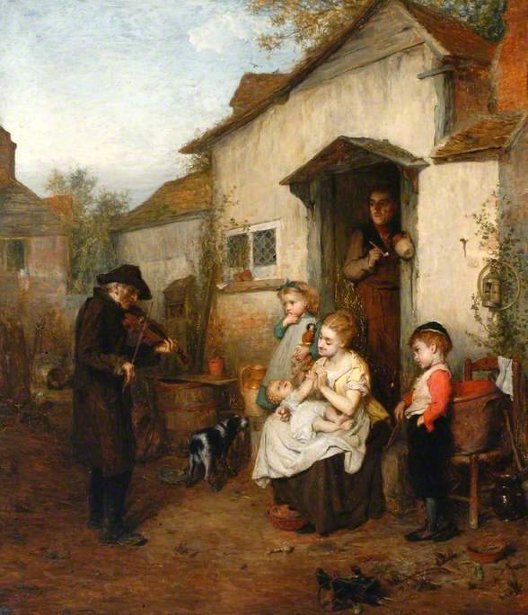
Here is a painting by the Scottish artist John Burr (1831-1893) of an itinerant fiddler playing for a family in a Scottish lane probably trying to make enough money to eat or maybe even receive some food for his entertainment.  I can’t help but think the father looking out has a skeptical look; possibly wondering what this will cost in the end.

Music and storytelling were a very different commodity in an age of widespread illiteracy and 24 hour media.  It’s hard to even imagine a time when all music was handmade and intimate and not an item to be mass marketed.