The Unlikely Banjoist

A post I’ve been hanging onto; a bit off-topic, personal, and possibly without any point.
Banjo
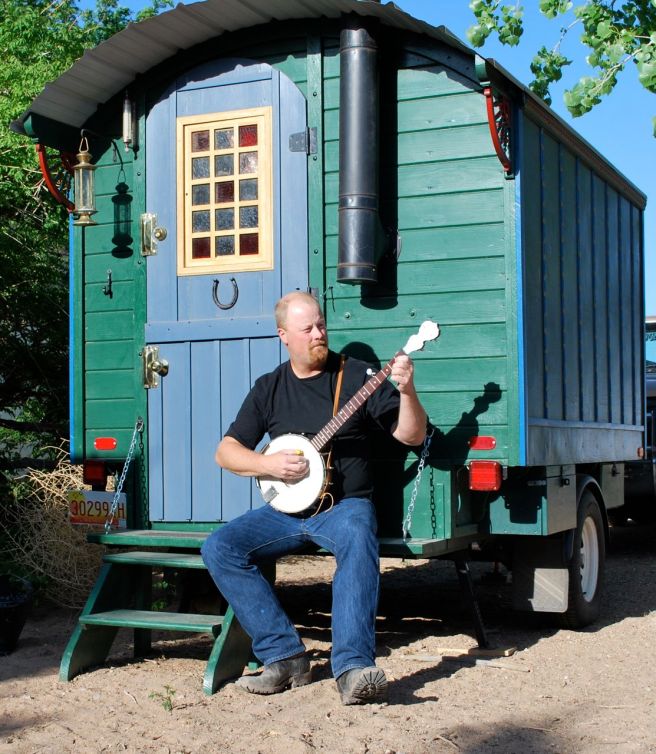
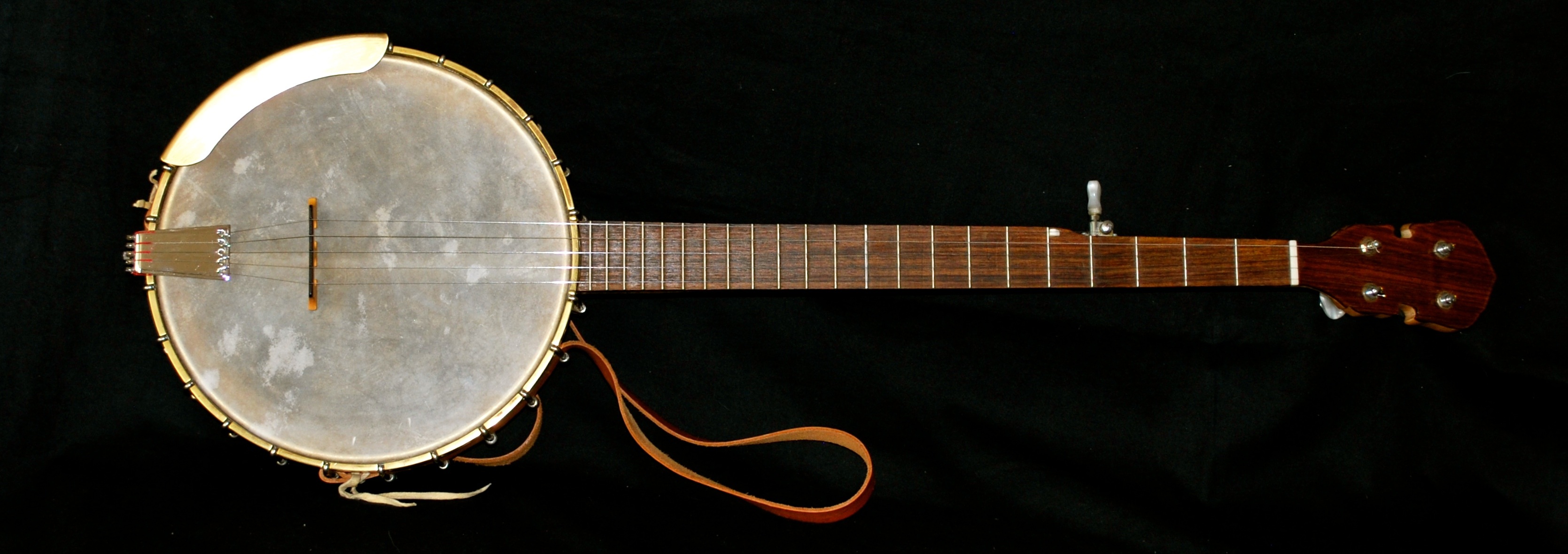
My most recent banjo polished up and fitted with a new calfskin head.

I am an unlikely banjoist.  I got a very cheap banjo when I was 14 years old but didn’t find a teacher.  I took a couple lessons from uninspired twenty-somethings but didn’t get much from them.  Fortunately, this didn’t stop me.   There was even a old neighborhood guy who offered some help but it turned out he only strummed a tenor-jazz-banjo.  He may as well have played a ukelele for all that it mattered to me. So I learned by listening and from the few books I could find that suited my interest.
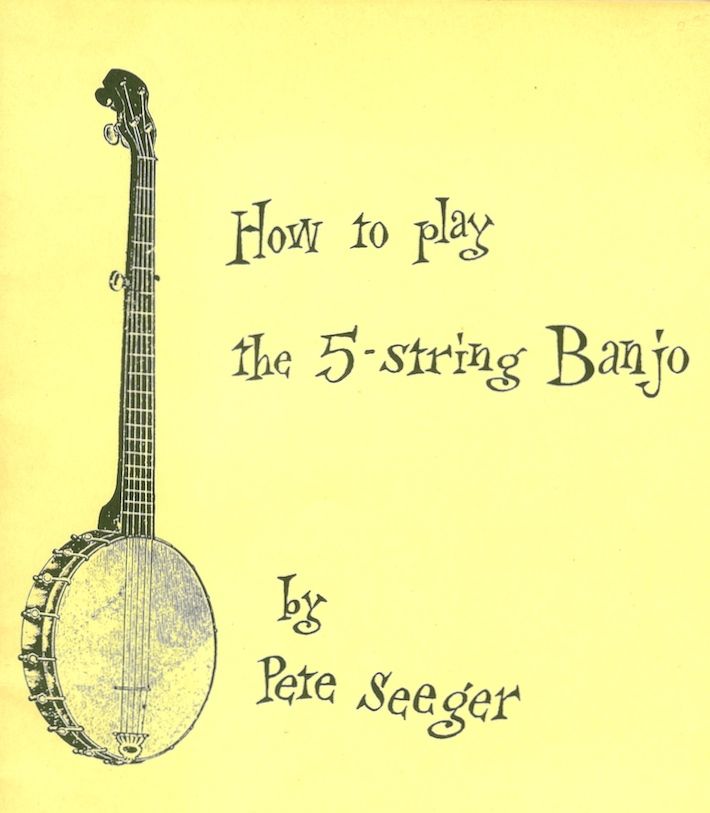
seeger_book_coverI don’t even know why I picked banjo particularly, but I did.  I was fortunate to be a latch-key kid from and early age, so when it wasn’t sports season, I cherished my solitary time after school.  I would often sit in the kitchen or on the back porch and plink around, playing old folk tunes.  I discovered Cecil Sharp and Francis Child and learned what I could about folksong of Western Europe and the British Isles.  I found this very old and diverse instrument adaptable to lots of styles of playing having found it’s way from 18th century plantation shacks to Victorian concert halls.

horn
My college instrument. Oh where are you now?

Coming from a classical music background helped.  My dark secret is the I spent three years in college as a music major.  I could read music and understood a little about musical structure so I spent time in the library digging through old folk music books and journals.  I never became great but good enough to not be ashamed to play in front of people and had about an hour-long proficient set of Irish, Scottish, Appalachian, and Ozark tunes in my repertoire.  Then life happened.  I gave it up (mostly) for over a decade while traveling and working like a dog and trying to be a good father but without playing an instrument, I think I lost a little of my identity.
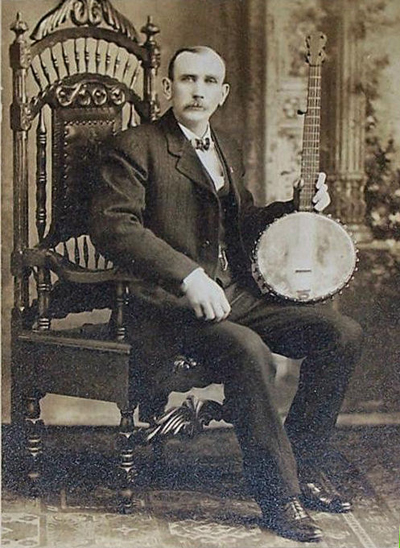
FancyChair-Large
From the era of the “classic banjo.”

So the short story is that I’m back.  Making time to do something I love has helped my mind immensely.  I’ll never be Tony Trischka, Earl Scruggs, or Bela Fleck, but at least I have some music back in my life.

DSC_0002
View of the backside to show off the beautiful maple figure.

For those few who may be interested in the technical details of this machine.  My most recent instrument is roughly a Vega design with a White-Lady tone ring.  The tension hoop and arm rest are plain brass and the head is genuine calfskin.  The neck sports a Mastertone-style peghead taken from the diagram in Earl Scruggs’ classic banjo book.  The fingerboard and peghead cover are cocobolo.  The tuners are scavenged off my first banjo and are Keith planetary-type except one.  The D string tuner is a replacement as someone actually stepped on my old neck and broke one!  The replacement is a 5-Star from Stewart-MacDonald’s lutherie shop.  These days I could get online and order one instantly, but back in the mythical pre-internet era this actually took some phone sleuthing.
Save

Romany Rai

Romano Rai (Romany Rye) (Traditional, English)

I’m a Romano Rai, just an old didikai,
I build all my temples beneath the blue sky,
I live in a tent and I don’t pay no rent,
and that’s why they call me the Romano Rai.

Didi-a-didi-a-didi-di-kai, chavves,
Tika-dika-tika-a-lai

Your Daddus tryin’ to sell a mush a kushto grai.
I’m a Romano rai, just an old didikai,
I live in a mansion beneath the blue sky,
I was born in a ditch, so I won’t ever grow rich,
But that’s why they call me the Romano Rai.

Tikka, tikka, didikai, tikka, tikka, didikai
That’s why they call him the Romano Rai

Tikka-tikka-didikai, tikka tikka, didikai,
That’s why they call him the Romani Rai.

I’m a Romano Rai, a true didikai,
My temple’s a mansion beneath the blue sky,
I’m a Romano Rai, a true didikai,
just campin’ around, on any ol’ ground,

But that’s why they call him the Romano Rai.


*Didikai is a term than Romanichal (British) call mixed-blood Romani.

Handcrafts

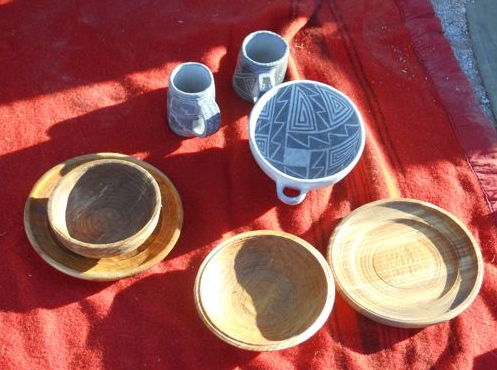
Some craftsmanship seen at Winter Count 2014.  Moving a little closer to a hand-made life, one skill at a time.

Ceramics by Roger Dorr, Woodwork by Mick Robins.

Hand made pottery made by artisans who collect the raw clays, slips, and paints make for greatly loved cookware and cups.  Wood turned on a foot-powered lathe from cleared alder trees make for intimate dinnerware.

Pots
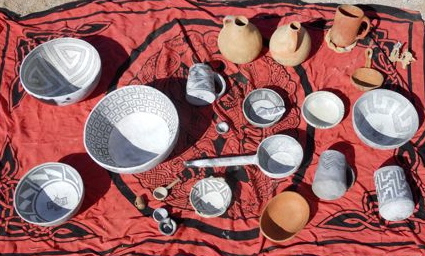
The wares of just one of the many great craftspeople associated with Backtracks and the Society of Primitive Technology.

Many cultures are represented at the gatherings but in the Southwest, the black-on-white ceramics dominate the fancy wares.

Packbasket
Packbasket

Packbaskets are found worldwide but only in small sectors of the western population.  This one is particularly beautiful.

Making a bowl by burning and scraping.
Making a bowl by burning and scraping.  Delicious ducks roasting in the background.

Even a simple bowl can be a satisfying accomplishment when it holds it’s first meal.

Fresh deer skins being turned into buckskin.

A lot of time and labor goes into dressing a fresh deer hide but the payoff is immense.  Buckskin clothing will last for many many years.

Perfectly tanned hides by "Digger".
Perfectly tanned hides by “Digger”.

Skilled artisans and craftsmen can make the best customers as they know and understand the care and effort that goes into a handcrafted project.

musicThe talent doesn’t end with the crafting of artifacts.  People who “Make” have skills that reach far beyond the world of modern consumption.  The primitive technology crowd brims over with artists and musicians of many types and genres.

More making, less taking.

Banjo redo

Last winter I had an important epiphany about myself as a musician.  I am under nor delusion that I will ever be more than a closet or campfire player.  For me, for now, that’s going to have to be good enough.  Although I love the fiddle more than any other instrument, I went back to my roots and picked up a Deering Good Time five string banjo a couple years back to see if I couldn’t revive my banjo playing.  I hadn’t really played much in over a decade but discovered that not only did the brain still remember some old tunes, but my big, beat-up fingers were actually still suited to it.  Ham-hands I’ve heard them called!

c-gt_100-150_large
Deering “Good Time” open backed 5-string banjo.

After playing the “Good Time” for a couple years, I felt I outgrew it as a player.  Don’t get me wrong, it’s a great instrument for the price (ca. $650), American-made, and travels well but I just wanted a little more substance and a thumpier traditional sound.  Not being able to afford anything fancy, and my playing not really being up to any professional par, spending a load of money I don’t have was out of the question.  It became apparent to me that it was time to make something better myself.  This isn’t quite as outlandish as it may seem as in my woodworking days in my early twenties, I made a couple banjos, a handful of mountain dulcimers, and some mandolin parts that were fair to partly decent instruments.  Anybody who knows me knows I hoard parts and hardware so fortunately I had a set of tuners, some fret wire, a tension ring, and a bracket set for a banjo (obviously the universe conspired for this to happen). For the rest, a quick trip through the Stewart-MacDonald catalog located the missing elements (e.g., a White Lady Vega-style tone ring, brass arm rest, bridge, and tailpiece, as well as a maple neck blank and rosewood fingerboard, and a calf-skin for the head).

Banjo3Unfortunately, time and energy were against me when I made the initial build last summer.  I was traveling and teaching for the university while working on this so I didn’t document the process.  So, I essentially built this one twice.  Once, to have something to play while traveling over the summer, then a rebuild in the fall to tweak the set-up and put a better finish on it (tung oil).  The photos don’t really do it justice here but hopefully, it gets the idea across.  Making an instrument is a doable thing.

Banjo1
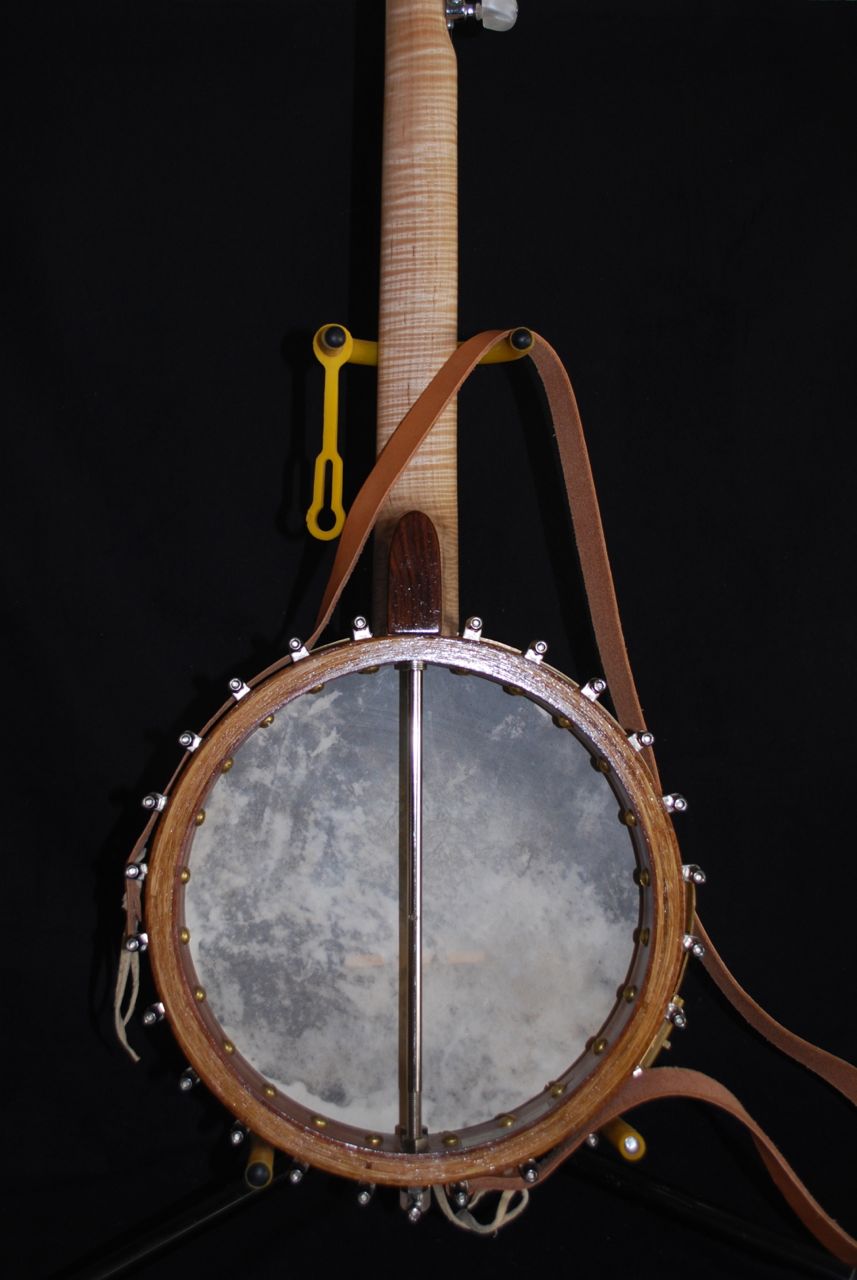
Banjo back to show construction. Steamed hoop comprised of three core layers of shagbark hickory with an inner and outer laminate of american black walnut. Neck made from a “flamed” piece of curly maple.

I won’t even attempt to describe the process and there are many better instrument makers who have done this before me (see the Foxfire books, Irving Sloane, Earl Scruggs and plenty of others).

Sloane
This book, and others, made instrument making an approachable thing for me 25-30 years ago.

To make a banjo, you essentially need a few, more-or-less mechanical parts, then find a way to attach them together in a fairly precise and meaningful way; that is to say a neck, complete with a fretted fingerboard and tuners, and a drum-headed hoop of some type.  Having some experience with steam bending, this part was not as intimidating as it might seem the first time around.  My choice for the body was a hickory core with walnut laminates for the outside.

Banjo4
Plain headstock. Rosewood head plate, fingerboard, and heel.

These pictures already show the six months of use and she already needs a good cleaning.  As can be seen though, there’s little ornamentation on the instrument; no inlay or bindings, just an octave marker on the side of the fingerboard.  I did steal the peghead design from Earl Scruggs’ book where he stole and printed the Mastertone design himself.  It was just too classic.

Banjo5
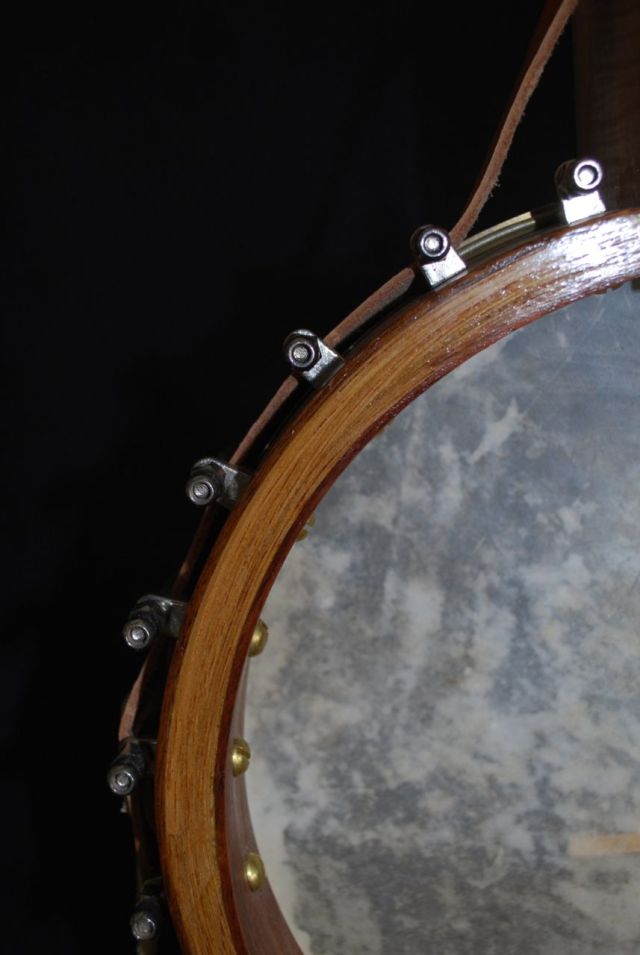
Rim detail to show laminae. Core (3) are hickory, outer and inner are walnut.

I had intended to veneer over the back but after completion, I liked the raw look that shows the construction.  Maybe I’ll change my mind about this later but for now, this is it. The calfskin head can be a finicky when traveling as it is affected by humidity.  Some players remedy this with a thin layer of spray-on silicone.  I may try this in the future just to see how it works.

Banjo6
This photo doesn’t do the maple justice. The Flame is very nice in the sunlight and has some real depth.

I rarely see a reason to hide a beautiful wood grain.

Banjo7
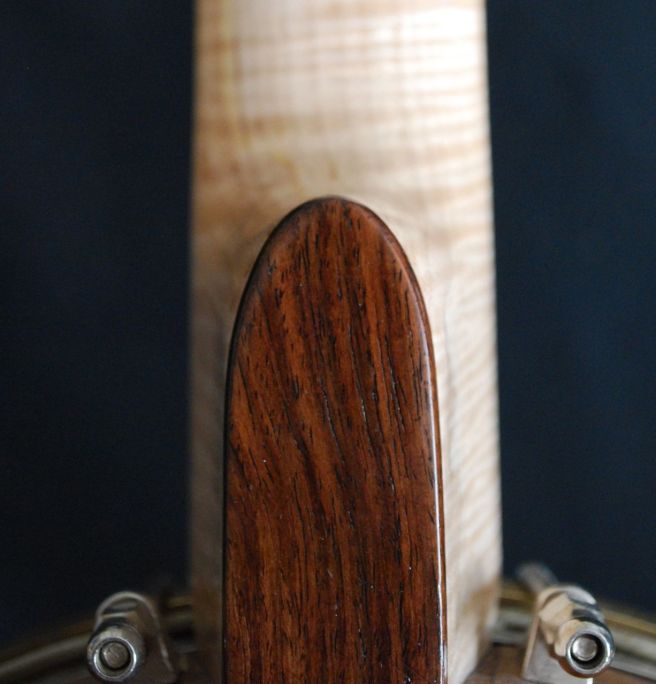
Rosewood heel cap made from a scrap. No necessary, but gives it a finished look.
DSC_0062
Detail of “the pot” as the body of a banjo is called. The walnut is s little bleached out in this image.

The components that make up the pot of the banjo are illustrated above.  From right to left: brass tension hoop, edge of the rawhide over wire, nickel-plated tone ring, tension brackets, and wood hoop.  the armrest is just visible in the lower right.

Banjo2

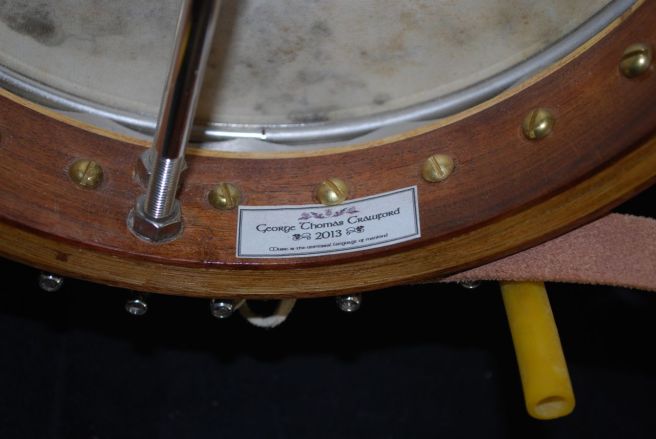
It’s remarkable how fast the weight adds up.  24 brackets, brass screws, tone ring, tension ring, tuners, and armrest make for some significant weight.  I think it’s a good idea for any artisan to sign their work, even if it’s never intended to sell.  This separates the hand-crafted from the mass-produced and show the care and the soul that goes into a hand-made work.

Now, time to practice.

So Long Earl

Thanks to spending so much time with my grandparents as a young child, Earl Scruggs has been a musical influence on me since before I can remember.  I loves seeing him and Lester Flatt on the Beverly Hillbillies and in my early teens, I wanted to learn to play like him.  I bought a very cheap (read junk) banjo and plugged away at it after school, annoying friends and roommates for the next decade and a half.  I never became a great player but still love to sit around and pluck the strings when I’m alone. I went off to college to become a classical musician but spent far more time strumming a banjo than studying or practicing my chosen instrument.

Click the image to go to the Earl Scruggs web page.

Very few people can affect a whole new sound and style of music and be emulated by so many musicians.  People like Earl Scruggs, Bill Monroe, and even John Hartford influenced so much music in ways many younger people wont even know and took virtuosity to a high and classic level.  I’ll pull out the Scruggs book I’ve been carrying around for 25 years and maybe try my hand at some American classical music tonight.

Enjoy one of the coolest banjo licks ever played.