Here’s another small project happening amidst all the “real work” that needs to get done during this quarantine.


I want to keep this one but after inquiries rolling in, it may go into the shop (or another just like it).
Be Safe!

Adventures of an Imperfect Man In Search of a Handmade Life

Here’s another small project happening amidst all the “real work” that needs to get done during this quarantine.
I want to keep this one but after inquiries rolling in, it may go into the shop (or another just like it).
Be Safe!
I’m sharing this little introduction to home distilling. If you’ve never thought about this before, it may be worth looking into. Enjoy!
The science of distillation has been around since 3000 BCE. There are four types of distillation: laboratory, industrial, herbal/perfumery, and food processing. These last two, herbal/perfumery and food processing, are the two we concern ourselves with today.
Distillation is a process of purifying liquids through controlled boiling and condensation. A liquid is converted into a gas/vapour through heat, and then recondensed through cooling to return the vapor to a liquid form.
You’ve probably seen an apparatus called a retort, or alembic, a glass container with a long, bent neck sloping downwards. As the substance heats up, the vapor travels down the neck and cools. A separate container catches the vapor as it returns to a liquid state. Figures III and VII below show two vessels that could be used to distill (1727).
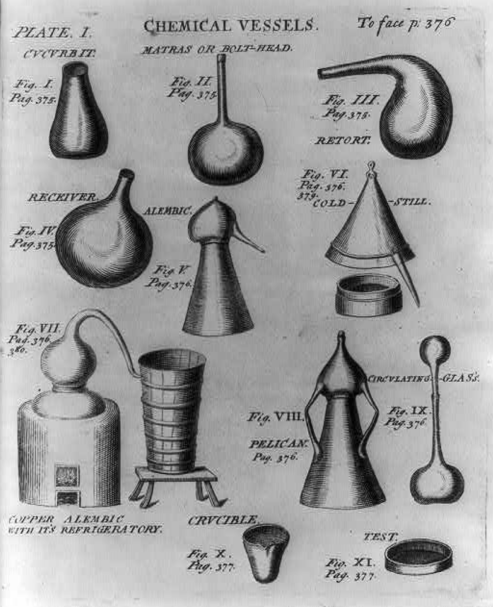 Fig. VII shows a distillation setup. 1727
As you can…
View original post 518 more words

 Preindustrial Craftsmanship