Finding “handedness” in archaeology… using the fletching of arrows as an example. As a professional archaeologist AND primitive technologist I am very skeptical when someone claims they can determine which hand of a maker is dominant on an ancient tool or weapon. One reason for the distrust is that the archaeologist may not have experienced creating the object in the same way the original maker did. I think the Leatherworking Reverend has a valid point in the following article (and not just because it affirms my own experiences).
At most find-sites that have arrows there will be a non-equal mix of S- and Z-wrap on the bindings. The dig report will assert that left-handed fletchers were responsible for those that aren’t the majority direction arrow binding, probably without mentioning whether it’s the Z- or S- that they are talking about. I can’t find where it was written down the first time, but it has been repeated until it became lore. Consider the Ötze website:
According to technical archaeologist Harm Paulsen, the two arrows could not have been fashioned by the same person. The fletching shows that one was wound by a left-hander and the other by a right-hander.
and the Mary Rose Trust:
Hopkins (1998) studied 408 shafts from chest 81A2582 (O9) and recorded that, in every case, the binding thread had been wound in a clockwise direction from the tip end of the shaftment (ie, the portion of the arrow…
Back to the beginnings. Larry Kinsella is a great flint knapper and an all-around talented guy who, amongst other things, recreates stone-age technologies from his home near Cahokia Mounds State Historic Site (one of the great cities of the prehistoric world) in Illinois.
A 6.35 kilogram (14 US pound) nodule of Burlington chert.
Back in 2008, Larry, prompted by Tim Baumann, created a great lithic experiment for a Missouri Archaeology Month poster.
On May 28th,2008, Larry received an e-mail from Dr. Tim Baumann:Larry, “I still need your help with the Missouri Archaeology Month Poster.The theme for 2008 is prehistoric lithic resources in Missouri. The back of the poster will have unmodified samples of chert and other lithic resources used by Native Americans in Missouri. I am working with Jack Ray and utilizing his new book on Ozarks lithic resources. Jack is also organizing the fall symposium on this same topic, which will be held on Saturday, Sept.27 at Meramec State Park in Sullivan, MO. If you would like to give a presentation at this event, please contact Jack.
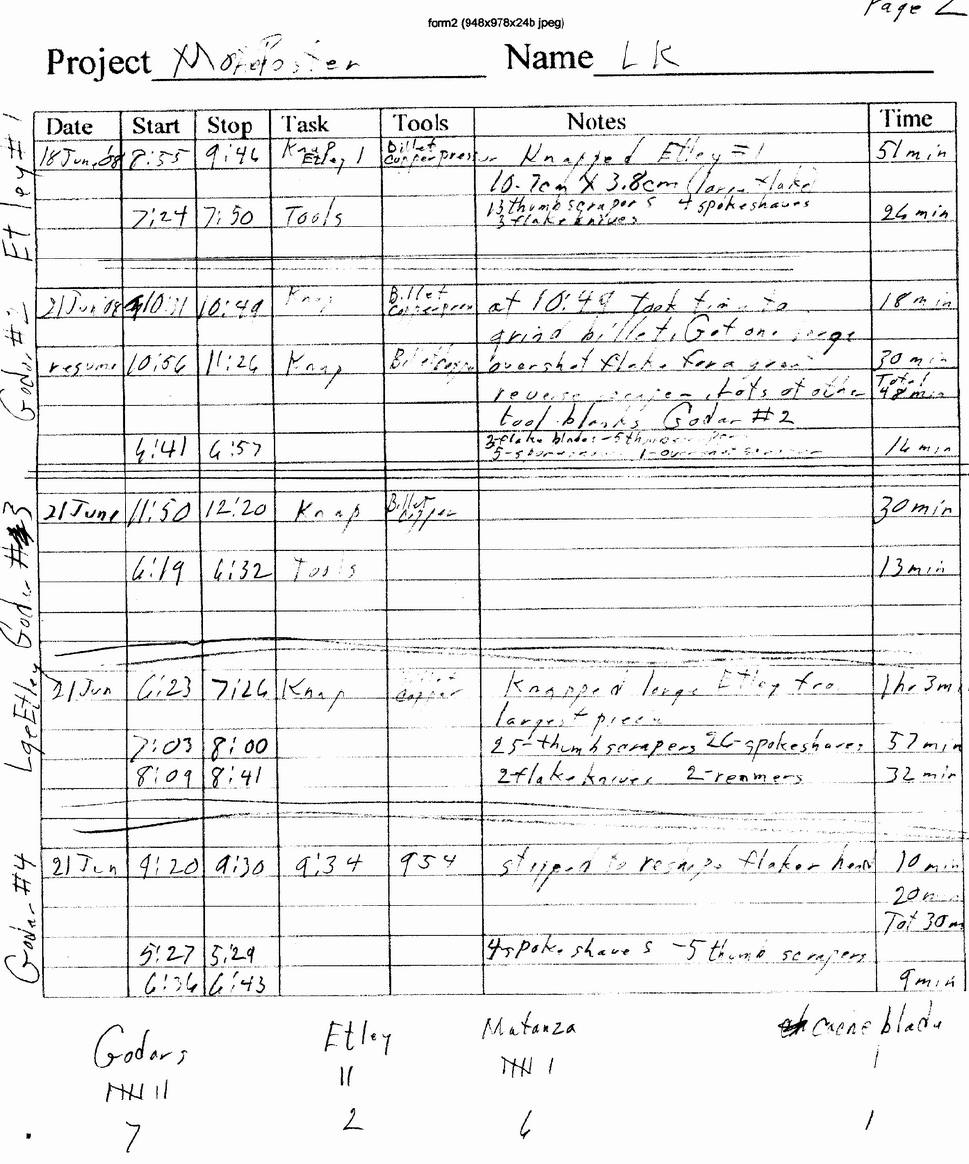
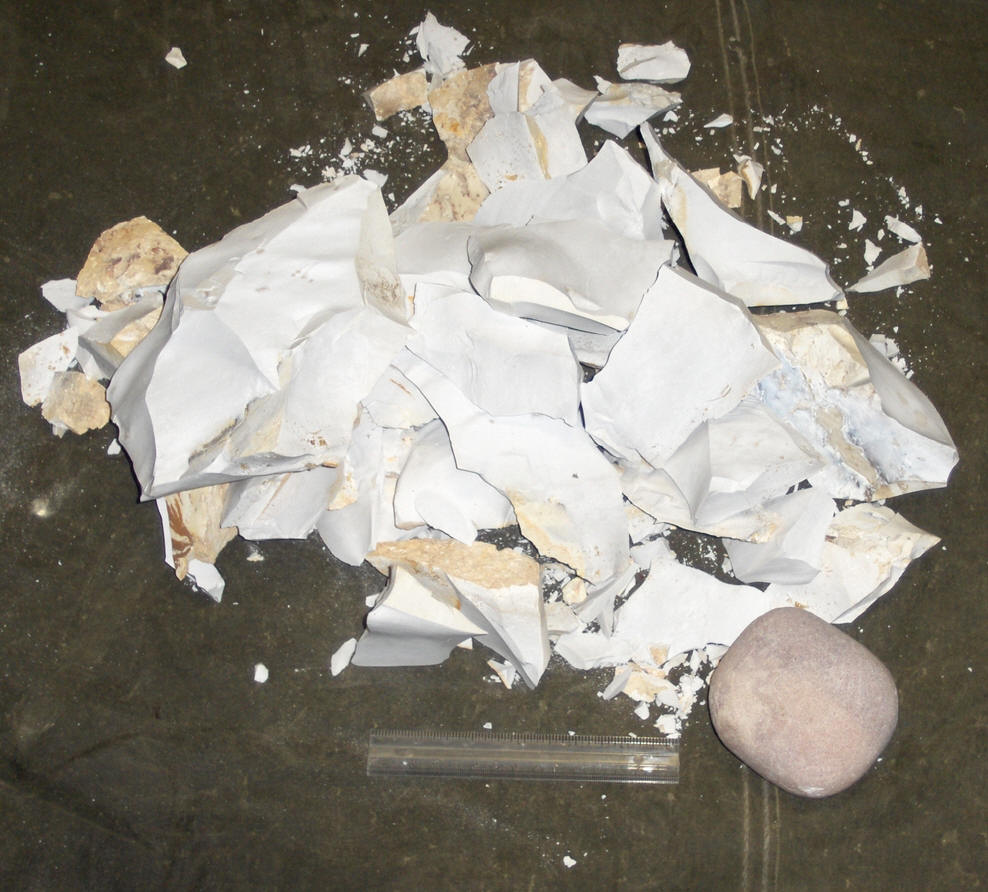
For the front of the poster, I would like to show the entire assemblage of lithic debitage and tools made from a single Burlington chert cobble or similar light colored chert. I was hoping that you and/or some of your friends at the Devil’s hole knap-in would be willing to supply the raw material and muscle to create this assemblage. I will then take the debitage and tools and arrange them with a computer design program into a spiral pattern with a background of obsidian or another dark colored lithic source.”Since this original contact, a few things were changed. Pete Bostrom was asked to do the layout and photography, for one.As with any project, unexpected hurdles arise and it’s up to the participants to modify their strategies and adapt to those hurdles.First: After Larry blanked out the nodule, it became apparent that he was producing much more debitage and many more tools than he had anticipated. That’s when he decided to stick with only a Late Archaic Assemblage. The wide variability in point sizes, shapes, and chert, along with the occurrence of many different types of chert tools, during the Late Archaic, seemed to gravitate toward that time period. Also, the tools could have been heat-treated if the stone had not worked as well as it did.Second: It also became apparent that this project presented a unique opportunity to try to understand the amount of material needed to produce certain point types. So, after the initial photograph of the raw nodule was taken by Pete Bostrom, and at the suggestion of Dr. Baumann, Larry saved all debitage, from all the point-making attempts, separately. This provided the opportunity to not only see what type of point could be made from a single spall but also, the other tools could be isolated to their specific spalls.Third:The sheer amount of material produced during the project, presented Pete Bostrom with problems too. How could he possibly display all that material and make it interesting to the general public? After all, that’s what the poster’s supposed to do, get the general public interested in archaeology.So:1) It was decided to keep all debitage, from each spall, separate.2) Keep separate notes and times on each spall using Larry’s pre-printed forms. Like this: 3) Photograph the resulting point types with their debitage.4) Use the debitage from each point to make additional tools.5) Photograph each point type, its additional tools, and debitage, together.6) Screen all debitage, from each spall, through window screen, to determine how much chert grit would have been available to do core-drilling for other projects, such as, drilling bannerstones.7) Weigh all materials. (Dr. Bauman weighed all the material, in Larry’s absence, due to surgery).8) Present Pete Bostrom with all the material so he could lay out and take the photographs for the poster.9) Present the photos to the printer so the posters could be made.Initial reduction from core to useful materials.
After reduction, each piece took it own trajectory and became a projectile point, other tool, or was cast away as debitage. Students of archaeology (and some professionals I know) can learn much from this type of experiment by examining the range and number of flaking debris generated in a single reduction episode.
After Pete received the materials, he created this excellent poster which is a remarkable work of art in its own right. Have a look at Larry’s pages explaining the process and learn something of the universal human technology that put us, for better or worse, in the place we are today.

Finding “handedness” in archaeology… using the fletching of arrows as an example. As a professional archaeologist AND primitive technologist I am very skeptical when someone claims they can determine which hand of a maker is dominant on an ancient tool or weapon. One reason for the distrust is that the archaeologist may not have experienced creating the object in the same way the original maker did. I think the Leatherworking Reverend has a valid point in the following article (and not just because it affirms my own experiences).



 Preindustrial Craftsmanship