“There never yet was, and never will be, a nation permanently great, consisting, for the greater part, of wretched and miserable families.”
William Cobbett, Cottage Economy 1833 (3).
Adventures of an Imperfect Man In Search of a Handmade Life

“There never yet was, and never will be, a nation permanently great, consisting, for the greater part, of wretched and miserable families.”
William Cobbett, Cottage Economy 1833 (3).
Sitting on the couch late in the evening, drowsiness coming on when a nearby gunshot pierces the air. The dogs go on alert and I am up on my feet. Probably neighbor poachers, but I need to have a look around anyway. My nearest neighbor is more than half mile away. The road is several hundred yards from the house, so I don’t get a lot of extraneous noise. Walking out onto the front porch I see the lights from three police cars lined up along the highway about 100 yards apart. Spotlights and flashlights were scanning the area, both toward and away from me. Weird stuff happens and I seem to be a magnet for crazy so my first thought was some sort of manhunt. Very awake now, I drive up the driveway toward the police. It would normally be a walk but I didn’t think it wise to come out of the dark toward a bunch of cops in the grass.
Luckily, I was completely wrong. It turned out that two cars traveling in the same direction simultaneously hit two bucks crossing the highway. The gunshot I heard was an injured buck being put down. The spotlights and police were looking for other possible injured deer. When I got to the road, one of the officers recognized me and said the magic words, “would you like one of these deer?” The only right answer is “hell yes, let me get a knife.” I was tired, it was late, but even a damaged deer is a gift of food.
I don’t like to butcher beat up meat. And this was the first road kill I did on my own. A cleanly killed animal is much easier to disassemble as you don’t have to work around bruising and broken bones. That stuff is edible but not very good. Survival food only for me.
However, dogs aren’t picky. They like it nasty. Good dog food is expensive so I decided to harvest as much meat that I couldn’t butcher cleanly into stew meat for the dogs. They love me.
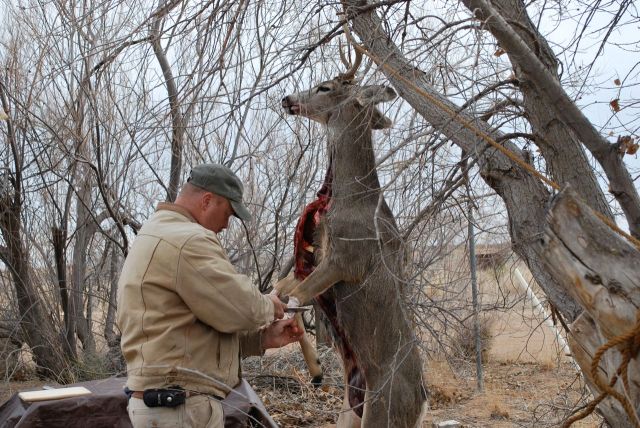
Now the bad part was that I had to work my day job and the light is still a bit short this time of year. I worked as I could, letting the carcass hang about 15 hours before butchering. In the end, we maybe got 30 good pounds of human food including two beautiful tenderloins, a few small roasts, and a lot of stew meat. As a bonus, the hide was in excellent condition and I was able to pull it off with only a few small cuts at the neck, legs, and tail. Although not large, the antlers are beautiful so I sawed off the top of the skull to deal with them later.
I am of the school of thought that it is everyone’s right to make his or her best effort to feed themselves and family. Due to many reasons, including the stupid human factor, this needs to be regulated in the modern world. This makes it difficult to hunt, especially in places like New Mexico with less than easy hunting regulations. After living on either home-grown cow or wild game for quite some time, the last few years have been a let down, having to buy commercial meat. I’ve seen the feed lots and I don’t want to contribute to those companies any more. Luckily, some free food came our way last week.
The winds slowed, the killer dust settled and I was able to get back to the bow. A few minutes with the power planer took the rough shape down to a nearly finished product. The calipers are useful and can save a lot of guesswork when making the same style bow over and over.

Above, the bow seen in its near-final form.
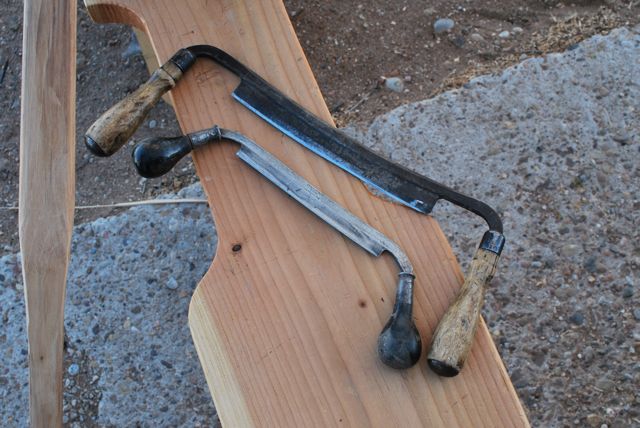
Despite the great labor savings that come from the power tools, wood is very organic and has character therefore need some finer, more controllable tools. These are the two draw knives I use the most.
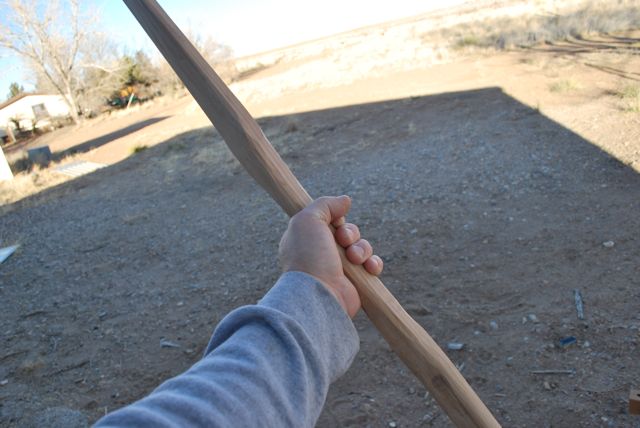
I took the limbs down til there was some little flexibility. Probably in the 100 pound range but still too sketchy to put a string on. As the day was drawing late I decided to rough out the grip and central riser area. Surprisingly, this takes quite a bit of time as it needs to fit the hand well, and look pleasing. It is difficult to get it “just right” in all dimensions as a tiny variance takes away from the symmetry of the piece. This part is purely about looks.
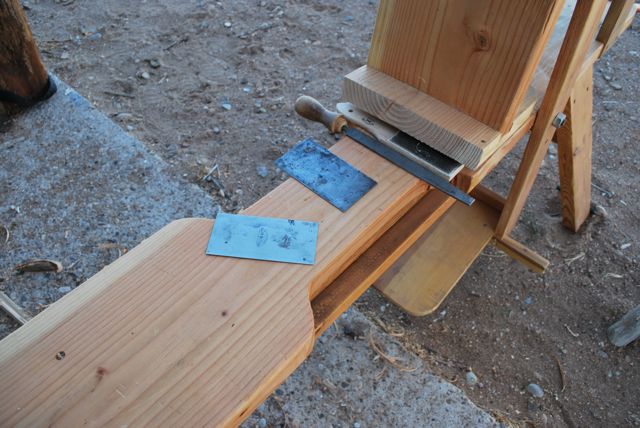
Once the knife work is done, its time to move to the cabinet scraper. Here are the two I use. To keep a good sharp edge I switch between the two as one dulls. The larger one is a standard Stanley cabinet scraper and the smaller is a Garlick of England. The English one is much harder steel but more difficult to get a good edge when sharpening. With them are the bastard file and file brush used to touch up the edge.

I hope to find time for the finish tillering sometime this week.
I received an advance copy of Tiny Homes: Simple Shelter when I went to my post office box today. I have been thumbing through it all all evening, looking at the photos and pondering the meaning of Shelter.
 Maybe the tides of change are subtle in the beginning. But I never thought I would be part of a movement when I began to sketch out plans for a tiny, mobile shelter for myself almost ten years ago. I am honored to be included amongst these great constructions in Lloyd Khan’s newest book about Tiny Homes. I am awed and inspired by so many great approaches to scaling back from the obnoxious sprawling but soulless houses of the last few decades.
The photos are beautiful and the layout is very well thought out. Like all the Shelter Publications, it will become an important and classic work to those of us outside the mainstream. Tiny Houses my be the flavor of the month to the media at the moment but will always be important to real people in need of real shelter.
And to keep up-to-date on interesting architecture, skateboarding, good music, and a host of other interesting topics, check in to Lloyd’s Blog from time-to-time.
My appreciation for house trucks has grown immensely over the years. It’s not easy building a structure that is both light, strong, and wind-resistant. Caravans, house trucks, and RVs have to undergo the rigors of hurricane weather every time they hit the road and still be light enough to be pulled. If you are willing to get RV-type mileage from your vehicle you can convert an older RV, large truck, fire engine, or bus into a fine living platform. Starting from a link on Lloyd’ Blog I began looking at some very cool house truck conversions. These have been around all my life and I’m surprised I haven’t started one yet.

These Bedford Fire Engines make beautiful platforms.
The trucks below were featured on the Tiny House Talk web page.

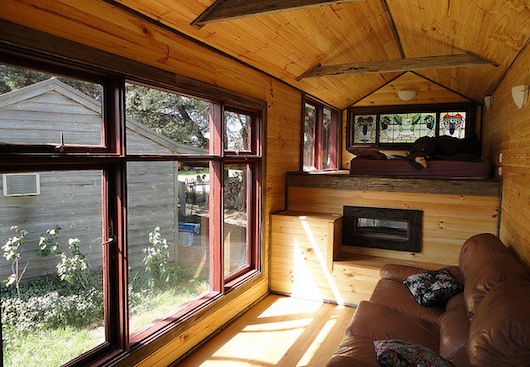 I wouldn’t want to drive these in high winds but the interior spaces are great. Visit his Flikr page to see more interesting work. They look very practical and I appreciate the low-maintenance exteriors.
And finally, one of the most beautiful art car builds I have ever seen… The Decoliner. While on his website, its worth looking at his other projects as well, especiall the 1800 cubic inch, 1000 h.p. tank motor turned art/race car.
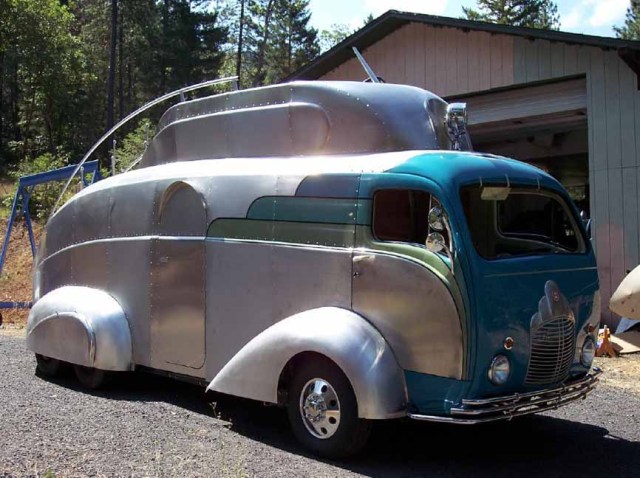
 Take the chassis from an old RV, add a classic truck cab and a lot of beautiful design work and this is what can happen. This is my new dream car. Time to peruse Craig’s List to start looking for a chassis.
Determined to get the pattern right once-and-for-all I have been slaving away on a new pair of shoes. As a matter of fact, I think these shoes are completely slave-labor-free. The leather upper and mid-sole are oak tanned leather (Hermann Oak), and the rubber soles were cut from SoleFlex sheeting. The laces were made from brain-tanned elk hide I processed myself.

The gent’s shoe as worn.
 Outside heel stiffener.
 Trousers cuffed to show height of shoe. I live where the plants are unfriendly to bare skin.
The pattern was created without a last based on previous turn-shoes and a mock-up done in heavy canvas. The shoe has no heel or shank as I am very used to walking barefoot or in sandals and moccasins. A little more on shoes I have made here at: Footwear. And some other leather work here.
 Preindustrial Craftsmanship