I like to add a little character and variety, even if I’m just making the same thing again and again. I want to believe that this is what my ancestors would have done, toiling away in the craft to make a living. It keeps things interesting and more human than the soulless, mass-produced consumables.
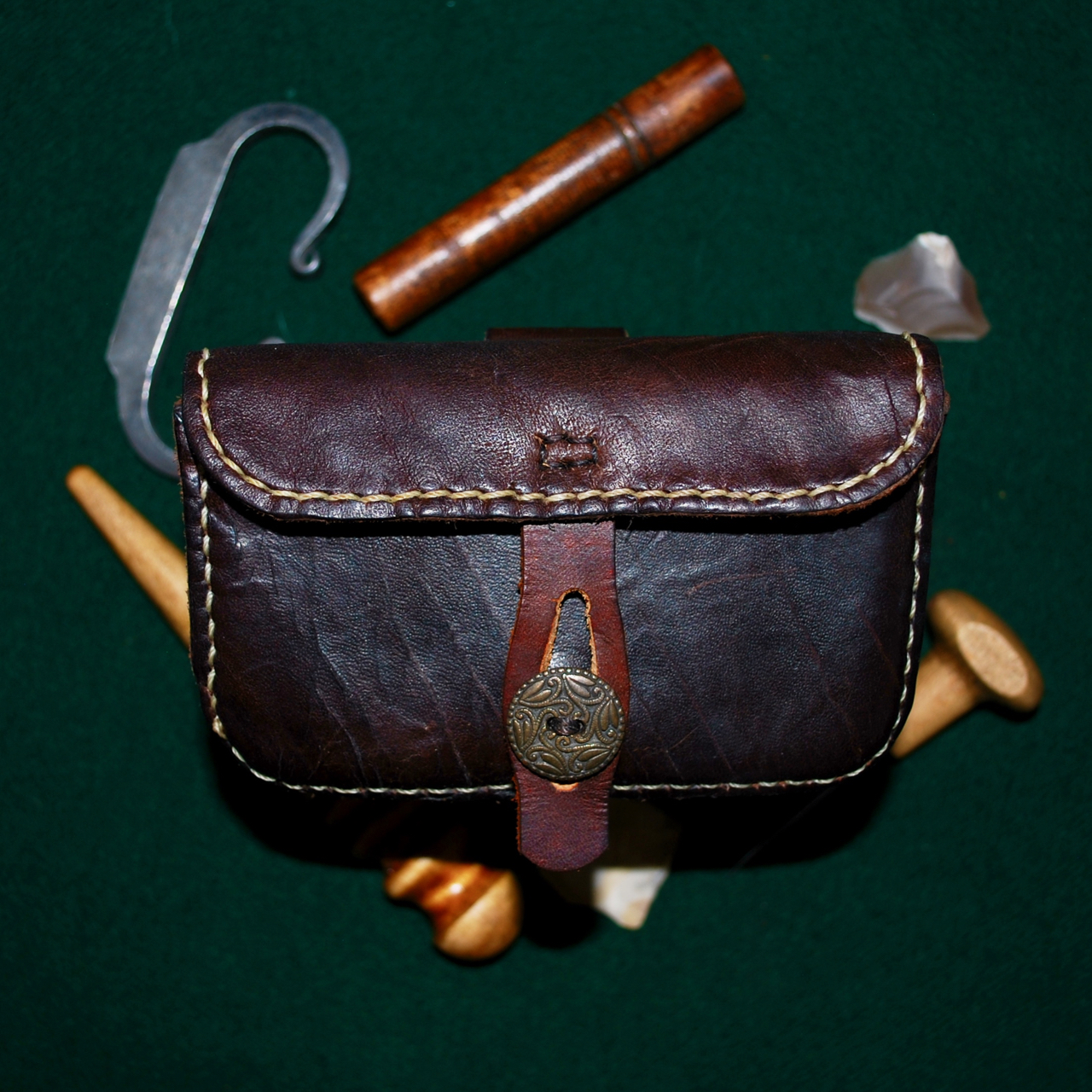
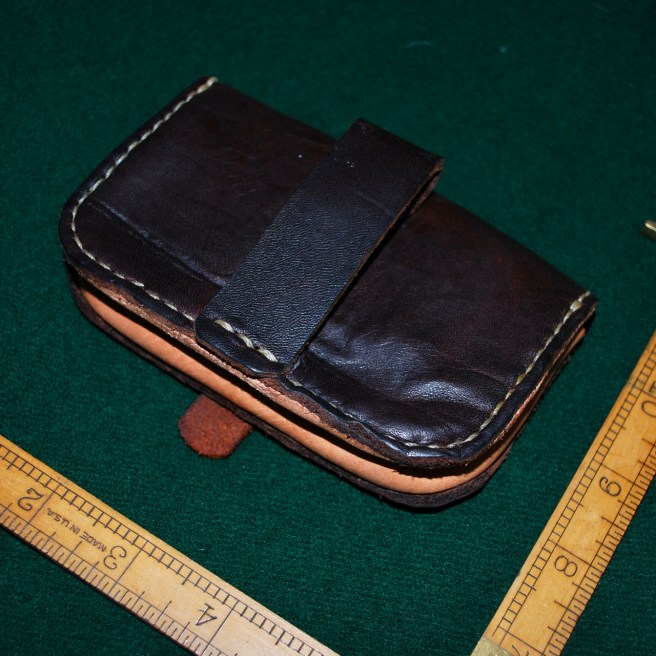
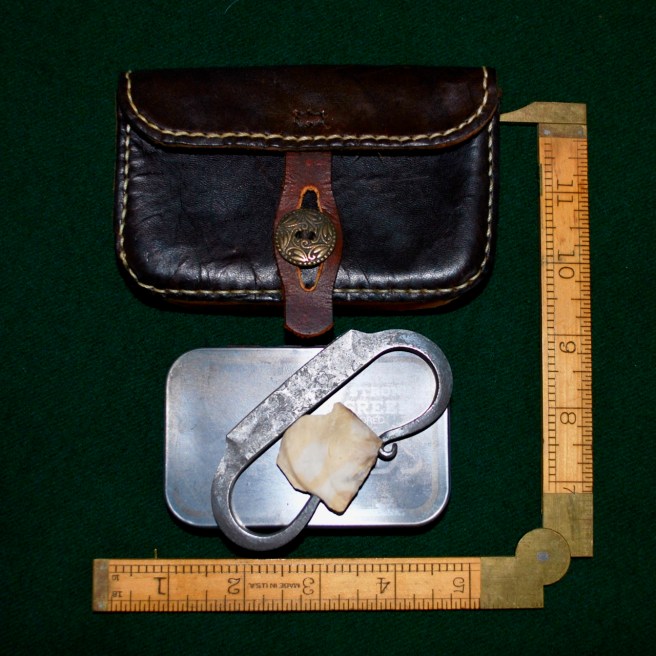
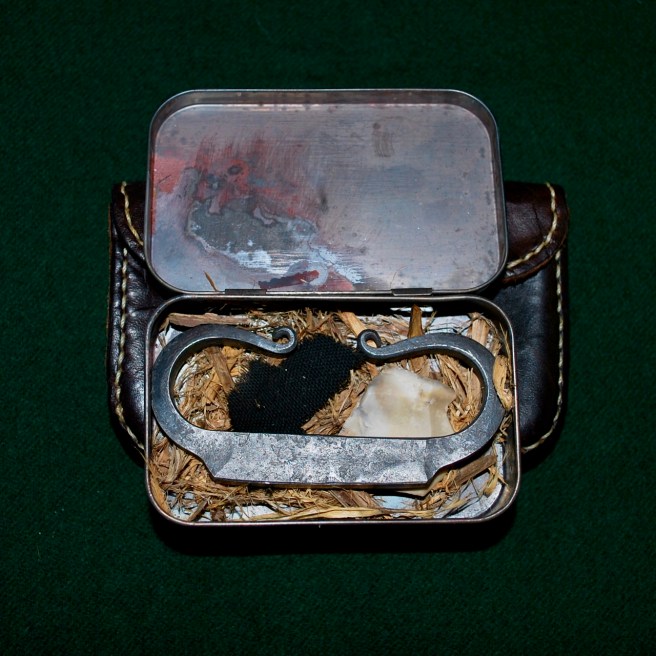
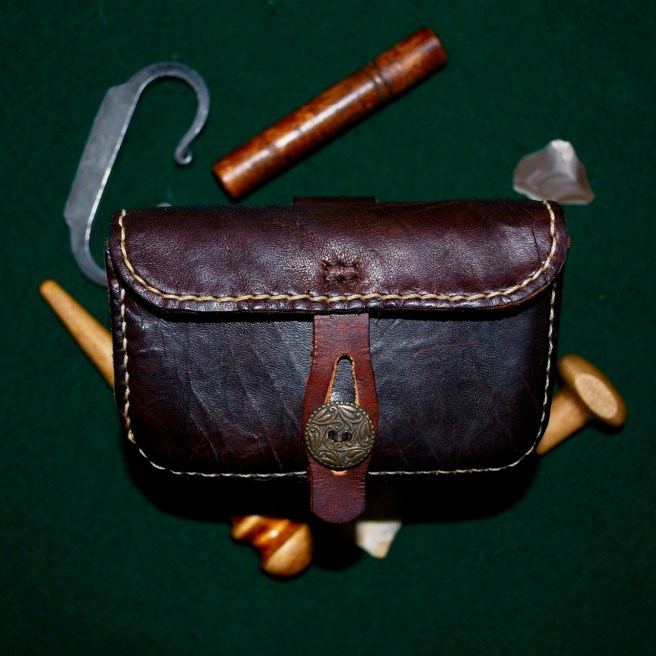
Here’s the most recent fire-kit with another beautiful vintage button. This will be sold through the Etsy shop at LostWorldCrafts: https://www.etsy.com/shop/LostWorldCraftsMade from 7 oz. Hermann Oak leather drum-dyed for the brown part and natural for gusset.
Thanks for looking. If you are interested, these generally don’t last a day on Etsy so check it out soon if you want one. Please follow the shop if you would like to keep up with the latest offerings.
I know this year has been very strange for most of us but please remember…
Life is Short. If you’re fortunate enough to live with the means and privilege and food security, consider yourself lucky. When I feel low or unhappy, I always want to remember the people subjected to abject poverty worldwide through no fault of their own. It seems that the privileged, the comfortable, and those with the least to complain about are the most vocal and judgmental and superior. Please, be kind.
One final paragraph of advice: […] It is not enough to fight for the land; it is even more important to enjoy it. While you can. While it’s still here. So get out there and hunt and fish and mess around with your friends, ramble out yonder and explore the forests, climb the mountains, bag the peaks, run the rivers, breathe deep of that yet sweet and lucid air, sit quietly for a while and contemplate the precious stillness, the lovely, mysterious, and awesome space. Enjoy yourselves, keep your brain in your head and your head firmly attached to the body, the body active and alive, and I promise you this much; I promise you this one sweet victory over our enemies, over those desk-bound men and women with their hearts in a safe deposit box, and their eyes hypnotized by desk calculators. I promise you this; You will outlive the bastards. Edward Abbey
“Edward Abbey from a speech to environmentalists published in High Country News, (24 September 1976), under the title “Joy, Shipmates, Joy!””
The Tobasco Donkeys, a little known musical group working at the Philmont Scout Ranch recorded a song using Abbey’s words in one of the verses. It fits well.
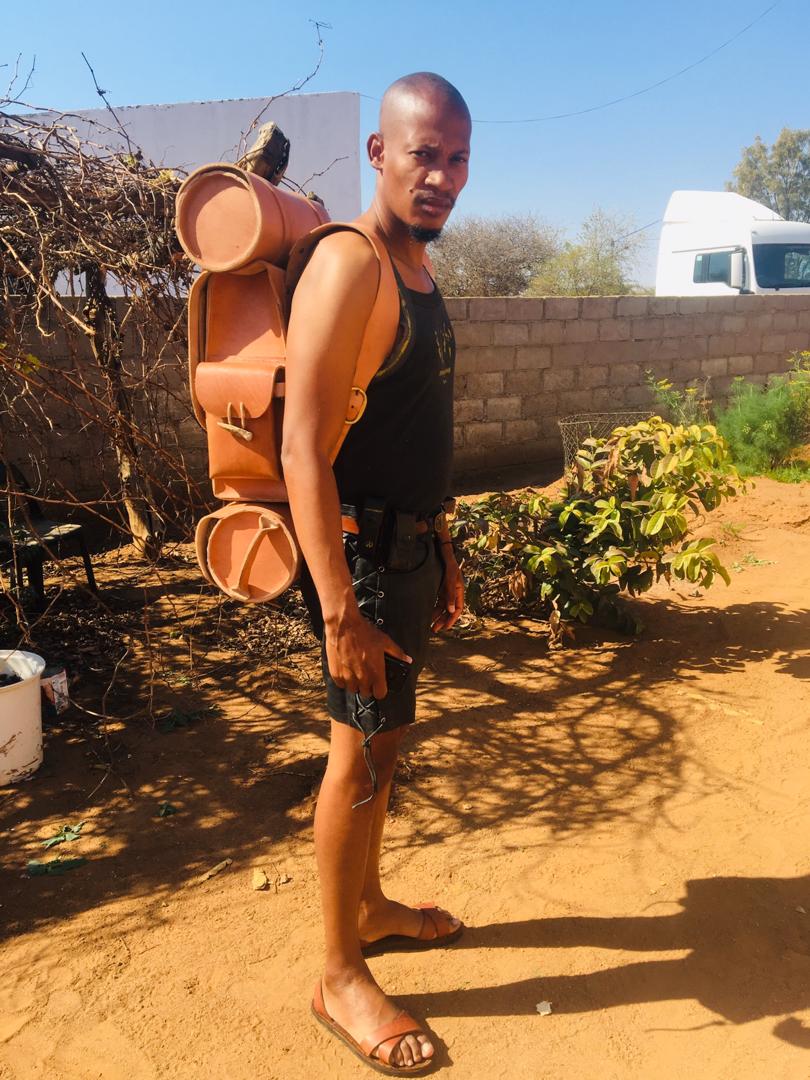
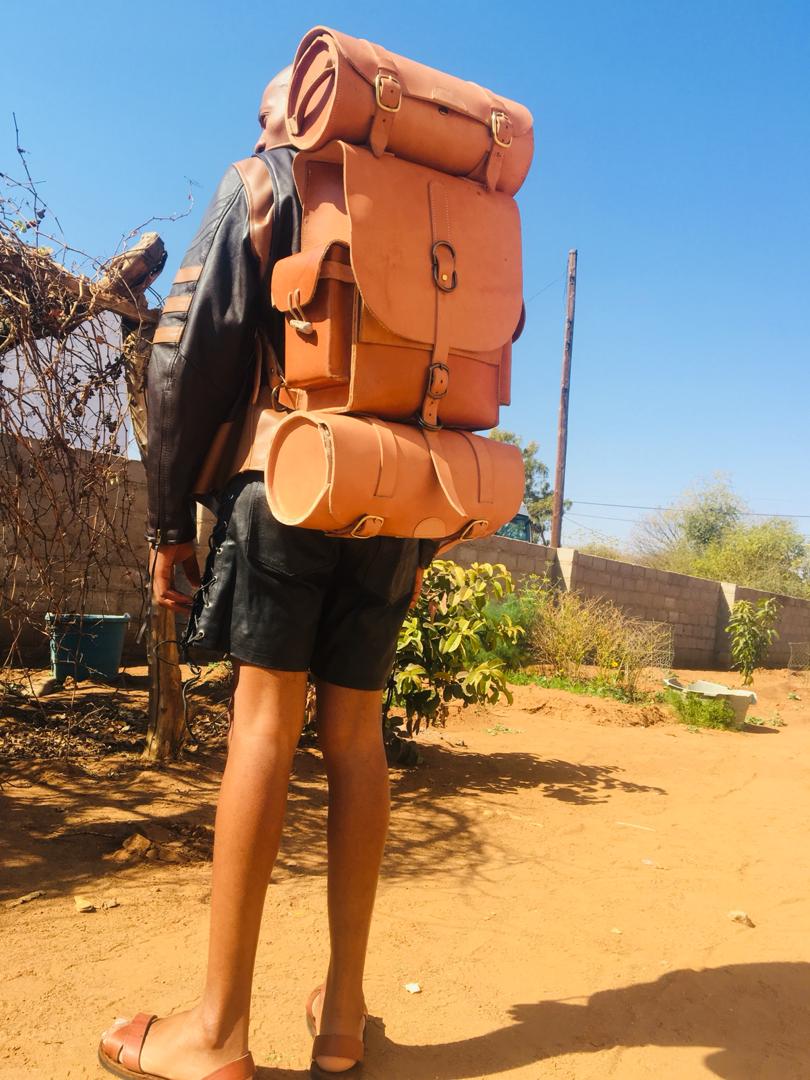
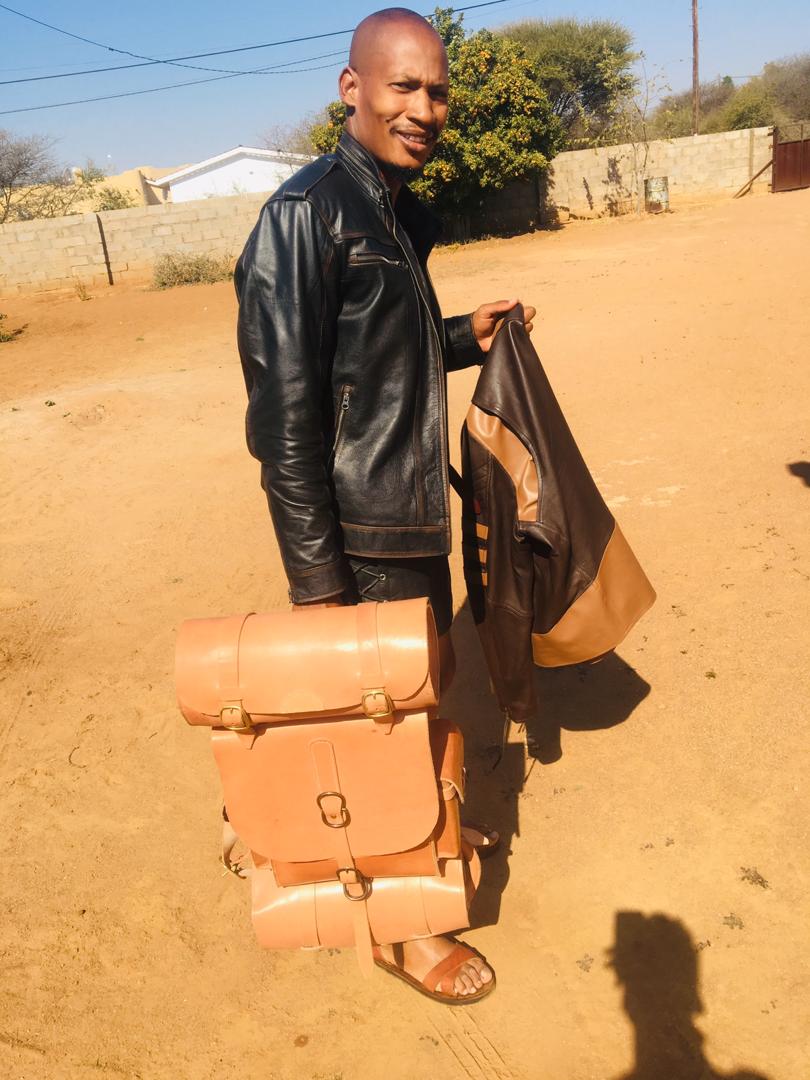
One of the better things about modern communication is the ability to meet and talk to people from nearly all parts of the globe. I have been in communication with Jacob from Botswana for years now and he has shared some photos of the beautiful backpack he made based on my earlier design. That one now resides in Montana and I hope serves some function for its owner. My personal pack has since been replaced by this one and is my new favorite piece of gear. But enough about me.
Right now, according to Google Maps, I am about 13,670 km (8,494 mi) from central Botswana and am unlikely to ever make it there, though not for lack of wanting to. However, the internet allowed us to connect across a vast distance in space and share ideas with strangers who have common interests.
Anyway, here is Jacob’s very own leather rucksack and the two portmanteaus inspired by this post to carry his gear into the bush of southern Africa. I suspect a backpack like this will outlive us all and become a fine heirloom to pass on to the next generation. Thank you so much for sharing these Jacob. I hope it serves you well for many years.
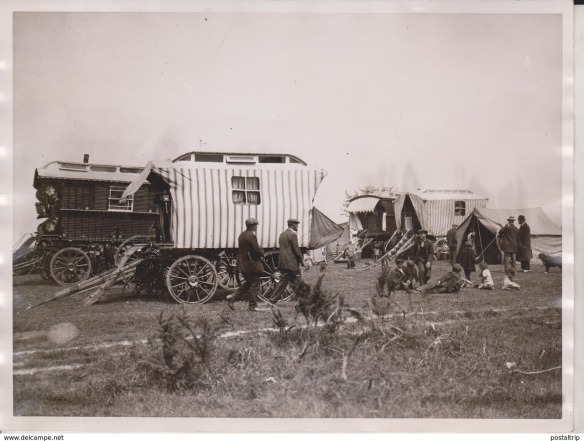
During the heyday of Caravan living it is important to remember that these were rarely the dwelling of a loner. The Caravan was the hub of the nuclear family and groups of wagons represented larger, extended family groups and allies.
Every traveler has a campfire has the center of daily life. The hearth has been our home for 1.5 – 2 million years now. No wonder it fascinates us and brings so much comfort.
Nomads in a stationary culture are often tolerated at best and left only marginal space to congregate. This will probably never change.
These high-end vardos with fancy covers are probably “gentlemen travelers,” the antecedents to modern RVers.
Yes, I know that Traveller has two Ls in our title but since we’re looking at Britain and the Continent that’s how we’re spelling it.
Here’s another small project happening amidst all the “real work” that needs to get done during this quarantine.
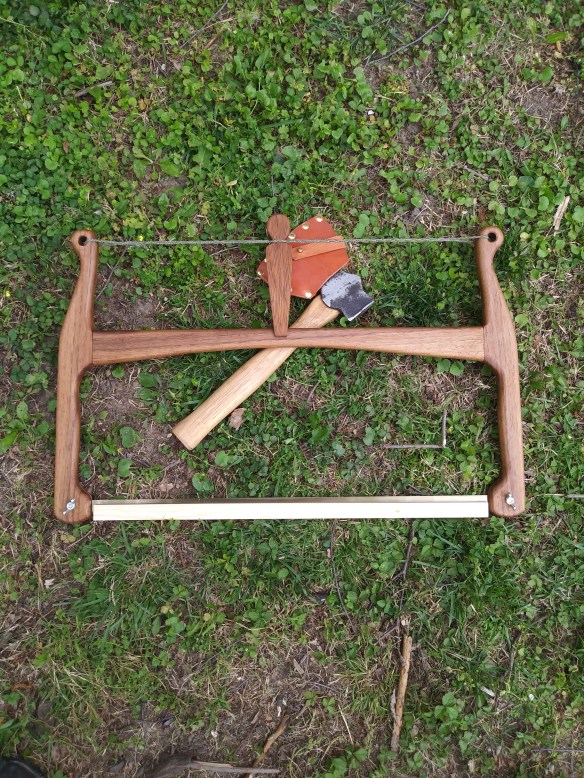
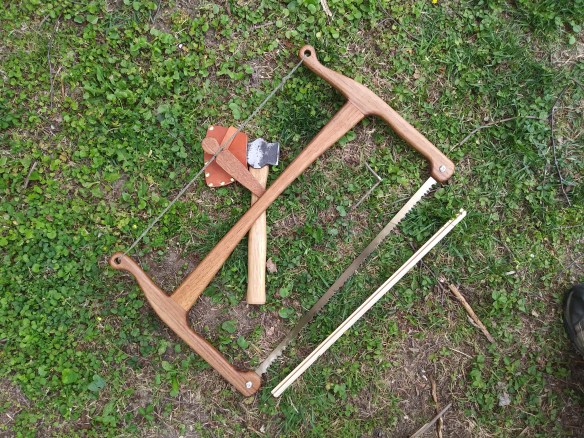
24 inch frame saw made from Missouri grown walnut. The “hanged man” style flapper is a scrap of mahogany from some repurposed shelves. The sheath here is pine.
I seem to sell or occasionally give away the saws I make. I needed a new one. The last one went into the Winter Count raffle as the prizes were looking a little scant this year.
I went into the workshop without much of a specific plan but came out with this little gem. Just a matter of removing the unnecessary bits really.
Finally, the pin sheath is stained and a canvas quiver is made to cover the saw when broken down for travel. This one is from old,, heavyweight canvas salvaged from a truck tarp. It will all fit into a neat 24 inch bundle.
I want to keep this one but after inquiries rolling in, it may go into the shop (or another just like it).
Be Safe!
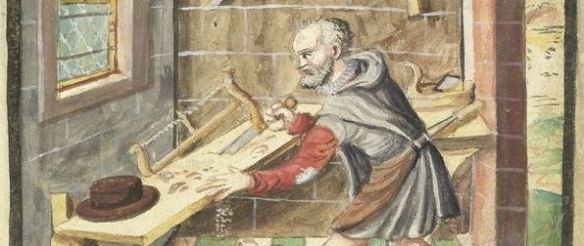
For your enjoyment: a Carpenter from 1589, Mendel Manuscript.
A look at the origins and evolution of our favorite camp stove…
This post was going to be a few words about the Primus stoves we all love and some images I’ve collected from around the web. As usual, I found myself rambling all over the topic without a clear direction but here is a bit of an overview of liquid fuel stoves and how they have evolved over the past 150 years. Clicking the image will link to a larger version in most cases.
Outdoor cooking has become something of a lost art for those of us raised in the industrial world, but not too long ago, what we think of as camp cooking was just plain cooking. Several major advances made in the 19th and early 20th centuries resonate in our lives without a second thought from most of us. Most of our grandparents or great-grandparents cooked with solid fuel (mostly wood, peat, manure, or charcoal) and their grandparents may have felt fortunate to even be able to cook indoors in bad weather. Much of the world still cooks this way and it is an eye-opener for those raised in the more industrialized countries if and when they travel abroad.
In the 19th century, the Caravan Craze, global expansionism, and long-distance campaign warfare sent massive numbers of otherwise “civilized” people back to the outdoors; often with high expectations about the board-of-fare. Although we, as a species, have cooked over campfires for many thousands of years, this is not always convenient or desirable; whether for speed, lack of fuel, or need for a low profile in the hedgerows. An early response to this need was the brazier or hibachi-type grill reinvented on numerous occasions in various parts of the world. These stoves can use small wood or charcoal but are heavy, smoky, and need large volumes of solid fuel for sustained use. Not a good option for the traveller (sic). When coal oil and kerosene became common, liquid fuel appeared to be the answer.
Tea at the Caravan with the Classic Svea Stove.
Although common now, liquid fuel stoves have not always been a good or safe choice for cooking on the road or in camp. Early portable stoves used a wick and some variety of coal oil for the fuel. The flame created with a wick is relatively low-temperature, causing incomplete combustion.
In fact, the early instructions for safe stove use are nearly the same as that of fireworks.
“LAY ON GROUND. LIGHT FUSE. GET AWAY! – USE OUTDOORS ONLY – UNDER ADULT SUPERVISION.”
Another feature of the earliest wick stoves, due to their relatively low burning temperature, is that they exude fumes and soot, like a low-quality oil lamp. This sooting and smoke make them unpleasant at best, especially in confined spaces. Though not a terrible option for the 1850s, they are nothing as good as what would come in the next generation.
Soyer stove.
The advancements of Alexis Soyer – The contraption above is one of the many inventions given to us by Alexis Soyer, celebrity chef and cooking guru of mid-19th century Britain. Many of his cookbooks are still referenced and can be found for free on the web. He was, by the way, born a Frenchman but we can forgive him this oversight for his many wonderful contributions to the world of food.
Not only did Mssr. Soyer invent several useful contraptions for cooking, but he is credited with organizing the first Soup Kitchen to help the starving Irish during the Famine.
As a further claim to fame, the large unit stove he developed for the British army during the Crimean War was such and excellent design it was still regular issue 120 years later. But I digress from our theme.
Seen in use above, this little stove was revolutionary for the time but still left much to be desired, especially if one wanted to cook with it indoors. I don’t believe you’d catch a sane cook using something of this sort on an actual tablecloth unless it was made from asbestos but it seemed like a good idea for the advertisement. In the 19th century, both camp and home cookery were beginning to change drastically; up to this time the two were not very different. Along with improvements in stoves, better cooking pots, and roasting pans, other kitchen gadgets were being developed to help make cooking better and easier. A humble and often overlooked kitchen appliance was invented in this period…
The wind-up cooking timer –
Soyer’s Alarum.
This little beauty is something that all modern cooks take for granted. It seems obvious now, but Soyer realized that mothers, chefs, and camp cooks have many things to attend to at once. He wisely decided that a dinging countdown timer timer could take some of the strain away from cooking and make for better prepared meals.
The coming of the pressurized stove – The Crimean war, the Raj in India, and other colonial ventures undertaken during Queen Victoria’s reign spurred on great advances in campaign living and long-term camping. The East India Company and the regular military encouraged officers to bring the comforts of home as whole careers were spent thousands of miles from home creating and running an empire. From this period, the Brits gave us great folding furniture, camp bedding, portable furnishings, and the Gypsy caravan but it took a Swede to take us to the next level, and camp technology has never looked back.
Lindqvist’s patent covered the burner, which was turned upward on the stove instead of outward as on the blowtorch.
Improvements and variations came quickly after their introduction.
…The Primus No. 1 stove, made of brass, consists of a fuel tank at the base, above which is a “rising tube” and the burner assembly. A steel top ring on which to set a pot is held above the burner by three support legs. Other Primus-style stoves may be larger or smaller, but have the same basic design. The No. 1 stove weighs about 2½ pounds, and measures about 8½ inches high with an overall diameter of just under 7 inches. The tank, about 3½ inches high, holds a little over two pints of kerosene and will burn for about four hours on a full tank.
We think of this type stove as a camp stove but they were marketed far and wide for household use as well.
…Prior to the introduction of the Primus, kerosene stoves were constructed in the same manner as oil lamps, which use a wick to draw fuel from the tank to the burner and which produce a great deal of soot due to incomplete combustion.
The Primus stove’s design, which uses pressure and heat to vapourize the kerosene before ignition, results in a hotter, more efficient stove that does not soot.Because it did not use a wick and did not produce soot, the Primus stove was advertised as the first “sootless” and “wickless” stove.
These stoves are still celebrated worldwide and are in use on every corner of the planet. They are a labor-saving device that frees their owners from fuel collection and actually lower airborne pollutants in the immediate area. They are also credited with limiting the natural deforestation that accompanies humans living in concentrated communities.
The ads give a hint as to how far and wide the Primus stove reached around the globe.
This Radius ad is interesting as it shows the kinship or reapplication of technology from blow torch to stove with only a little modification by the engineers. Below, this advertisement for an aftermarket pressure cap shows the need for improvement as stoves could easily become clogged and explode as a pressurized bomb. I narrowly escaped this hazard myself when my stove nozzle became clogged on an outing. A chemical fire-extinguisher is never a bad Idea to have handy living on the road.
The designers continually improved this simple device with, among other features, a safety cap that intentionally failed at a lower pressure than that which would have caused the stove to turn into a brass grenade. Although safety features were invented to reduce the number of serious accidents, I suspect these little contraptions are responsible for a fair number of burns and the loss of more than a few homes, autos, and RVs.
As with any successful product, there were and are many imitators of this relatively simple design and many still on the market models come from former Soviet Union, China, and India.
Judging by the marketing, they bring nothing but bliss and happiness to the laboring mother… but seriously, these devices were probably a huge boon to the housewife no longer in need of wood or dung for cooking fuel.
The switch to gasoline –
Although introduced in the early 20th Century, the Second World War and subsequent decade saw widespread popularity of the gasoline stove for military use. Unlike kerosene, gasoline (or purified “white gas”) is truly explosive, not just flammable. Placed under high pressure, these are potentially bombs. However, gasoline or derivatives can now be found almost anywhere on earth with the spread of the internal combustion engine, making this a fuel of choice for international travelers. As per usual with us humans, we chose practicality and convenience over safety.
The iconic early stove of this design is the Svea 123 as it it is a beautiful combination of design features including simplicity of construction, easy field repair, and heating power.
Classic Svea 123 and a close cousin.
Here’s a link to lighting the Svea 123 (and a little info about why they are so cool): “DEMYSTIFYING THE SVEA 123“
n.b. The original link was dead when I last checked but I have saved an archive copy here with credit to the author.
Variations on the theme are endless, from the Svea 123 (gasoline) to the Ultra-Primus double burner home range (kerosene). The various designs proved themselves in kitchens, on river trips, mountain tops, and in virtually every modern backpacker’s gear in one form or another. For much of the world, this style stove is still the centerpiece of kitchen cooking.
A different spin on the basic Svea design. The main feature of the 71 is it’s convenient packaging for the traveller.
Summitting Everest, a pretty great endorsement.
As a side note to history, the design was so successful that many other companies copied the essential design. Here are just a few ads for the Optimus line of stoves and lamps, another spin-off, from their own website showing a wide range of related products over the last century.
The modern era of the camp stove –
In my lifetime, liquid fuel backpacking stoves have undergone some serious refinements but overall, the system for liquid fuel stoves is essentially the same. Safety has been a big issue, of course, but size (decrease) and fuel capacity (increase) are probably the biggest changes. Many stoves use canister fuel (butane or propane), alcohol, or solid fuel pellets; but I won’t get into those as they are beyond our scope and interest here.
A new era; the MSR XGK multi-fuel stove.
The final round of changes came from Mountain Safety Research and its later competitors. The big innovation was to separate the fuel tank from the burner assembly and add a pressurizing system to the tank. Small but efficient details were added like the self-lighting sparker, self-cleaning tube, and the inclusion of a lightweight wind screen. I have used one of these for used with pretty good success but I still find myself choosing the Svea 123 for many journeys.
Links and Further Information –
This post is woefully inadequate in so many ways but it is meant as a quick overview of the pressurized liquid fuel stove we all love so much. Here are some links to some great information on the web.
And my all time favorite, the Svea 123. We have been friends for many years.
If you don’t already own a 123, click the images to find out more.
With aluminum cup.
The Base Camp is a specialist equipment internet retailer based in Littlehampton, Southern England since 1986. They stock classic stoves and have an excellent selection of obsolete parts.
The Fettle Box is a good source for pieces and parts for your classic stove. I have had good luck with them.
Finally, the Classic Camp Stoves Forum. Several images above were found here. Information about virtually every kind of stove available. History, art, repairs, tutorials, and reprints are all available on the Forum.
Click here for the mother load of information about Classic Stoves.
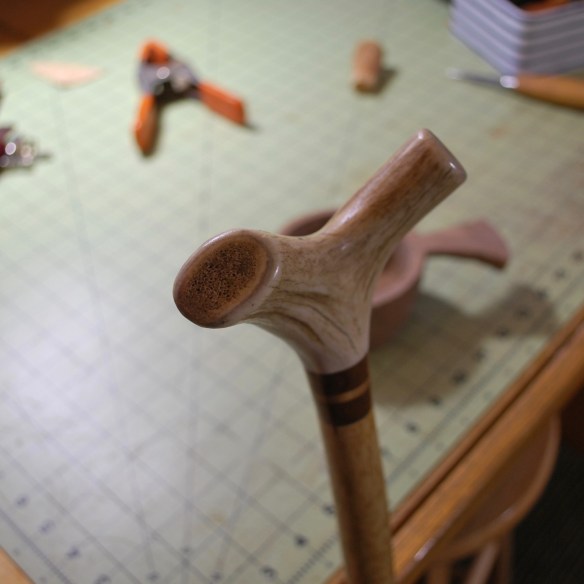
I’ve been carrying this walking stick in one form or another since 2001. What does that mean? I just can’t leave well enough alone, that’s what. It was a straight knobbed staff before attaching the stag horn but I decided it would be more useful and aesthetically pleasing with the fork on top.
A quick polish with walnut oil this morning.
The fork is not only good for resting the thumb but works well for creating shelter and provides a bit of heft should it be needed for persuasion.
The cancelous tissue is fairly light in this one as the buck had an unfortunate highway encounter with a truck. That’s how I found it.
This stick has long been a comfort on walks where stray dogs, javalinas, or other beasties may be encountered. I remember that it took me weeks of wandering around the high country, looking to find the right diameter, length, and character in a sturdy oak, in this case Quercus gambelii or Gambel oak). I don’t kill trees lightly, especially in marginal environments, as they are slow to grow and benefit the earth so much.
It’s always difficult to photograph walking sticks and longbows.
The foot of this one is capped in heavy copper to prolong life of the wood. It’s good to save those bits of hardware for re-purposing.
Terrible “selfie” of the previous hickory staff that this antler was mounted on. I can’t leave well enough alone so I changed it.
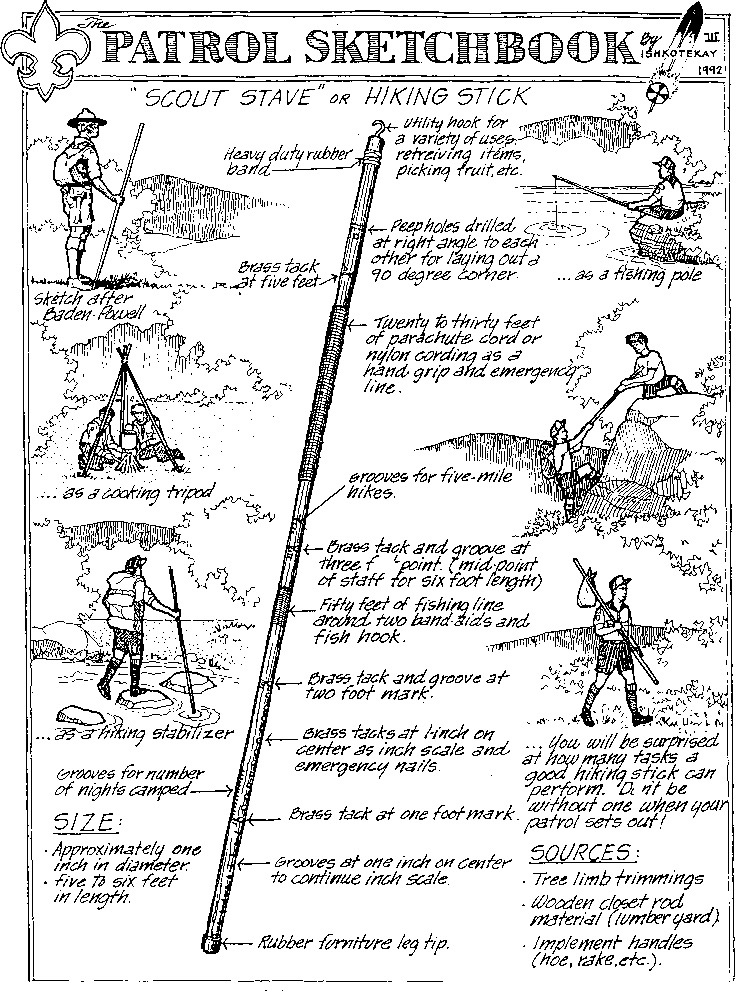
And just for fun, here is a nifty Sketchbook drawing of some uses for the traditional Scout Staff from and artist who goes by “Ishkotekay.”
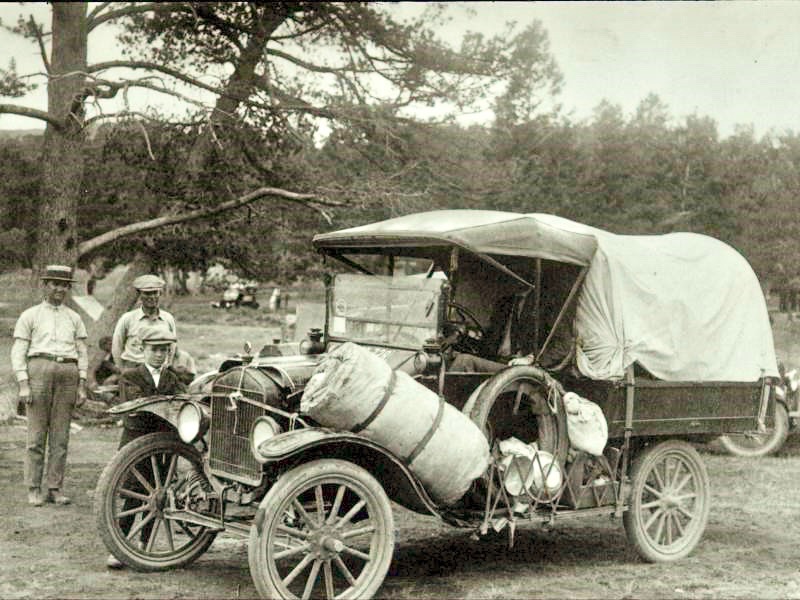
This is a pretty good setup for any outdoorsman (our outdoors woman for that matter). By 1925, the scouts had worked out a pretty good uniform and gear setup based on many old experts not the least of which was the US Army.
If there’s a bit of a paramilitary look to the scouts it certainly owes much to its military background in Britain and further as a result of the Great War. Still, there’s a lot of good info to take away from this. These are truly the essentials.
The new internet Bushcraft world has very little on the old-timers knowledge.


















 Preindustrial Craftsmanship