A Quiver

My new quiver.  Re-worked from one I made earlier in the winter but was just not quite right.  I like it a lot now.  It’s a little smaller, hangs either vertically (Medieval style) or from a shoulder strap which is removable.  Made from oak tanned leather and so far, just washed down with yellow saddle soap.

It’s a simple and not very interesting design really but suits me well.

Winter Count Bow Makers

Thanks to those who participated in our bow making class this year.  I failed to get many photos so if anyone would be willing to share theirs with me, I would be most grateful.  Email me at zcoyotez (at) yahoo.com.

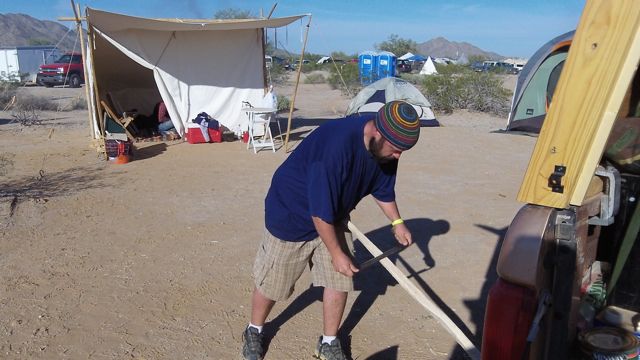
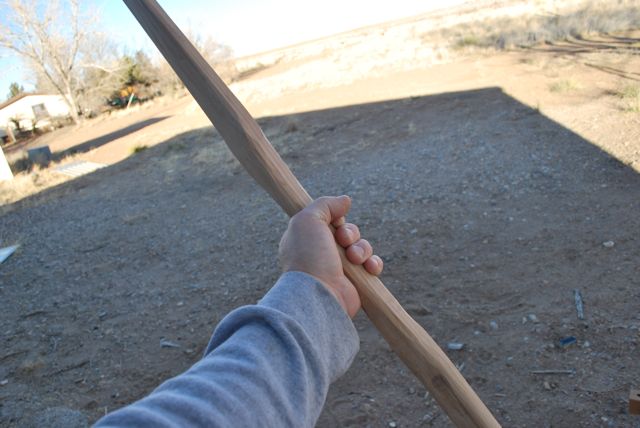
We made very traditional flat bows.  This is a straight-forward, predictable design that is easy to tiller and makes a fine shooter.

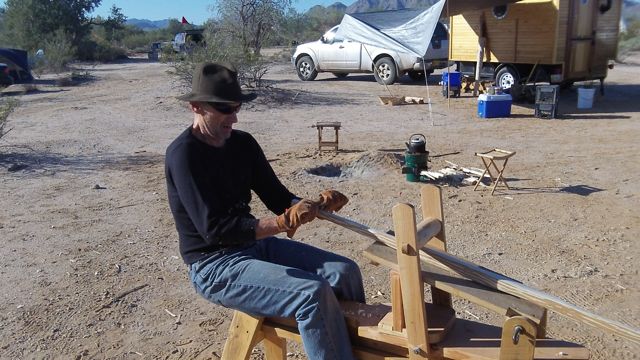
I use a minimum of tools, relying primarily on the axe, drawknife, and spokeshave for the heavy work with rasps and cabinet scraper for finishing.

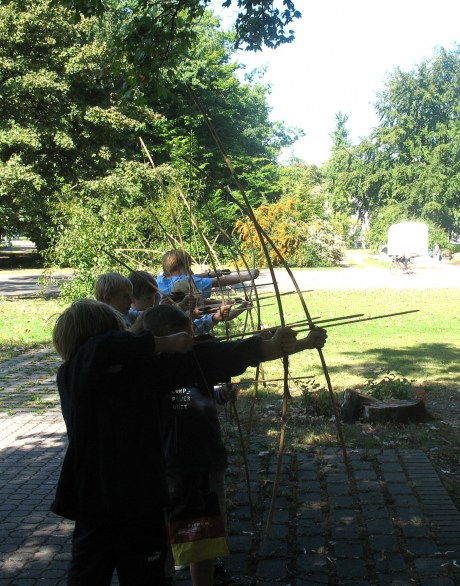
It is a little more difficult to teach such a hands-on skill to groups, as opposed to individuals, but the class seemed to go very well.  The point was not to just make a bow but to learn enough of the concepts that everyone in the class should be able to go home and make more without much guidance.  A key to the success is using good staves to begin with.  There is enough to learn without added problems of twists and knots in the raw material.

All of the bows were successful and I hope will bring happiness for years to come.

Hickory Bow part 2

The winds slowed, the killer dust settled and I was able to get back to the bow.  A few minutes with the power planer took the rough shape down to a nearly finished product.  The calipers are useful and can save a lot of guesswork when making the same style bow over and over.

Above, the bow seen in its near-final form.

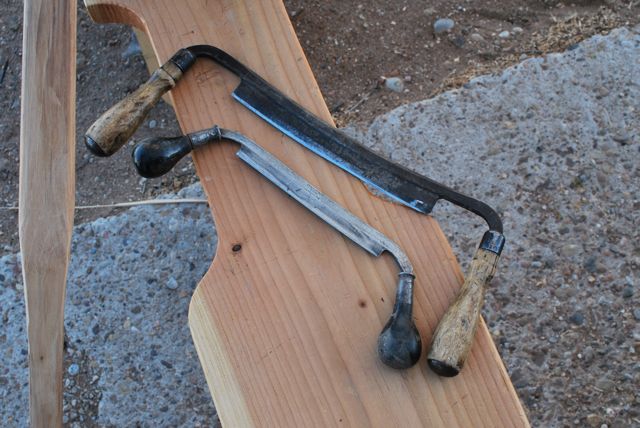
Despite the great labor savings that come from the power tools, wood is very organic and has character therefore need some finer, more controllable tools.  These are the two draw knives I use the most.

I took the limbs down til there was some little flexibility.  Probably in the 100 pound range but still too sketchy to put a string on.  As the day was drawing late I decided to rough out the grip and central riser area.  Surprisingly, this takes quite a bit of time as it needs to fit the hand well, and look pleasing.  It is difficult to get it “just right” in all dimensions as a tiny variance takes away from the symmetry of the piece.  This part is purely about looks.

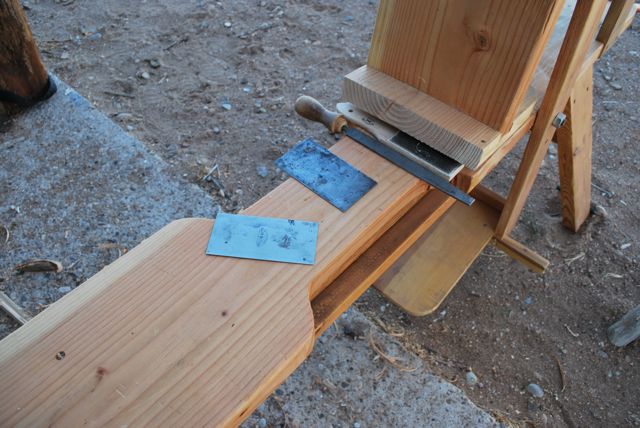
Once the knife work is done, its time to move to the cabinet scraper.  Here are the two I use.  To keep a good sharp edge I switch between the two as one dulls.  The larger one is a standard Stanley cabinet scraper and the smaller is a Garlick of England.  The English one is much harder steel but more difficult to get a good edge when sharpening.  With them are the bastard file and file brush used to touch up the edge.

I hope to find time for the finish tillering sometime this week.

Hickory Bow

The next hickory bow.  I have a barn full of aged staves languishing that need to be made into bows.  Today the weather was good and I had some free time so I jumped on the opportunity to get back into production.  Over the last three years I’ve only made about one bow per year as commissions.  That’s the result of abstract (albeit interesting) work cutting into an honest living.
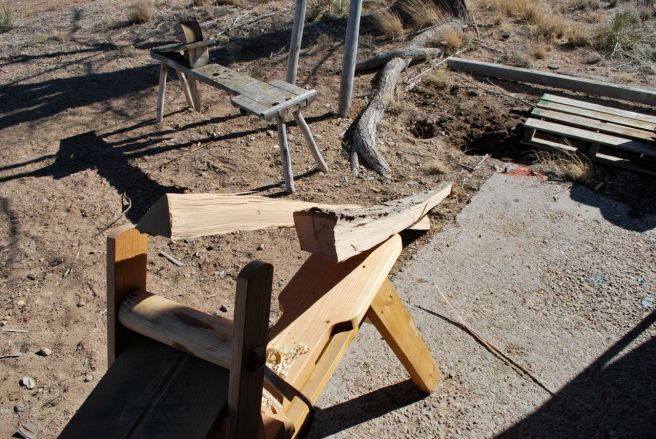
Above are a couple hickory staves cut from the old tree farm in Missouri.  This tree was as near perfect as possible so I intend to get bows from both inner and outer portions of the trunk.  The few bows made from this tree already are fine shooters so my hopes are high.

Although I will be using power tools for much of the roughing out, old-fashioned methods are at least as fast at this stage.  The froe is a handy tool that any green wood worker should have.

This stage is a bit of a break from tradition for me.  This bow is sort of a test in speed and efficiency as I don’t have a lot of leisure time in my week currently.  This stave was split from a larger piece and, as consequently there is some tear-out between growth rings.  The rough back is the cross-over between rings that will need to be smoothed to a single, perfect growth ring before finishing.  As it was very close to perfect, I skipped this normal step and began to roughly mark out some landmarks of the final bow such as the center of the bow, handle, limb width, etc.

The lath I use to mark a clear center line.  I have markings and distances marked for various length bows.  I find a flexible lath and a good eyeball to work better than a chalk line on the curved and undulating surface of rough wood.  This stave is an excellent teaching example as it has almost perfectly straight grain.  The sketch on the bow back is an idealized version of the finished product.  During the shaping process, knots, wavy grain, and twists are taken into account.

It is apparent here that the bow has progressed.  To speed the process, I sawed away much of the excess down to an approximate shape for the finished bow.  Final shaping a tillering commence.  Most of this will be done with a draw knife, spoke shave, scraper, and rasps.

This hickory has been air dried on the high plains of New Mexico for much of the last seven years (damn I’m old) and is extremely hard and dense.  Sharp tools are essential at this point for precision and control.

Lots of shavings like the one above will be generated tomorrow as I ran out of light today.

A note on the the bow itself.  The design is a classic flat bow with consistently tapered limbs.  Although, like many bowyers before me, I experimented and tried many designs over the years, I am returning to basics for the present and a design that has worked for thousands of years. More to follow tomorrow.

In the mean time, here are a few other more recent bows I’ve made.  Most of these are are probably posted around the site already.

Archery Artisans

The arts and crafts of bow-making and arrow-making are alive and well.  If anything, they have grown in quality and quantity in the 30 years I have been involved in archery.  I, like most of the other bowyers I know, learned in relative isolation with very little printed information available.  After a few successful bows, I was lucky enough to find a copy of James Duff’s 1932 classic Bows and Arrows which explains the English Longbow in great detail.

After making a couple dozen bows of various styles, I began to make arrows and realized that this is where the real magic happens.  A bow is simply a leaf spring that stores energy applied slowly by the archer and (hopefully) returns that energy very quickly to launch an arrow.  On the other hand, an arrow is a work of art and craftsmanship that undergoes tremendous force during acceleration and should be able to survive the trauma of slamming into a target at speeds approaching 200 feet per second (135 mph or 220 km/hr).  On top of this, a good arrow must have some weather-proof qualities to handle massive temperature fluctuation, damp grass, heat, sun, and possibly rain.

I mention this because to many people I speak to just getting interested in archery, that to make a bow is the holy grail of primitive technology.  For me, it is that creation of a matched set of 12-24 arrows that work well for me and my bow and will hold up under hard use.  Yes, there is something cool in making a great bow, but building a good arrow is far more important.

On that ramble, here are a couple of good links I recently stumbled across on the internet.

Bow Explosion is a German website from a bowyer working in the Black Forest with and interest in flight shooting.

Ashbow has an excellent Picasa Web Album documenting some excellent archery and other primitive technology skills.

And I cannot say enough good about the ATARNnet.  The forum of the Asian Traditional Archery Network.  There is a load of great information there about Asiatic archery, from Scythia to Japan and everything in between.