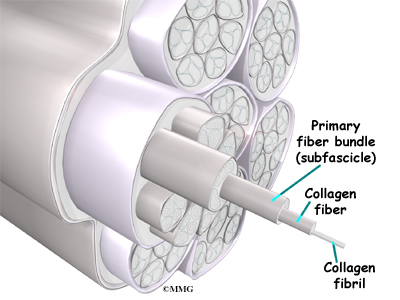
Sinew is the term used to describe tendon or ligament in more formal English. It is the cord that connects muscle to bone or bone to bone in skeletal animals. Like rope, it is made up of bundles of bundles of bundles as shown in this anatomical illustration.
For our purposes, sinew is a true gift to the primitive technologist, survivalist, or low-tech hunter as it provides us with so many possibilities. Sinew is the fiber stripped from animal tendons and used as a strong thread or it can be braided or plied together to make a stronger cord or rope. It can be used to make bow strings, tie objects together permanently, backing and strengthening a bow, or lashing spear or arrow points onto their shafts. It binds well with hide glue, having almost identical chemistry (collagen). This causes it to act a lot like duct tape, binding and sticking to most surfaces.
It is also important to know that every human on Earth had access to and likely utilized sinew in the pre-modern world. It is a gift of nature that aided our ancestors in the making of compound and composite tools.
Here are two recently hafted spear points points. If you haven’t worked with sinew, its difficult to convey just how amazing and useful this material is. It has been called the “duct tape” of prehistory but it is even better than that. It not only holds well and is remarkably strong, but shrinks and strengthens as it cures. The points above were hafted (tied on) with sinew dipped in hide glue to create a solid and tight hold on points. This method holds up very well for throwing darts or spears and is nearly impossible to break.
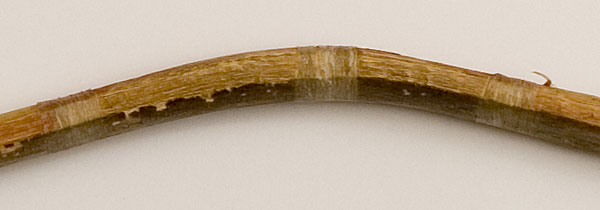
Sinew backing and binding on a Nez Perce bow. Courtesy of NPS.
If you hunt (or know someone who does), you can acquire this from the legs and back straps (the strap covering the tenderloins) of nearly any animal of size. Elk, bison, and deer are obvious candidates for long pieces and are readily available in North America. Smaller animals such as rabbit can be used, but as in so may things, longer can really be better. The main issue I have with the shorter sinews is that it is more difficult to work wet as it must be continually added while binding.
Today I’m prepping to present some primitive skills on Saturday, from raw materials to finished goods. I’m also getting some kid’s activities together to draw in the latest generation.
An assortment of stone-age technology laid out to take to the public.
I study the technology of prehistory. Because of this, I believe strongly in the benefits of experiential archaeology. It gives perspective on a very deep level. We can walk in the shoes of our ancestors, so to speak. I say experiential here not experimental and I’m glad to hear this word coming into the dialog of other primitive technology people. While not trying to dwell on the words themselves, it is an important distinction. Experimental generally implies the ability to replicate an actual experiment (i.e., testing a hypothesis to see what you find).
Experimental pottery; gathering materials, construction, paint, and firing. Click the image to see more about this project.
True experiments are things like:
Can a tree be cut down using an exact replica of a prehistoric axe?
Is it possible to move a ten ton stone over long distances using only the technology and manpower available in the Neolithic?
Can fire be made by rubbing sticks together?
Will a Medieval arrow penetrate 14 gauge armor plate?
You certainly gain the experience through these experiments but you are also testing something specific with something like a yes or no answer. Experimental archaeology can create some popular misconceptions as well. Just because something could be done, doesn’t mean that prehistoric people must have done it that way.
Replicated woven sandals as found on the Southern High Plains and throughout the greater Southwest. Produced from narrow-leaf yucca (by Stacey Bennett).
Experiential archaeology integrates this and everything else learned along the way. E.g., How comfortable are these shoes, is there more or less back pain using a tump line on a pack, what kind of wear can be expected on arrow fletchings over time? This allows us to ask even more questions and have a fuller knowledge of ancient peoples.
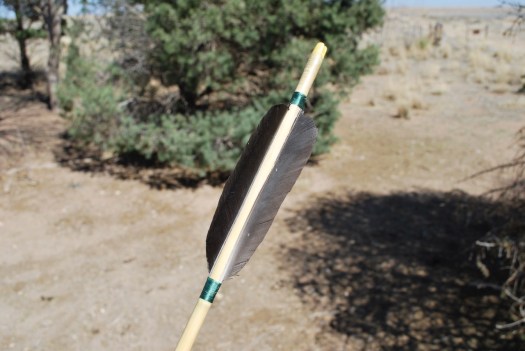
Testing silk lashed goose feather fletching. Clicking the image links to bamboo arrow making.
I really enjoy the various directions replication takes the maker. Learning the finer points of cutting and scraping with stone flakes or abraders, working with antler and wood, creating glues and mastics, and developing an appropriate paint or sealer as on the spear thrower below.
Upper Paleolithic-style spear thrower. Image links to the “how to” for making this thrower.
Whatever you do and whenever you learn, it’s all good.
Don’t leave the kids out of the things you find important…
Nota bene! The following ramble was written at three in the morning and may contain sentiment, ramblings, and a bit of opinion. I don’t want this to sound preachy. What was intended as a few childhood pictures from primitive technology events ran away with itself in the dark hours between sleeps. ~G
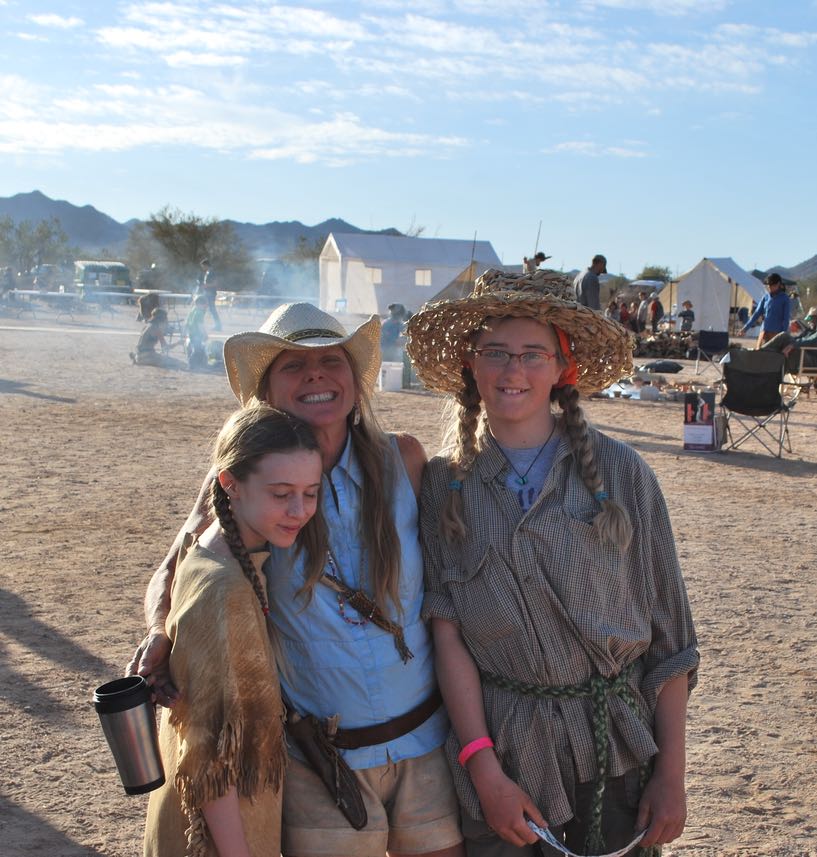
Learning to shoot at an early age. Skills like this build coordination, confidence, and an understanding of the greater things in life.
There is a certain amount of balance that can become of the unique skills we gain along the path of our lives. Some people come to events, take classes, and return to the ‘normal’ life at the end of the week relatively unscathed by the learning they paid for and the time spent.
The first brain-tanned shirt and wearing it with pride. It was a hand-me-down from a friend’s daughter.
To closely paraphrase a linguistic anthropologist I knew long ago,
“Some things we love are embraced the way most people embrace their religion, they take away some message, feel strongly about it, but leave it for Sundays. When we find the thing that is our passion, we embrace it like a lover; it encompasses all our thoughts and becomes our entire life.” ~L.F.
This is how I feel about primitive skills, wilderness living, and pre-industrial craftsmanship. Without consciously trying, it just became a part of life growing ever stronger from teenage into full adulthood. While living in the consumer world, this alternative floated in the background of the mind and continued to influence activities when our child came along.
We were not perfect parents. Far from it. But we were consciously better than our own. We really tried. We learned. I sometimes wish I had it to do all over again. Overall, I think we did pretty well and were lucky in many ways. We encouraged exploration, learning, and self-reliance. By not child-proofing everything or creating needless prohibitions, we were forced to be more aware and in the present. Yes, it is probably more work and yes, it can be exhausting but children should learn their most valuable lessons at home from family, whatever ‘family’ may mean to you and yours.
Every kid and every family is different. They aren’t robots and it is clear to any observer that they have a mind and ideas of their own from a very early age. We can only steer them as best we can, present them with our ideas and beliefs, and provide the types of opportunities we think will give them a good grounding for their future lives before setting them free to try their skills in the world.
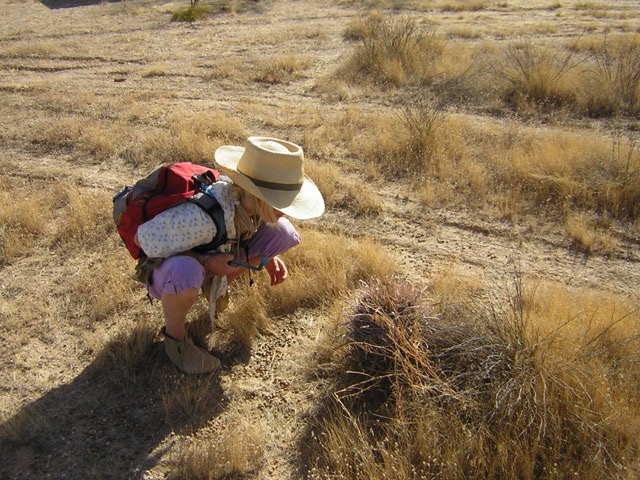
Examining a fish-hook cactus in the Sonoran desert.
It makes me sad hear or to read in social media that parents that I actually know are so down on the next generation. Complaining that they don’t go outdoors, have useful lifeskills, proudly hitting them, or even ridiculing them for using the technology they themselves provided. If that is the case, the blame is only ours! We cannot place the blame on media and movies and video games, schools, government or a general millennial malaise. It is not anyone else’s job to raise our children well. We are, to a large degree, culpable. When I hear a parent complain that their kid watches too much TV, or plays too many video games, I am baffled.
None of us are perfect, but we can give the following generations the values and ideals we may only cherish in the abstract.
Modelling the yucca fiber skirt with her buckskin shirt. A monumental amount of yucca processing.
The intended descriptions have strayed into a hopelessly sentimental post, but anyway, enjoy some of my favorite photos I dug out recently.
Making fire in the Arizona desert 2009.
I leave you with this broad paraphrasing of Edward Abbey:
Give them the skills and encouragement to get out there and hunt and fish and mess around with friends. Let them ramble out yonder and explore the forests, climb the mountains, bag the peaks, run the rivers, breathe deep of that yet sweet and lucid air. And at the end of the day, sit quietly for a while with them and contemplate the precious stillness, the lovely, mysterious, and awesome space we call earth.
We are fed by those that surround us. Choose wisely.Blacksmithing her first knife.
I hope to see a few of you in the great outdoors very soon. And don’t forget to bring the family if you can.
Reposted from 2008; what a different life it seems now.
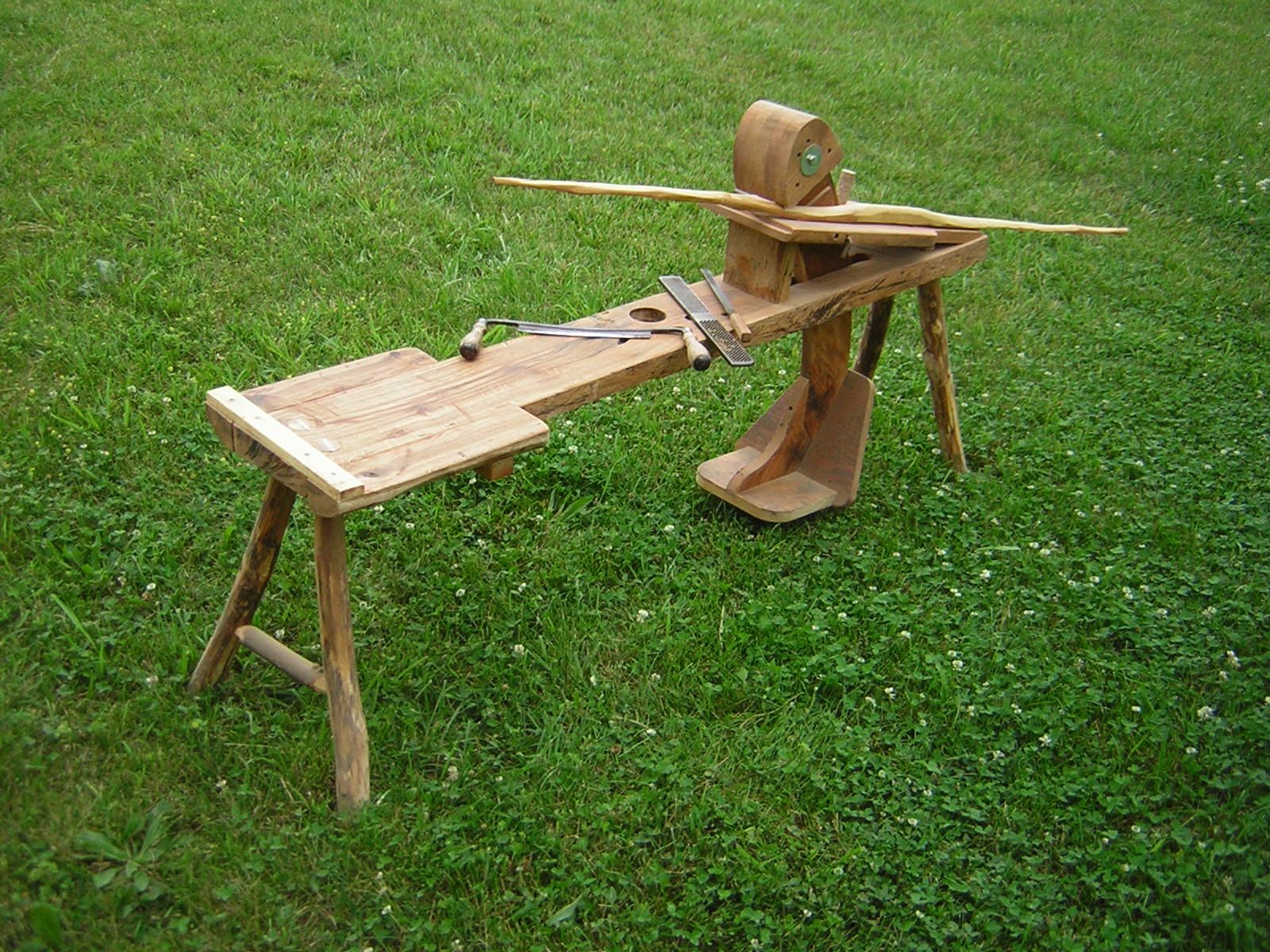
Here is one of my favorite old shave horses. It is made from a plank chainsawed from an enormous pin-oak limb that came down during a storm years ago.
It weighs quite a bit but the weight means more stability when using it as a work bench. All my other horses have had an adjustable table but this one is set to a good angle strictly for working bows.
There are plenty of depictions in old art and many made specifically for every occupation in Diderot’s Encyclopedia from the 18th century. I made my plans for this one based on several I measured over the years and made lots of adjustments to my first one to get the right “fit”. My second and third attempts got better and better. Total cost estimate: about $5.00 for bolt and a few screws.
An advertising card from when people appreciated hand made archery equipment. No training wheel, gizmos, releases, or sights. There is no date on the image but I suspect that late 18th century or early 19th century would not be too far off. Apparently javelin throwing was in vogue at the time as well. Now we have television, video games, and the internet. I feel fortunate to live at a time when primitive technology is making a resurgence. We felt very alone 20 years ago doing these things but an upside to the world-wide-web is connecting people with so much to teach each other.
Click the image to access the British Museum page for this item.
I’ve been doing a little consulting to my nephew*, who has been making a Mongolian bow for a school history assignment. His theory is that the Mongolian bow gave the advantage to the Mongols during their invasion of China in the 14th century, so he’s making one and testing it out. I disagree in a greater part, but it’s more important that he can research, develop and coherently defend a theory. I offered to make him some contemporary bamboo arrows to go with the bow, partially because I knew he wouldn’t have time, and partially because it was an opportunity for me to learn some new skills working with bamboo. He’s also going to be a little more forgiving than a paying client if I make a couple of mistakes while I’m learning, or take some shortcuts.
Paleotool has an excellent two parter on making bamboo arrows, I…
Finding “handedness” in archaeology… using the fletching of arrows as an example. As a professional archaeologist AND primitive technologist I am very skeptical when someone claims they can determine which hand of a maker is dominant on an ancient tool or weapon. One reason for the distrust is that the archaeologist may not have experienced creating the object in the same way the original maker did. I think the Leatherworking Reverend has a valid point in the following article (and not just because it affirms my own experiences).
At most find-sites that have arrows there will be a non-equal mix of S- and Z-wrap on the bindings. The dig report will assert that left-handed fletchers were responsible for those that aren’t the majority direction arrow binding, probably without mentioning whether it’s the Z- or S- that they are talking about. I can’t find where it was written down the first time, but it has been repeated until it became lore. Consider the Ötze website:
According to technical archaeologist Harm Paulsen, the two arrows could not have been fashioned by the same person. The fletching shows that one was wound by a left-hander and the other by a right-hander.
and the Mary Rose Trust:
Hopkins (1998) studied 408 shafts from chest 81A2582 (O9) and recorded that, in every case, the binding thread had been wound in a clockwise direction from the tip end of the shaftment (ie, the portion of the arrow…
A sheef of pecok arwes, bright and kene, Under his belt he bar ful thriftily, (wel koude he dresse his takel yemanly: His arwes drouped noght with fetheres lowe)
Geoffrey Chaucer, The Canterbury Tales, Prologue, The Yeoman, lines 104-7.



 The more you know…











 Preindustrial Craftsmanship