Vardo News, Russian Style

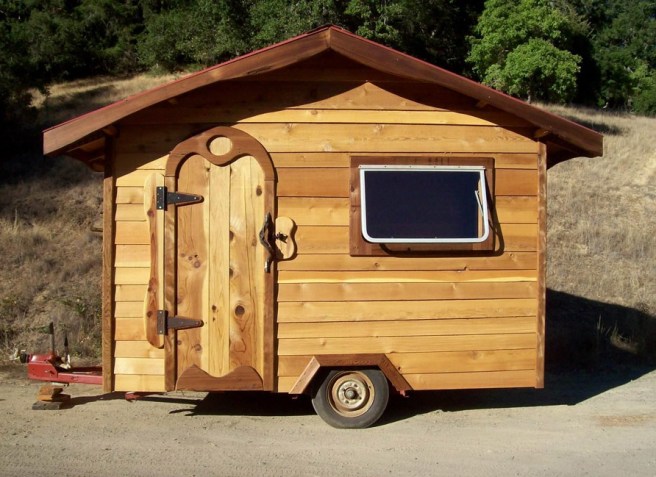
вардо, that’s Russian for Vardo; and it certainly looks more interesting in Cyrillic. Searching some Russian pages for vardo information yielded a wealth of photos and some interesting information about Traveler culture in Eastern Europe.  There’s as much fascination with the Traveler lifestyle in the largest country on Earth as there is on this side of the globe as we are more alike than we are different, despite what politicians might say.
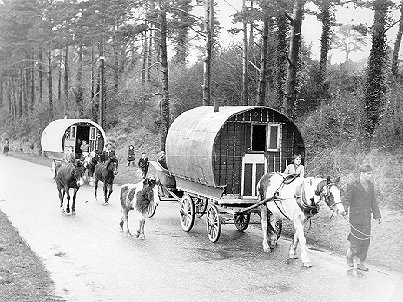
trav02The enchantment that some of us have for life on the road spans the world.  Our ancestors were all nomads but some seek the comforts of permanent roots.

trav06It’s only in our recent past to settle for a permanent dwelling when the Earth is our canvas on which we write our lives largely and bold.  Most of us in the “New World” certainly wouldn’t be here at all had our ancestors been stay-at-homes or successful and steadfast.  I think we have it in our genes to look for greener pastures.

horsefaireThat’s why so many of us (1 in 300 according to U.S. statistical data) at some point in our lives choose an itinerant life against the image portrayed as “typical” and settled.

92477527_Gypsy_002This feeling is certainly not exceptional, from Reading Wagon to Winnebago, it’s relatively easy to make one’s home on the road.
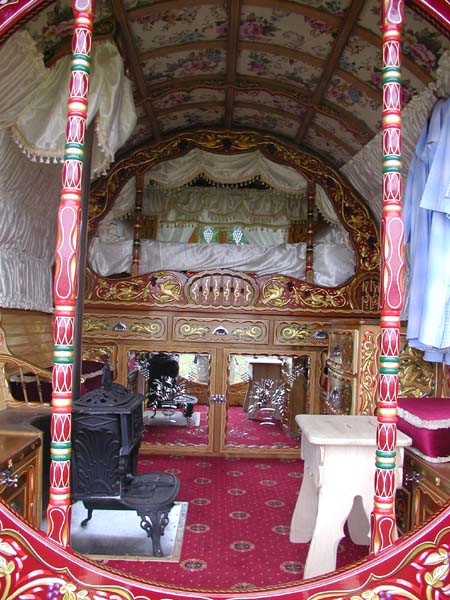
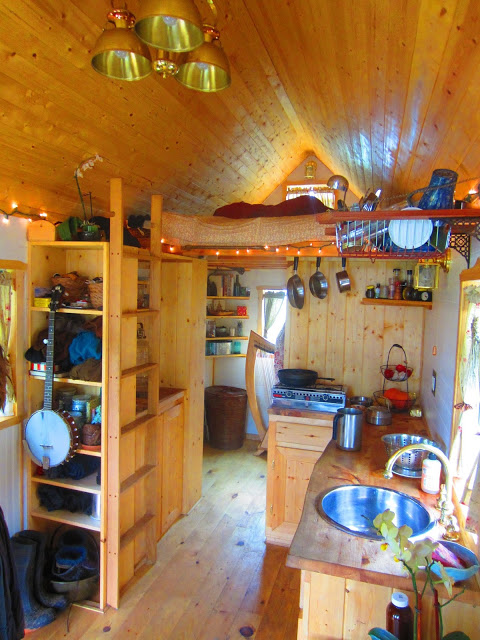
OLYMPUS DIGITAL CAMERAMaybe not as spacious as a spec home in Los Angeles but when the outdoors is your home then the real luxury can be limited in square footage.
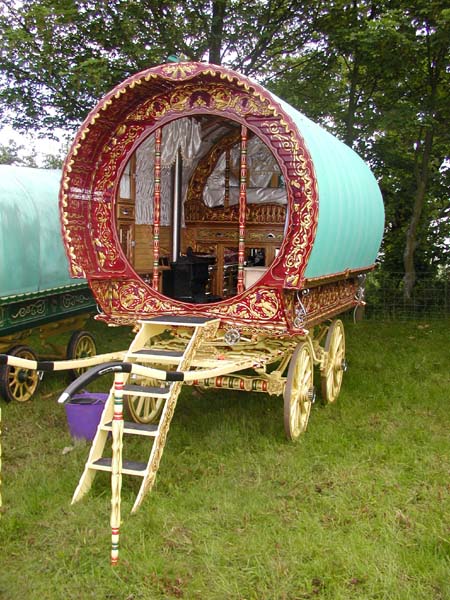
OLYMPUS DIGITAL CAMERAAnd, of course, there is the romance of the Road.  Think of Steinbeck, Kerouac, McCarthy, or Tolkien; the great adventure stories of the Road that never ends.  We need nothing but our rolling universe and the few things we bring along.

Reading RomanceFor western Europeans, there is a special romance with the horse, wagon, and music that makes this lifestyle especially enticing to some, leading to the immense sales of caravans that will rarely see actual use but represent a freedom most of us may never get to know.
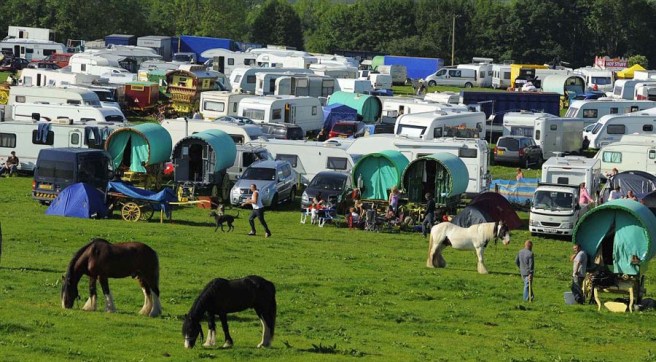
Horses graze in a field next to travellers during the horse fair in Appleby in Westmorland, Cumbria.

So if it’s in you, you are not alone in looking for some adventure on the open road that is your life.
Making a Traditional Turning Saw, part 1

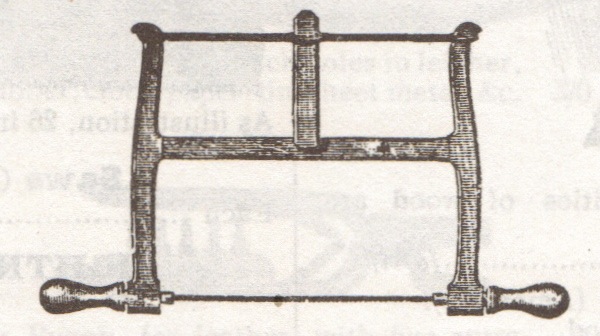
1907Tools-frame saw
Image from a 1907 turning saw add.

Bucksaws, bowsaws, and other frame saws are often lumped together into a single category in modern American or British English (unless you happen to be a traditional hand woodworker of course).  And why should anyone care anyway?  Bucksaws are replaced by chainsaws, bowsaws have become cheap, pot-metal, throw away abominations, and turning saws are replaced by band saws, scroll saws, saber saws, or even cheap coping saws.

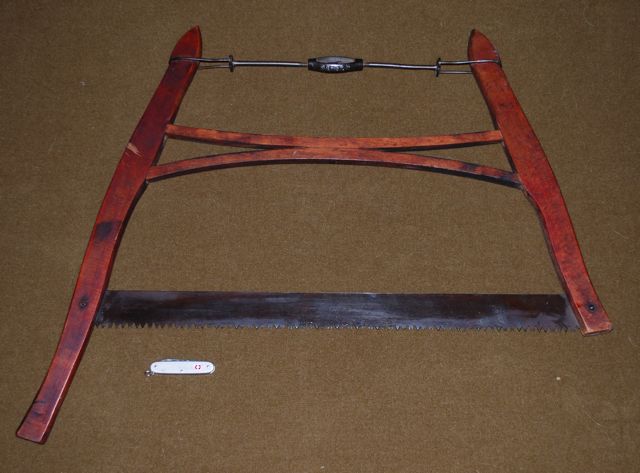
The firewood bucksaw is the biggest of this family and one I’m glad to have in my toolkit.  Yes, I still own a chainsaw but find I use it less and less in favor of the quiet bucksaw that takes no petroleum and spews out no noxious fumes.  I have read that most homes kept a big bucksaw handy as the easiest means of creating firewood and I can certainly understand why this would rank above the axe for cutting logs to length.

Firewood bucksaw, the grandfather of the family.

Skipping even the practicality of being able to make your own excellent tools for a few dollars (or less if you are energetic), there is a great beauty and practicality in this ancient design that our ancestors hit upon a couple thousand years ago.  The basic premise of this design is to create a structure that will put a very thin strip of serrated metal under immense tension to simulate the stiffness of a much thicker material.

I regret that we’ve come to a point in our history where making a tool is odd, yet making something with our tools is not (yet).  Where working for hours at some other thing, we get tokens of cash to purchase something we could have made ourselves in far less time and probably less energy spent.  I believe Thoreau was on to this sort of thinking.

DSC_0916
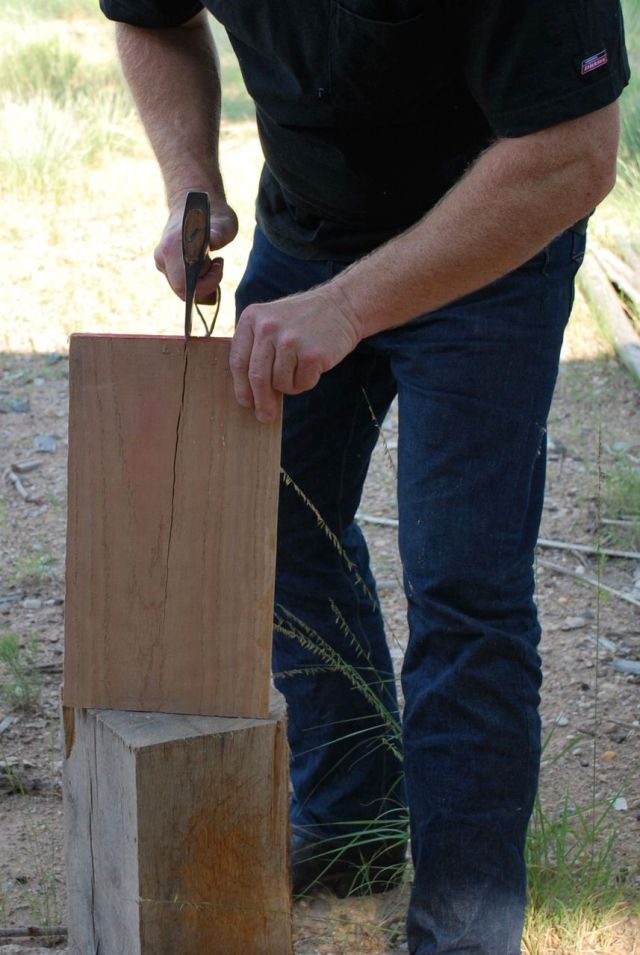
Splitting out the pieces.
Halving and halving again to make straight grained boards.
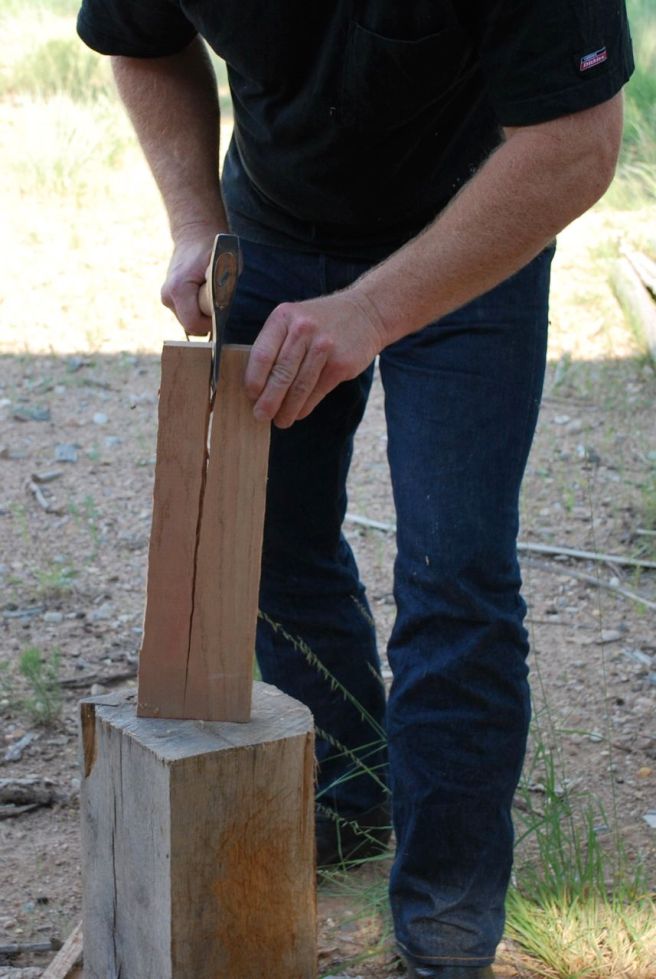
Halving and halving again to make straight-grained boards.

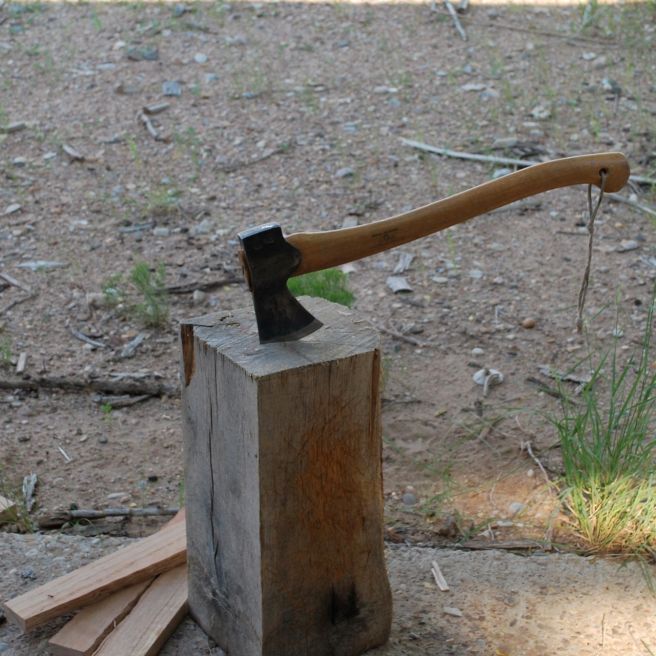
Choosing a length of straight-grained oak in this case, an axe is, by far, the fastest method of reducing it into the constituent pieces for the saw parts.  This is far faster and better than sawing, creates no noise or dust, and ensures that each part is exactly in alignment with the grain.

Finished in seconds.

For a quick and dirty saw, these could be worked almost instantly into the mortice and tenon.  However, as we always intend to make a tool we will cherish and pass on, some shaping is in order with an eye for form and comfort.

Template on card stock.

I have a file of templates I keep from past projects so I don’t have to continually reinvent these things and I highly recommend this.  I find it helpful to write the details on the card stock, as well as label and date them (the notes on the one above are on the underside).  Now comes the somewhat tedious task of shaping the arms for which I didn’t take a photo (maybe I’ll remember next time).  I saved a few minutes by using the belt sander to taper the upper portions of the arms to save on shaping later.

Cutting a mortice.
Cutting a mortice.

After marking up the arms, I cut the mortices with a bench chisel.  These are easier than many people think but do take a very sharp chisel and a little practice.

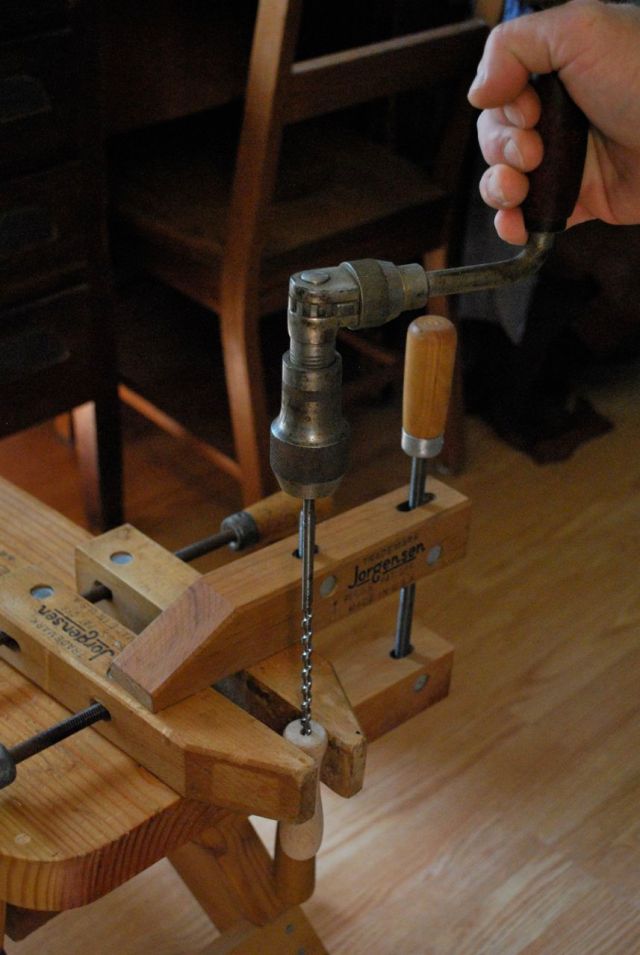
Drilling for the blade and handle connection.

I used a 5/16″ doweling bit for this as it leaves a very clean, precise hole for the 1/4″ brass rod to run through and turn freely.

DSC_0963
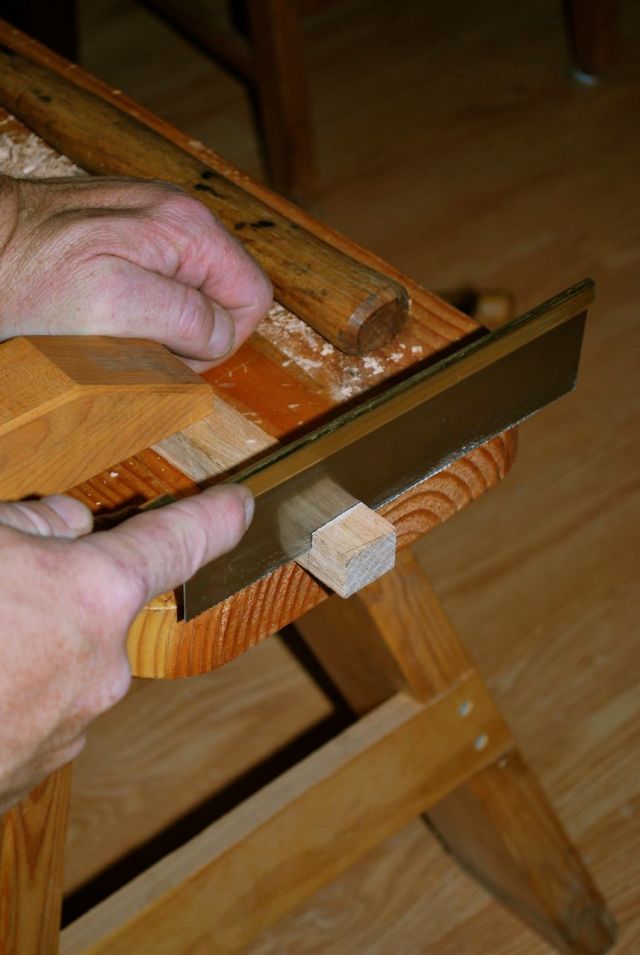
Finally, the tenons are cut with a thin backed saw.

Cutting the tenon is very easy if the lumber is split precisely with the grain as opposed to sawn out on a table saw (ignoring the natural grain).  After the cheeks are cut, its a quick matter to pop off the waste with a sharp chisel.

DSC_0955
Auguring the handle for the brass rod.

I used a spare file handle for the primary handle.  A 1/4″ hole is augured about 1 1/2″ deep for the 1/4” brass rod that will become the connection for the blade.

DSC_0965

The rod is driven into the handle and will be cross-pinned for security.

Come back for Part 2.

Some thoughts on drawknives

D.B. Laney's avatarA Woodworker's Musings

Like all other hand tools, the drawknife is a simple machine designed to provide the user with an advantage that will; give him (or her) more control, increase his (or her) productivity or shorten the workday.  (Or all three, if you’re lucky.)  Of course, there is the added benefit of being every bit as therapeutic to use as a spokeshave.

Most folks new to working with hand tools may have developed some faulty notions about the drawknife and its use.  Let’s explore this simple, but extraordinarily useful tool and how to get the most out of it.  First, let me throw out a caveat here.  As always, let me state, that is no absolutely right way to use any particular tool.  The way that works best for you, is the “right way”.  That said, there are a few things that you should understand about the drawknife that are, pretty much…

View original post 852 more words

Ostrich Egg Globe ca. 1500

From Discover Magazine online…

Engraved Ostrich Egg Globe is Oldest to Depict the New World

By Breanna Draxler | August 19, 2013 1:18 pm
Image

The first known globe to include the New World was recently found at a London map fair—an impressive 500 year survival for it being engraved into ostrich eggs.

According to analysis by an independent Belgian scholar, Stefaan Missinne, the globe not only predates the previous record holder—a globe made of copper alloy between 1504 and 1506, now on display at the New York Public Library—but the evidence suggests it was actually the model used to cast that previous record holder.

The two globes are identical down to their smallest details, from the wave patterns on the ocean to the disproportionate size of continents. The handwriting is the same, and even the typos match up: “HISPANIS” instead of HISPANIA and “LIBIA INTEROIR” in place of LIBIA INTERIOR.

A Rare Find

The grapefruit-sized globe was spotted at the London map fair in 2012 by an anonymous globe and map collector. By that point it had already passed through two dealers’ hands since being purchased from an unnamed but apparently important European collection. Due to these layers of mystery, globe expert Stefaan Missinne was called in to figure out if the globe was legitimate, and if so, when and where it originated.

The globe’s northern and southern hemispheres each came from the round bottom half of an ostrich egg. To figure out its age, Missinne sent the globe to a radiologist who used CT scans to measure the bone density loss in the shell. By comparing the density to that of modern ostrich eggs, and eggs of known ages in museum collections, Missinne calculated the rate an ostrich egg loses bone density: about 10 percent each century. This means the ostrich egg globe would have been engraved around the year 1500, consistent with the idea of it being the cast for the copper globe. And since copper can be melted but egg cannot, the egg would have had to come first.

Ahead of Its Time

Whoever made the globe had access to the latest information about explorers from all the European countries vying for world domination. Many explorers were just returning from their journeys that profoundly changed the way people saw and understood the world. The shape of the Asian peninsula, for example, reflects the explorations of Italian Henricus Martellus, and the two tiny islands of North America were those happened upon by Christopher Columbus. Other details reflect the then-recent exploratory accounts of Marco Polo, the Corte-Reals, Cabral, and Amerigo Vespucci, who coined the name New World, or “MVNDVS NOVVS” as it is labeled on the globe.

Missinne suspects the globe was engraved by an Italian hand, as he describes in the cartography journal Portolan today. The scholar points specifically to Florence which, in 1500, was the richest city in Europe and a renowned map-making hub. Feuding families in positions of power funded exotic artistic and cultural projects, so an ostrich egg globe of the newly discovered lands would have been right up their alley.

Image

The Drama is in the Details

Another creative force in Florence at the time was Leonardo Da Vinci. The lack of New World references in Da Vinci’s writings, and the artist’s inexperience with engraving, suggest to Missinne that Da Vinci could not have been the globemaker himself. Still, the great thinker’s influence is apparent. The transfer of the map from paper to globe appears to have been done via Da Vinci’s unique method for transferring a 2-dimensional drawing to a 3-dimensional sphere by slicing it into triangles.

Apart from the new lands depicted on the globe, the waters tell their fair share of stories, too. In the Indian Ocean, for example, a sole ship is shown tossed on the waves, its origin and destination unknown. And off the coast of Southeast Asia, the Latin legend warns of a legendary monster: “HIC SVNT DRACONES” it says; Here there are dragons.