
Extreme poverty in Paraguay has not stopped a community from creating beautiful music there.
The Retro DIY Project – A Breakfast Shelf For 6

aking a concept is much more fun than just making a set of plans for a woodwork project.
ere are the plans for a breakfast shelf for 6 that I made back in 2010, complete with cutlery drawer, shelf for the egg cups and juice glasses and pegs for the coffee or tea cups.
Related articles

Irish Brogues and Other Simple Shoes
It’s time for new shoes. After a soon-to-be-finished commission for a leather satchel, I intend to dive into a brogue-making project in the style of 19th century Ireland. This basic design certainly dates back much further than this as shown by archaeological finds in bogs throughout Europe. Don’t confuse these brogues with the more modern usage such as:
 This is a brogue in the Scottish/Northern English semi-formal fashion with decorative holes reminiscent of the drains left in old field shoes. Nor is this to confused with the type of shoe that some modern-primitives call “ghillie-brogues” or more properly, just “ghillie”:

These earned their proper name from Scottish Ghillies; a term used to denote game wardens, hunting and fishing guides, and sometimes, even poachers. A simple shoe style that probably goes back several millenia in Europe.
What I decided to shoot for was a shoe that is relatively simple to produce, is closed for winter use, and can be regularly worn in public without arousing too much comment.
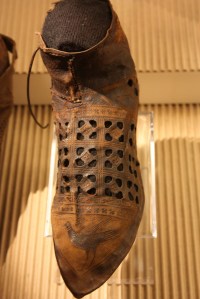
To me, something like the “bird shoe” above is very cool but not really acceptable in an unforgiving office environment. I would gladly hunt elk in these but for some reason, modern work culture has a fairly standardized and limited uniform. This style tends to be cut from a single piece and sewn around three-quarters of the sole. This one is punch decorated, probably to show off the stockings inside, a sign of wealth. This is a form of “turn-shoe” or soft-sole sewn inside-out then “turned”. A sturdy high top 12th century Dutch example with a center-seamed upper is seen below. In my opinion, these would make a fine winter shoe.

I can’t help but see the similarity between these and North American center-seam moccasins.
 The style above is a well-documented Irish “Type 1” dating anywhere from the 1st centuries A.D. through the Middle Ages. A little more complex in construction, especially to get a perfect fit, it has been argued that these may be the result of craft specialization in the early Christian period of Northern Europe. I plan to make a pair of these and contemplate them as a possible design for teaching simple shoemaking. There is some real sewing involved, but not enough to intimidate most beginners.

For those who know American moccasin styles the pattern above seems very familiar as a one piece, side-seam shoe.
So, this brings us to the “Irish Brogue” or Type 5 shoe. These are known well up into the nineteenth century and I wouldn’t be surprised to find them in even more modern contexts, especially amongst the poorer populations. There are similar shoes depicted in Colonial America, probably made in the home for lack of money or access to a cordwainer.

The above brogues appear to be a “built” shoe, having separate soles, multi-pieced upper, and a heel lift; the only difference between these and others from the period is the lack of ties or buckles. Although difficult to tell from the image, they are likely constructed similar to those below:

Hopefully, updates will soon follow to track the creation of a new pair of shoes.
Romans Loved the Celts
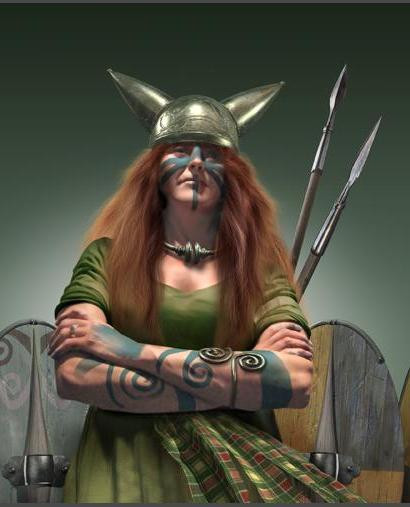
“Nearly all the Gauls (Celts) are of a lofty stature, fair and ruddy complexion: terrible from the sternness of their eyes, very quarrelsome, and of great pride and insolence. A whole troupe of foreigners would not be able to withstand a single Gaul if he called his wife to his assistance who is usually very strong, and have blue eyes; in rage her neck veins swell, she gnashes her teeth, and brandishes her snow-white robust arms. She begins to strike blows mingled with kicks, as if they were so many missiles sent from the string of a catapult. The voices of these women are formidable, even when they are not angry but being friendly.”
—
Ammianus Marcellinus, 4th century Roman (of Greek origin) soldier and historian.
An open-minded scholar for his day with famous observations about both pagan and christian fanatics. From the Res Gestae that “no wild beasts are so deadly to humans as most Christians are to each other.” Too true today even.
“Marcellinus writes of Christianity as being a pure and simple religion that demands only what is just and mild, and when he condemns the actions of Christians, he does not do so on the basis of their Christianity as such.”
Origins – Guitar Maker
A beautiful, but all too short of a film showing a master luthier at work.
Bill Coperthwaite

It’s one of those things, that a week or so ago, I heard a thought to write a blog entry all about Bill Coperthwaite, but sadly, it has now turned into a eulogy as we just received the news that he died, when he drove his van into a rock, in his local town, Machiasport, Maine.
Bill has come into our story a few times: the last time was last summer, when we were on the road in Austria in the early conceptional stage of the zome, the central structure of the Zodiac Tent. He was a man of action and the weather then was such that we couldn’t really work outside so much, so Bill went wooding a lot and carved a few spoons, in-between design discussions. One of his memorable pointers was about the redundancy of jogging, and other exercise routines when instead you can go out into…
View original post 494 more words
Makers Unite!
A pep talk to the MAKERS out there. It’s from Nike but I like the message a lot.
Intelligence, something to think about
“Suppose my auto-repair man devised questions for an intelligence test. Or suppose a carpenter did, or a farmer, or, indeed, almost anyone but an academician. By every one of those tests, I’d prove myself a moron, and I’d be a moron, too. In a world where I could not use my academic training and my verbal talents but had to do something intricate or hard, working with my hands, I would do poorly. My intelligence, then, is not absolute but is a function of the society I live in and of the fact that a small subsection of that society has managed to foist itself on the rest as an arbiter of such matters.
”
| — | Isaac Asimov, from What is Intelligence, Anyway? |
Sad to See You Go…


This isn’t the blog post I wanted to write tonight. A few readers emailed me with the news that Bill Coperthwaite died in a car accident in Maine on Tuesday. Icy road conditions, lost control of the van. Died at the scene.
So what am I thankful for this Thanksgiving? Simple – having met Bill. About 10 years ago, the museum acted as training ground and consultants for a PBS program called Colonial House. I had little to do with it, other than making 4 housefuls of furniture. But my wife Maureen & I, along with several of our great friends and co-workers back then, were part of the clean-up crew. That meant we travelled to Machias, ME and stayed out in this glorious seaside house, while we worked at the site dis-mantling the innards of several 17th-century style houses…in absolutely perfect New England early October weather as I recall…
View original post 550 more words
Ex RAC Series 1 Lambretta; Sidecar Combo for Sale


 These don’t come up very often… in fact, I’ve never seen one for sale before. I’ve seen pics of the RAC Lambretta’s of course, but here’s your chance to own one. It’s been completely restored, by no-one less than the famous Rimini Lambretta Centre, who have done their usual fantastic restoration job, and, to give it a bit more oomph, stuck a Innocenti TV225 engine under the panels. You also get the original 150 engine as part of the deal. The full spec is available on the eBay listing, here, but this is a real head turner, as well as being eminently practical scooter if you want to lug more than a tent and a sleeping bag with you to the next scooter rally, without going to the extremes of a full caravan conversion.
Below are a couple of pics I found on the Red Devil motors blog
View original post 36 more words
 Preindustrial Craftsmanship