
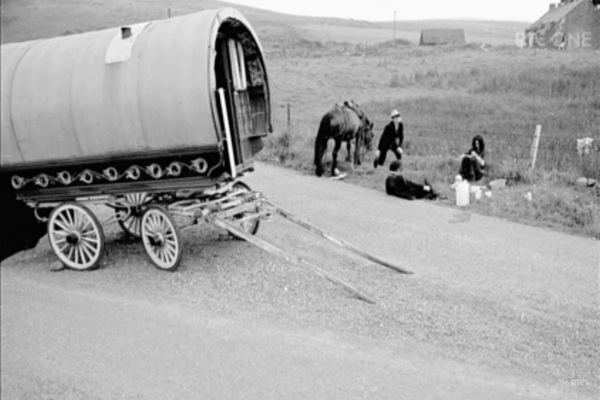
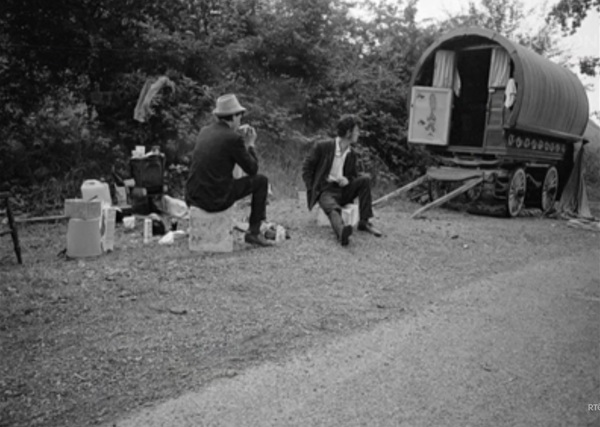
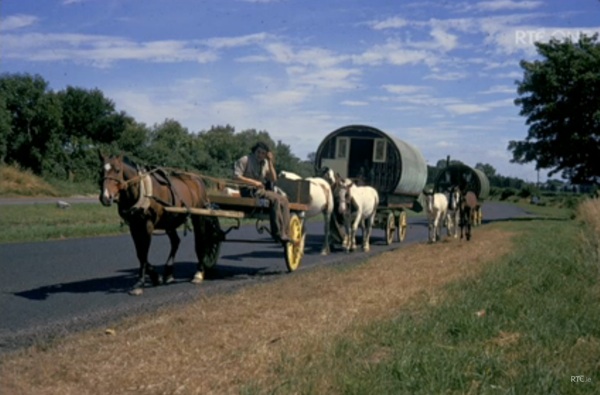
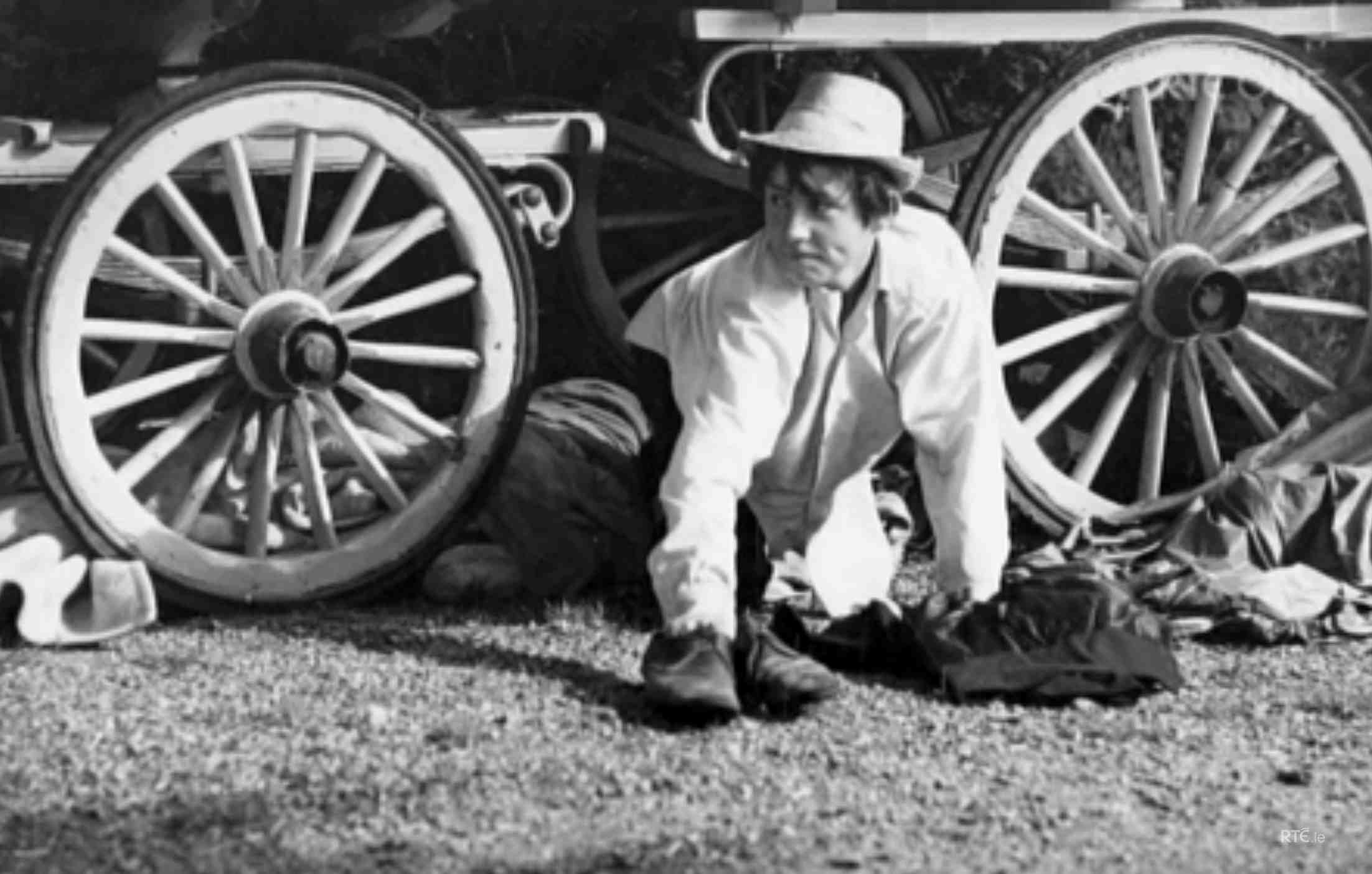
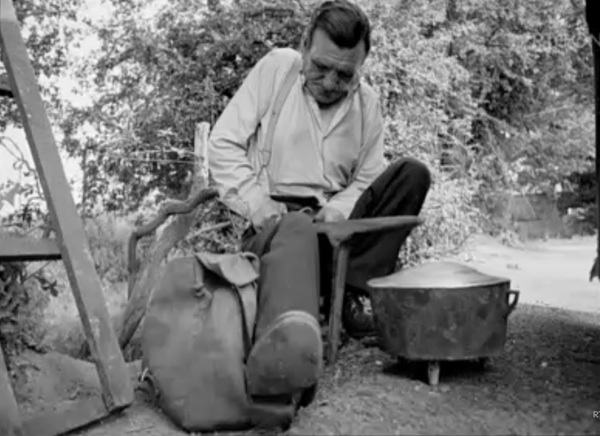
 Screenshot images from Tinker to Traveller, a documentary about “Two Californian anthropologists who spent a year living with the travelers on a Dublin site in 1970 return to Ireland to learn what has happened in the intervening years.”
Travellers in England

Les Wattam


 Plenty of great Waggons to look at here. Click an image to be re-directed to Les Wattam’s page.
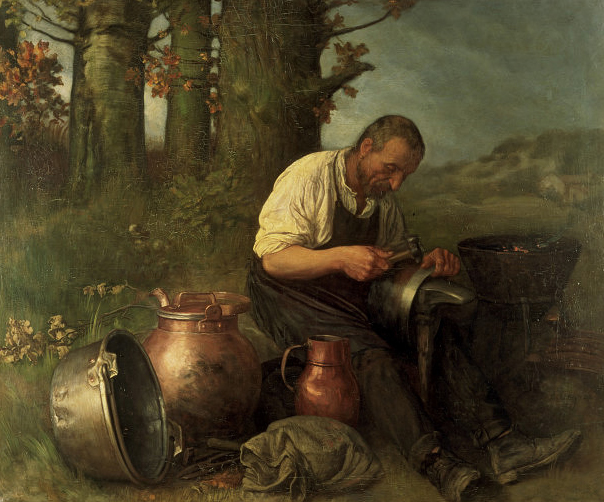
Der Kesselflicker (The Tinker)
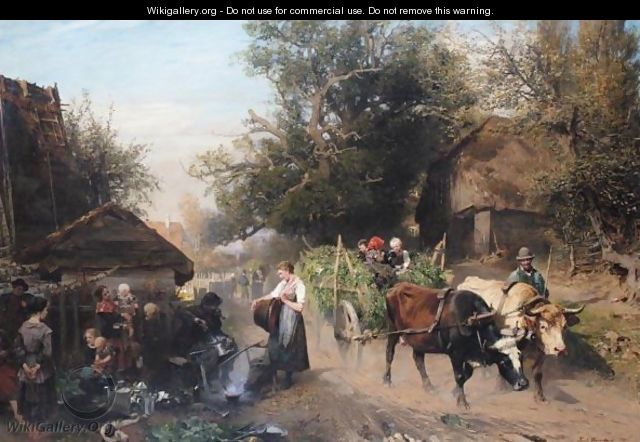
The Tinker
Upcycled Sweater Shoes
Check out Uncommon Cate’s stuff here!


Lovely warm and soft, these shoes (or perhaps slippers) began as an accidentally shrunken wool sweater. These poor, shrunken, often high quality wool sweaters end up in thrift and consignment stores on a regular basis. They also tend to cost next to nothing, so all in all they make perfect material candidates for any felt related project. These shoes are a quick and fairly simple project.
I began with two wool sweaters that had been washed in a washing machine until they were fully felted. Both were good and thick which makes for a warmer and more durable material.
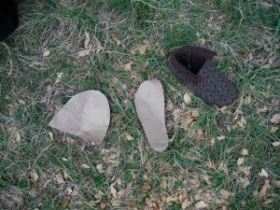

The Pattern: The mid-sole is simply a tracing of a foot. The front upper is made by laying a piece of paper over the foot and tracing around the edges. I cut the sole out of the slightly thicker of the two sweaters because the sole gets more wear, and then…
View original post 246 more words
Medieval Tinsmith
Tinsmiths were the sheet metal workers of the preindustrial days in Europe, the Middle East, and Asia. This almost certainly includes Africa as well but I haven’t been able to find any depictions yet. These craftsmen created many everyday objects and mended all sorts of metal.
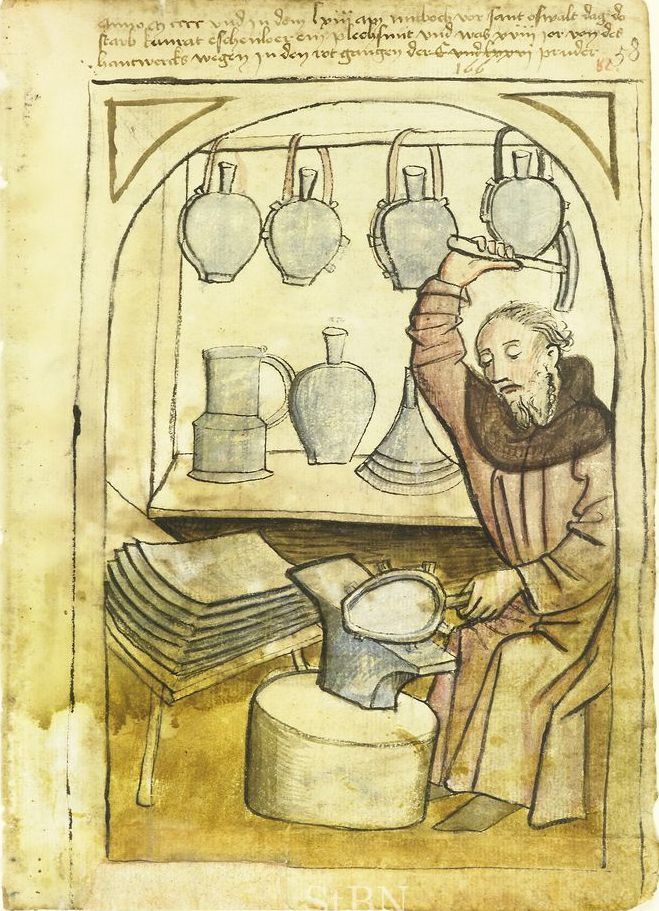 Here we see a smith creating a flask. I doubt he would be whacking it from that height but old images of carpenters and smiths use this convention to show the movement. Behind him are some of his wares including a pitcher, something shaped like a bottle, and a pile of funnels. A stack of prepared metal sheets sits on a table next to him.
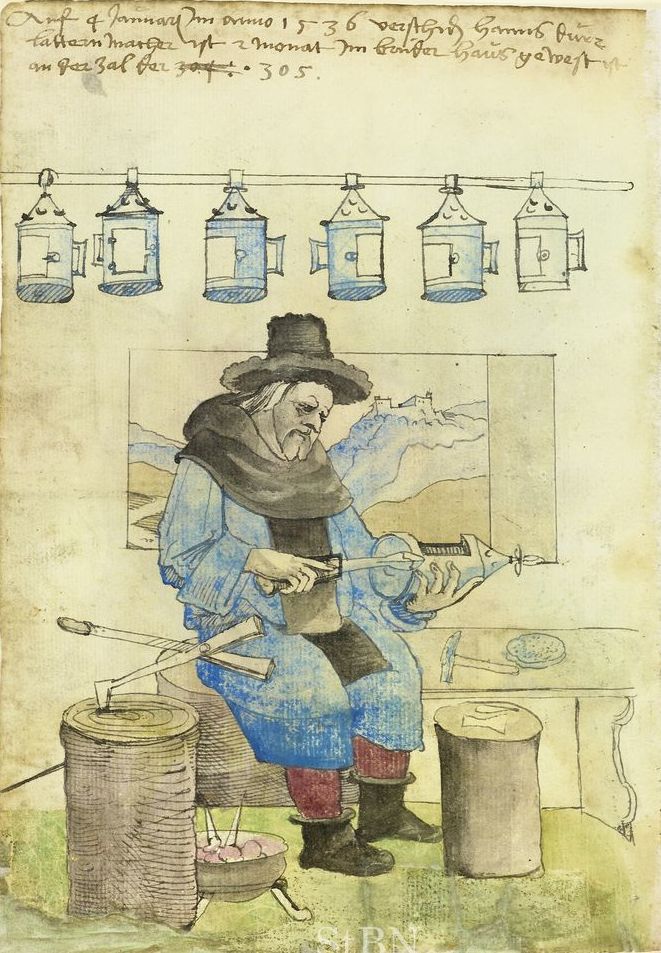 The lantern maker has more great tools. He is set up in front of the window for light. His work surfaces are stumps but his bench is a fancy trestle type, not the typical tenon leg affair one normally sees from this period of history. In this image, the smith is in the act of soldering the base onto the lantern. This is the oldest image I have found, so far, of a soldering iron in use. The little three-legged pot on the floor is a brazier, holding coals to heat the iron and he has a pretty nifty stake tool on the bench. I think it’s a shears but please correct me if I’m wrong on that one.
A Couple More Medieval Tools
When I say Medieval…
The pump drill goes way back in time. At least into Dynastic Egypt and probably well beyond. Drills like these are made from perishable materials so we only have the drill bits and generally do not know to what they were attached. From and archaeological point of view, it’s a bit like trying to decipher a battle by looking at the spent bullets.
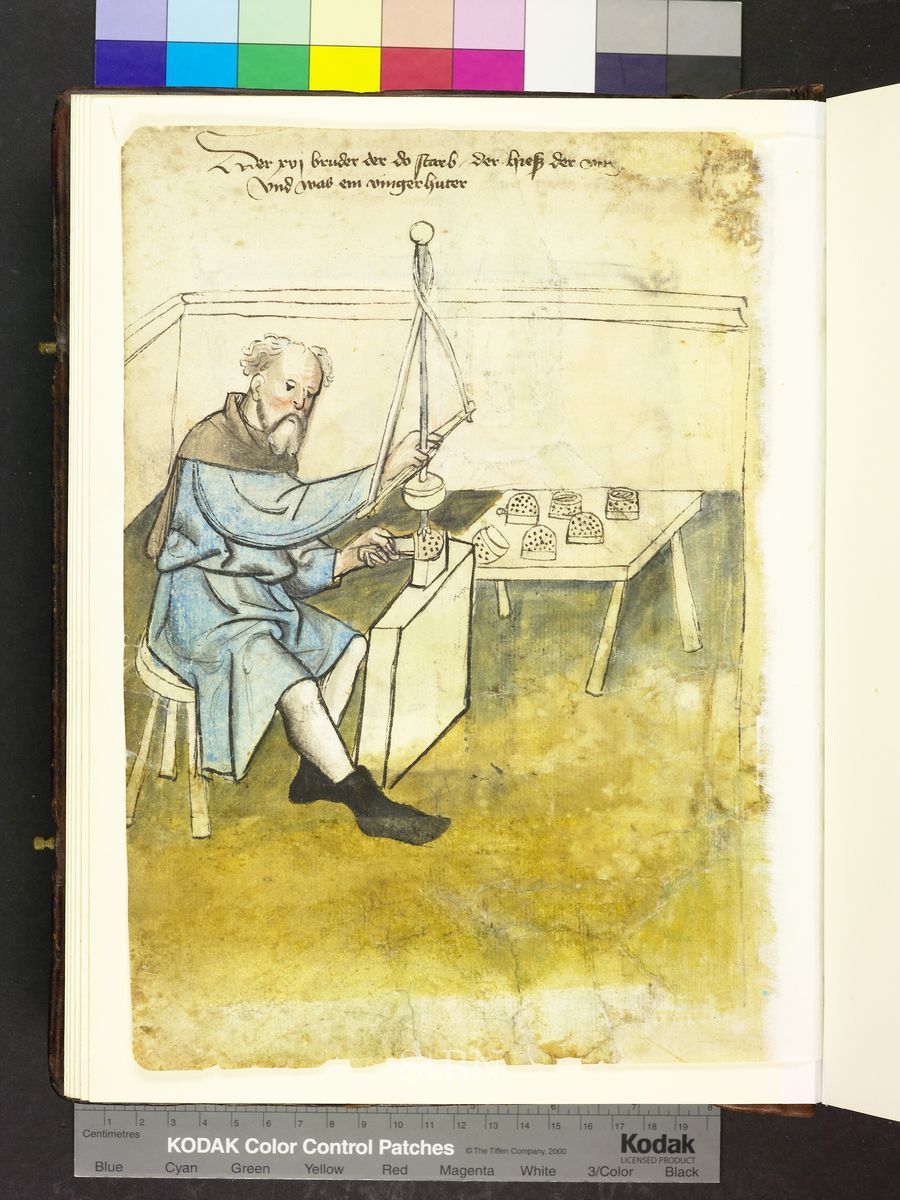 Again, this one is from 1425. The caption says he is a vingerhuter which I think would now mean thimble-maker. Any help with this will be appreciated. These things look more like wine strainers or little colanders to me. Anyway, the important part to see is the awesome pump-drill and the small block on which he is working.
The next image is a stone mason at work. I’m not a stone worker myself but I’m intrigued by a couple of his tools.
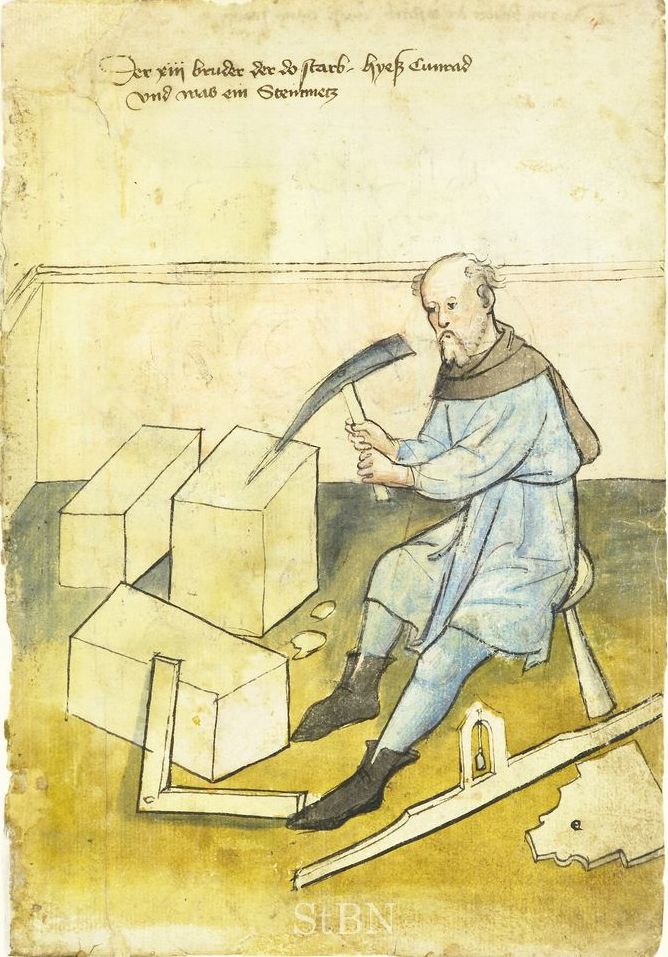 Not only does he have nice square and template but is sitting near his sighting level. In the days before spirit levels, this involved a little plummet hung in an arc on a straight edge. A bit like a sophisticated winding stick. Oddly enough, no dividers are visible to round out the trio of masonic symbolism.
Carpenter, 15th-16th Century
Prior to power sawmills and corporate lumber production, much of the carpenter’s project time was filled with simply making trees into boards. Most illustrations I have found of preindustrial carpenters feature someone hewing, planing, or chiseling with the occasional scene of sawing a board to length or width.
An image is just as much about what is chosen for inclusion as that is left out.
I love to ponder the details of old illustrations and paintings to really see what the artist was trying to show us. These images are no doubt biased in what they choose to show; and for good reason. There is a semiotic tradition in Medieval illustration to choose certain symbols to denote specific trades or historical characters and it should be remembered that the illustrators are not necessarily experts with the trade they are depicting.
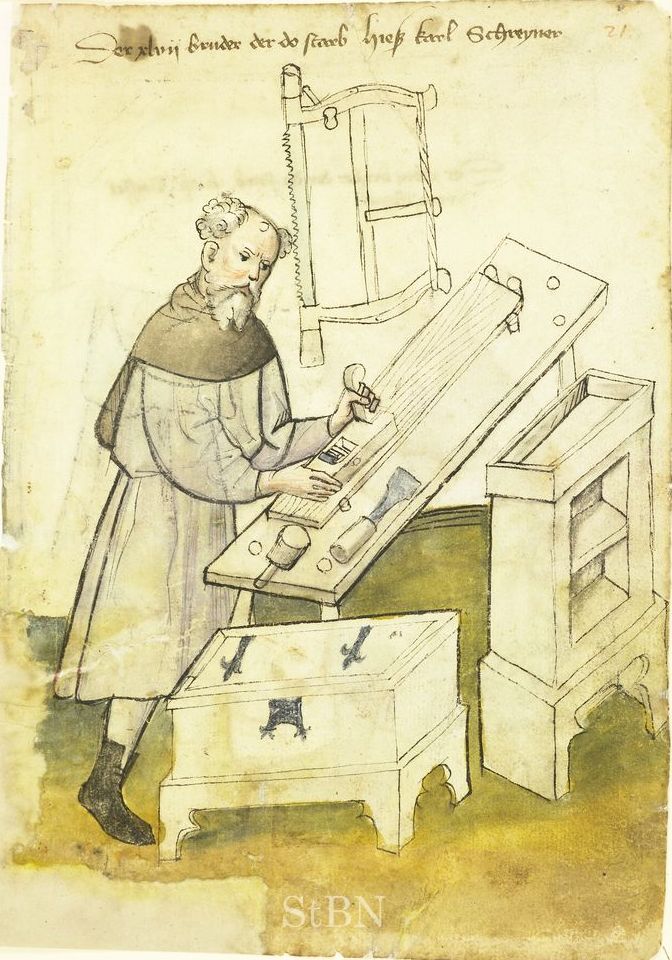
Here we have the same carpenter from a previous post dated to around 1414.
The foreground holds a familiar skirted six-board chest with iron hinges and an escutcheon plate around the presumed locking mechanism. Either he is building these or perhaps it holds his tools. Beside it is a nice little cabinet of similar construction. He is working on a simple European bench with through-tenon legs, popular since the later Iron Age. His board is secured simply by four bench dogs.
Only four hand tools are shown. The frame saw, plane, chisel, and mallet. No doubt his dividers, straight edge, and winding sticks are in the box.

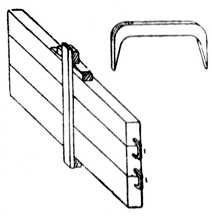
Just for fun, here’s another carpenter from about a hundred years later hewing a board to size with a bearded broad-axe. The work sits on a pair of saw horses with the typical tenon legs. Also, note the iron dogs used to secure the board to the horses. Living in the era of screw clamps, we don’t use these as much but they are still occasionally found holding boards while being glued like so:
And finally, a late 16th century carpenter cross-cutting a plank. I like this image as it depicts more tools, though in less detail. Chisels, hammers, and a square hang on the wall, a plane sits in the background, and the broad-axe sits on the floor next to the hewing stump. The frame saw hasn’t changed at all. I don’t know if the supprt under the board is unique but it appears to be stepped to hold planks at graduated levels. Pretty nifty if you ask me. And finally, a couple of details about the clothes; I love the sagging stockings and the patched elbow of his shirt. Definitely dressed for work.

Occupation, Bag Maker
Bag maker and salesman from the 15th century. This should inspire some Medieval era artisans out there.
 Cutting board and leather knife.
 Preindustrial Craftsmanship