Great observations Ted!


Or you could come to Norway, get a job which gives you the right to social services and get the hip replacement for free. I know I’m queuing up for one – Ted 😉
Adventures of an Imperfect Man In Search of a Handmade Life

Great observations Ted!
Or you could come to Norway, get a job which gives you the right to social services and get the hip replacement for free. I know I’m queuing up for one – Ted 😉
“I believe I was fitted by nature to become a woodworker, and had my father been a wagonmaker or millwright, a carpenter or cooper, I would have been taught by my father the trade that he knew. He saw that I would whittle something, for when I was even smaller and lived in the woods I would ask for his knife whenever he came home. He always demurred, saying, “You will cut your fingers,” for a woodworker’s knife is always sharp.
I would tease until he would hand it out with the remark, “Now you will cut yourself.” I invariably did, and it was generally the fore finger of my left hand. That finger is just covered with small scars of every possible shape. I was bound to whittle something. Father knew it, so he calculated to give me a trade where I could whittle away and bring in a little money thereby.”
Chris Weeks
Wood Craft – December 1905

Kindness to children, love for children, goodness to children—these are the only investments that never fail.
Henry David Thoreau
At least that is what it is purported to be. It’s beautiful to see such sharp tools in the hands of masters. And to think, they accomplish this without a Moxon or Roubo bench.
The big sky becomes a beautiful backdrop for sunset over the Llano Estacado.

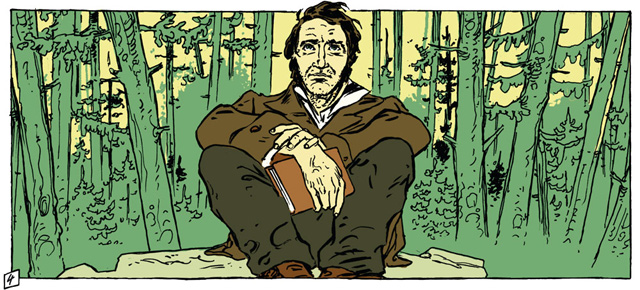
“A sad soul can kill you quicker, much quicker, than any germ.”
Henry David Thoreau

Ralph Waldo Emerson

Tiny Green Cabins has some pretty nice and well thought-out designs. I find their website a little difficult to navigate but their blog has some interesting stuff on it. I am very much a traditionalist and a form-follows-function kind of guy. However, I think they have some new and innovative designs as well as some very nice features for comfortable living.


Check out this house tour of one of their recent builds. It’s worth the 13 minutes.

Life is short. Don’t take your best parts to the grave.
Hillbilly Tansu – It’s good to see a “regular guy” woodworker employing the good old joinery of our predecessors. Mr. Merritt writes a good blog and I particularly appreciate the good illustrations and photos.
I had an easy, slow paced day in the shop. No rush. Just enjoyed my time working wood and making. My goal today was to chop the mortises in the front cross rails and to fit the corresponding post tenons.
 I had set out the joinery for these pieces a few days ago and was able to jump right in with chopping the mortises. The main mortise is a standard thru mortise. There is a mortise that intersects with it perpendicularly. That mortise is reduced two thirds of the way thru to a square profile. Its this intersection that must be given attention. I can’t just chop one mortise and then the other. If I do so when the second mortise meets the hollow of the first there is the potential for spelching (breakout) of the unsupported fibers. In the past I have inserted a scrap block into the first mortise…
View original post 433 more words

 Preindustrial Craftsmanship