Spear Thrower Follow Up


A quick follow-up on yesterday’s post in the wee hours of the morning.

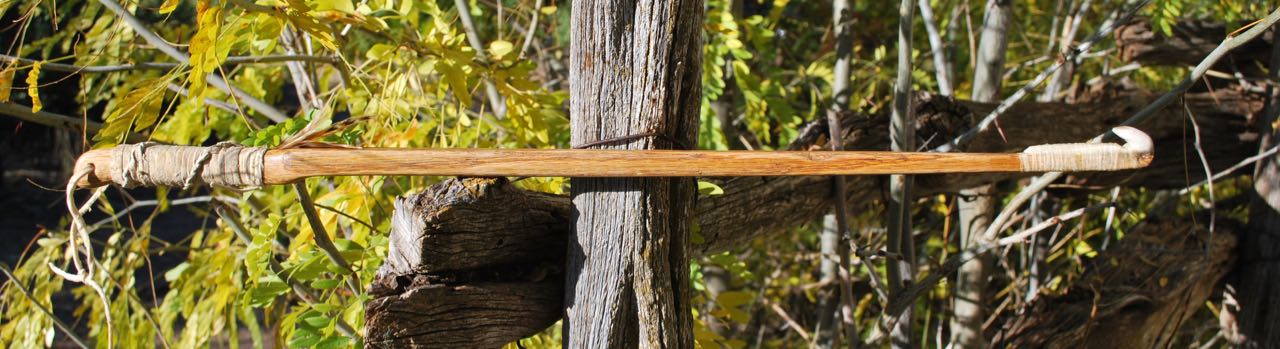
Hook engaged.
Hook engaged.

Based on a question that came in yesterday it seems appropriate to show the thrower in use.  This is my favorite dart but I’m a little embarrassed by the sloppy fletching.  The base (proximal end) of the dart is carved out in a shallow cone and reinforced with some very fine hemp, coated in hide glue.  The indent should not be too deep or the hook only catches the rim and will break off bits when thrown.  It should “bottom out” for best contact.

DSC_0002 (16)
Hook detail.

The hook is pulled out here to show length.  I find that if the hole and pin are too deep, the release is not smooth as it binds up during the throw.

DSC_0003 (12)
Hole oblique.

Nothing magic, just a technology we all knew back in our family past.  I should say that there are three primary types if connection for spear throwers; this on just seems the most popular.  I hope to address the others sometime down the road.

More Paleolithic Technology in the Shop

DSC_0001 (9)I recently finished another Paleolithic inspired spear thrower (a.k.a. atlatl).  This came about due to some throwing over the past year that re-energized my feelings about this technology and it’s sporting aspects.  As usual for this type of project, I made several at once since the tools were at hand.  Here’s a quick rundown on the process of connecting an antler hook to a wooden handle.

DSC_0002 (13)
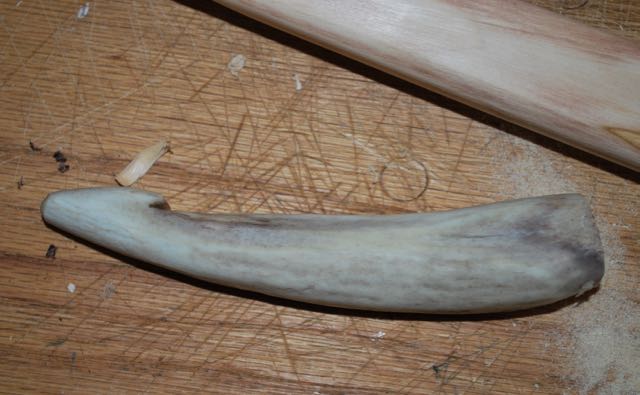
I cut the antler and rough out a notch for the hook. A few hours soaking in water will soften the cancellous core for easy working.
DSC_0001 (11)
Drilling can easily be done on the softened antler with a narrow knife, stone flake, or tapered drill bit.
DSC_0003 (10)
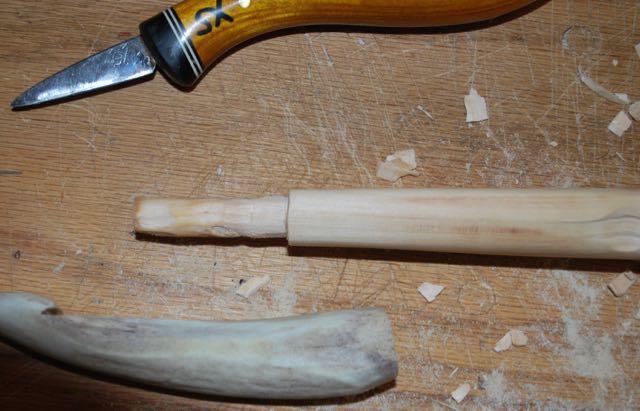
Once the hole is drilled (I take it down to about 3/8 inch or a little thicker) the handle can be roughly whittled, testing periodically for fit.
DSC_0002 (14)
Argh! A moment of distraction means the snap of a stone bit!
DSC_0005 (10)
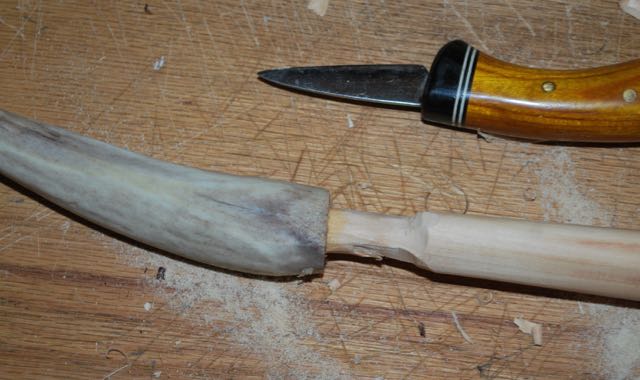
A process of trial and error will eventually make a tight joint.
DSC_0006 (7)
Nearly there.
DSC_0007 (8)
Cleaning of the shoulders of the joint makes for a much neater look and solid connection.
DSC_0008 (3)
If the fit is tight, the drying cancellous tissue in the horn sticks surprisingly well. However, I want this to be maintenance-free for the owner so a drop of wood glue will insure decades of strength.  Now the slow and tedious shaping can commence.
DSC_0001 (10)
Antler hook after shaping.
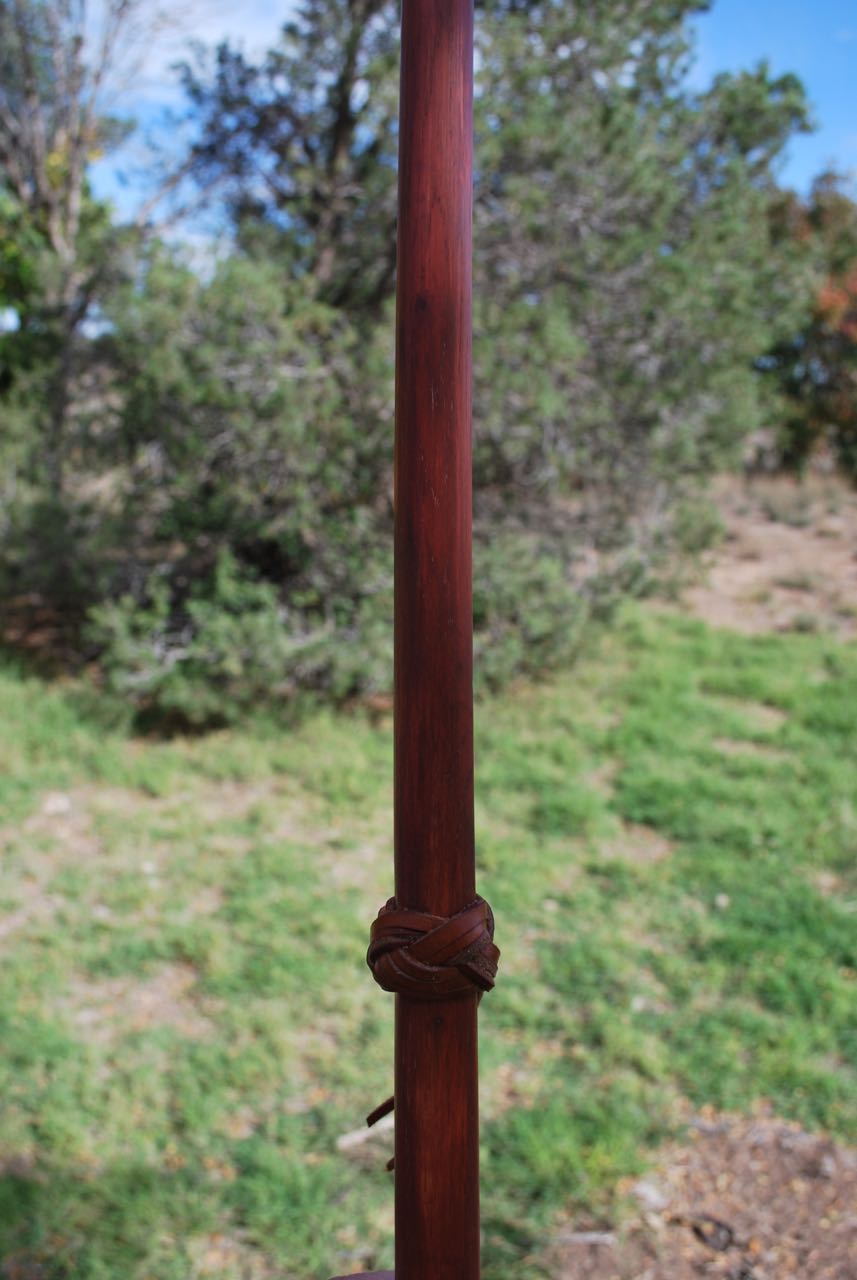
Hickory handle after being painted with red ochre.
Here is the hickory handle after being painted with red ochre.
And, for mine, I added a turk's head knot in vegetable-tanned leather to keep hand placement consistent.
And, for mine, I added a turk’s head knot in vegetable-tanned leather to keep hand placement consistent.

My favorite style is the Western European Upper Paleolithic “hammer-handle” style thrower.  It works well with heavier darts and is a solid companion.

Spear Throwing Time

I recently got around to repairing my partner’s atlatl for an upcoming throw at the Landmark.  It’s been in use for seven years now and suffered some dings as well as losing it’s wooden hook.  The handle is oak and the original cocobolo hook has been replaced with antler which will hopefully last a lifetime.

DSC_0002 (9)The hook itself can come under a lot of stress, especially if it lodges in a too-deep socket on the spear or dart.  I started keeping them fatter and flatter, more like Upper Paleolithic specimens from Europe, making them stronger with a smoother release.  This design works well for me.

DSC_0003 (8)
Side profile of the nearly finished antler hook.

The hook above is held by elk sinew and hide glue. It may need another round to smooth it out.

DSC_0002 (10)
Sinew coated in hide glue drying on the spear thrower hook.

Sinew is an amazing material to work with.  I learned about it when I was a teenager by reading Larry Dean Olsen’s classic book Outdoor Survival Skills and have been a proponent ever since.  Real sinew has many advantages over modern materials including the so-called “artificial sinew” in that it adheres to many surfaces, bonds perfectly with hide glue (sharing much of the same chemistry), and shrinks as it dries making for a tighter bond.  Another advantage to sinew as a survival tool is that every animal has it, so watch out.

DSC_0001 (8)
Grip wrapped (half-hitched) with buckskin lace and ornamented with some hackle feathers.

Finally, a lot of folks prefer a leather gripped handle for a better hold when wet or sweaty.  This thrower has won quite a few competitions in the past and I hope that tradition continues in it’s newest reincarnation.

Reoww!
Reoww!

They work!

Save

Trade Card from a Bow and Arrow Maker

An advertising card from when people appreciated hand made archery equipment.  No training wheel, gizmos, releases, or sights.  There is no date on the image but I suspect that late 18th century or early 19th century would not be too far off.  Apparently javelin throwing was in vogue at the time as well.  Now we have television, video games, and the internet.  I feel fortunate to live at a time when primitive technology is making a resurgence.  We felt very alone 20 years ago doing these things but an upside to the world-wide-web is connecting people with so much to teach each other.

Click the image to access the British Museum page for this item.

A Nice Cup of Tea; eleven steps to the perfect brew

As I get older I find a drink more tea and truly appreciate this sometimes underestimated drink.

img_2873

I saw this over at Brain Pickings and it shows a lot of good sense from one of my favorite writers, George Orwell.  Here are his eleven rules for making good tea excerpted from his 1945 essay, A Nice Cup of Tea.

If you look up ‘tea’ in the first cookery book that comes to hand you will probably find that it is unmentioned; or at most you will find a few lines of sketchy instructions which give no ruling on several of the most important points.

This is curious, not only because tea is one of the main stays of civilization in this country, as well as in Eire, Australia and New Zealand, but because the best manner of making it is the subject of violent disputes.

When I look through my own recipe for the perfect cup of tea, I find no fewer than eleven outstanding points. On perhaps two of them there would be pretty general agreement, but at least four others are acutely controversial. Here are my own eleven rules, every one of which I regard as golden:

First of all, one should use Indian or Ceylonese tea. China tea has virtues which are not to be despised nowadays — it is economical, and one can drink it without milk — but there is not much stimulation in it. One does not feel wiser, braver or more optimistic after drinking it. Anyone who has used that comforting phrase ‘a nice cup of tea’ invariably means Indian tea.

Secondly, tea should be made in small quantities — that is, in a teapot. Tea out of an urn is always tasteless, while army tea, made in a cauldron, tastes of grease and whitewash. The teapot should be made of china or earthenware. Silver or Britannia ware teapots produce inferior tea and enamel pots are worse; though curiously enough a pewter teapot (a rarity nowadays) is not so bad.

Thirdly, the pot should be warmed beforehand. This is better done by placing it on the hob than by the usual method of swilling it out with hot water.

Fourthly, the tea should be strong. For a pot holding a quart, if you are going to fill it nearly to the brim, six heaped teaspoons would be about right. In a time of rationing, this is not an idea that can be realized on every day of the week, but I maintain that one strong cup of tea is better than twenty weak ones. All true tea lovers not only like their tea strong, but like it a little stronger with each year that passes — a fact which is recognized in the extra ration issued to old-age pensioners.

Fifthly, the tea should be put straight into the pot. No strainers, muslin bags or other devices to imprison the tea. In some countries teapots are fitted with little dangling baskets under the spout to catch the stray leaves, which are supposed to be harmful. Actually one can swallow tea-leaves in considerable quantities without ill effect, and if the tea is not loose in the pot it never infuses properly.

Sixthly, one should take the teapot to the kettle and not the other way about. The water should be actually boiling at the moment of impact, which means that one should keep it on the flame while one pours. Some people add that one should only use water that has been freshly brought to the boil, but I have never noticed that it makes any difference.

Seventhly, after making the tea, one should stir it, or better, give the pot a good shake, afterwards allowing the leaves to settle.

Eighthly, one should drink out of a good breakfast cup — that is, the cylindrical type of cup, not the flat, shallow type. The breakfast cup holds more, and with the other kind one’s tea is always half cold before one has well started on it.

Ninthly, one should pour the cream off the milk before using it for tea. Milk that is too creamy always gives tea a sickly taste.

Tenthly, one should pour tea into the cup first. This is one of the most controversial points of all; indeed in every family in Britain there are probably two schools of thought on the subject. The milk-first school can bring forward some fairly strong arguments, but I maintain that my own argument is unanswerable. This is that, by putting the tea in first and stirring as one pours, one can exactly regulate the amount of milk whereas one is liable to put in too much milk if one does it the other way round.

Lastly, tea — unless one is drinking it in the Russian style — should be drunk without sugar. I know very well that I am in a minority here. But still, how can you call yourself a true tea-lover if you destroy the flavour of your tea by putting sugar in it? It would be equally reasonable to put in pepper or salt. Tea is meant to be bitter, just as beer is meant to be bitter. If you sweeten it, you are no longer tasting the tea, you are merely tasting the sugar; you could make a very similar drink by dissolving sugar in plain hot water.

Some people would answer that they don’t like tea in itself, that they only drink it in order to be warmed and stimulated, and they need sugar to take the taste away. To those misguided people I would say: Try drinking tea without sugar for, say, a fortnight and it is very unlikely that you will ever want to ruin your tea by sweetening it again.

These are not the only controversial points to arise in connexion with tea drinking, but they are sufficient to show how subtilized the whole business has become. There is also the mysterious social etiquette surrounding the teapot (why is it considered vulgar to drink out of your saucer, for instance?) and much might be written about the subsidiary uses of tea leaves, such as telling fortunes, predicting the arrival of visitors, feeding rabbits, healing burns and sweeping the carpet. It is worth paying attention to such details as warming the pot and using water that is really boiling, so as to make quite sure of wringing out of one’s ration the twenty good, strong cups of that two ounces, properly handled, ought to represent.

Find the original, full essay here: The Collected Essays, Journalism and Letters of George Orwell, Volume 3, 1943-45, Penguin ISBN, 0-14-00-3153-7.

Here’s a slightly more tongue-in-cheek take from Tony Cuddihy over at Joe.ie.  It is Irish, but you have to admit that they certainly know their tea as well.
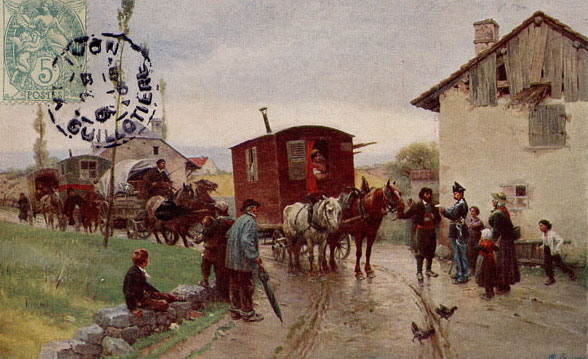
Tony’s rules and advice cover these six topics:

1) ALWAYS scald the cup

2) One cup of tea = four cups of wee

3) Overmilking in the JOE office is not something you come back from

4) Crisps and tea together are a no-no

5) The only cooked meal that goes with a cup of tea is…

6) So, what is the perfect accompaniment to a cup of tea?

Click the cuppa above for the article from Joe.ie.