This post was prompted by a few photos I recently took to document some of my projects.
I fully disassembled , repaired some problems, refinished, and did a full set-up on my Banjo. Not surprisingly, it was a bigger job than I hoped for but really paid off in the end. When I built this one several years ago it was something of a rush job while working and traveling so some details were never attended to as they should have been. The action now is great and the fretting couldn’t be better in my opinion and I already see some real improvements in playability. I’ve been happily sneaking in a little practice after breakfast on most days and even a little at lunch if I’m motivated. Finally, I’m coming back to becoming an actual player reviving skills from 30 years ago. I’m a little sad that I ever let music fall out of my daily life but better late than never I suppose.
Plain and simple; a little like me. I laminated the wooden ring from shagbark hickory with walnut inside and out. The tone ring is a Vega Whyte-Laydie design.I have never inlaid anything but I think I might give it a try sometime. For now, the peg head is an unadorned Mastertone style.The fingerboard, heel cap, and peg head covering is rosewood over a maple neck. The flame in the wood is beautiful in this one.
I you want to read about the initial construction of this one, click HERE or on the image below.
Don’t leave the kids out of the things you find important…
Nota bene! The following ramble was written at three in the morning and may contain sentiment, ramblings, and a bit of opinion. I don’t want this to sound preachy. What was intended as a few childhood pictures from primitive technology events ran away with itself in the dark hours between sleeps. ~G
Learning to shoot at an early age. Skills like this build coordination, confidence, and an understanding of the greater things in life.
There is a certain amount of balance that can become of the unique skills we gain along the path of our lives. Some people come to events, take classes, and return to the ‘normal’ life at the end of the week relatively unscathed by the learning they paid for and the time spent.
The first brain-tanned shirt and wearing it with pride. It was a hand-me-down from a friend’s daughter.
To closely paraphrase a linguistic anthropologist I knew long ago,
“Some things we love are embraced the way most people embrace their religion, they take away some message, feel strongly about it, but leave it for Sundays. When we find the thing that is our passion, we embrace it like a lover; it encompasses all our thoughts and becomes our entire life.” ~L.F.
This is how I feel about primitive skills, wilderness living, and pre-industrial craftsmanship. Without consciously trying, it just became a part of life growing ever stronger from teenage into full adulthood. While living in the consumer world, this alternative floated in the background of the mind and continued to influence activities when our child came along.
We were not perfect parents. Far from it. But we were consciously better than our own. We really tried. We learned. I sometimes wish I had it to do all over again. Overall, I think we did pretty well and were lucky in many ways. We encouraged exploration, learning, and self-reliance. By not child-proofing everything or creating needless prohibitions, we were forced to be more aware and in the present. Yes, it is probably more work and yes, it can be exhausting but children should learn their most valuable lessons at home from family, whatever ‘family’ may mean to you and yours.
Every kid and every family is different. They aren’t robots and it is clear to any observer that they have a mind and ideas of their own from a very early age. We can only steer them as best we can, present them with our ideas and beliefs, and provide the types of opportunities we think will give them a good grounding for their future lives before setting them free to try their skills in the world.
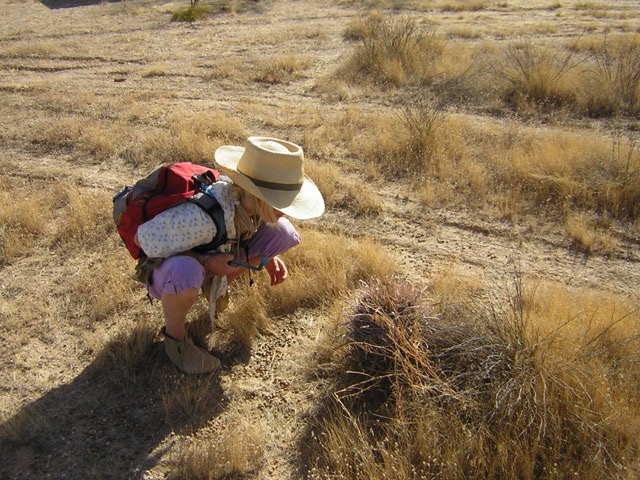
Examining a fish-hook cactus in the Sonoran desert.
It makes me sad hear or to read in social media that parents that I actually know are so down on the next generation. Complaining that they don’t go outdoors, have useful lifeskills, proudly hitting them, or even ridiculing them for using the technology they themselves provided. If that is the case, the blame is only ours! We cannot place the blame on media and movies and video games, schools, government or a general millennial malaise. It is not anyone else’s job to raise our children well. We are, to a large degree, culpable. When I hear a parent complain that their kid watches too much TV, or plays too many video games, I am baffled.
None of us are perfect, but we can give the following generations the values and ideals we may only cherish in the abstract.
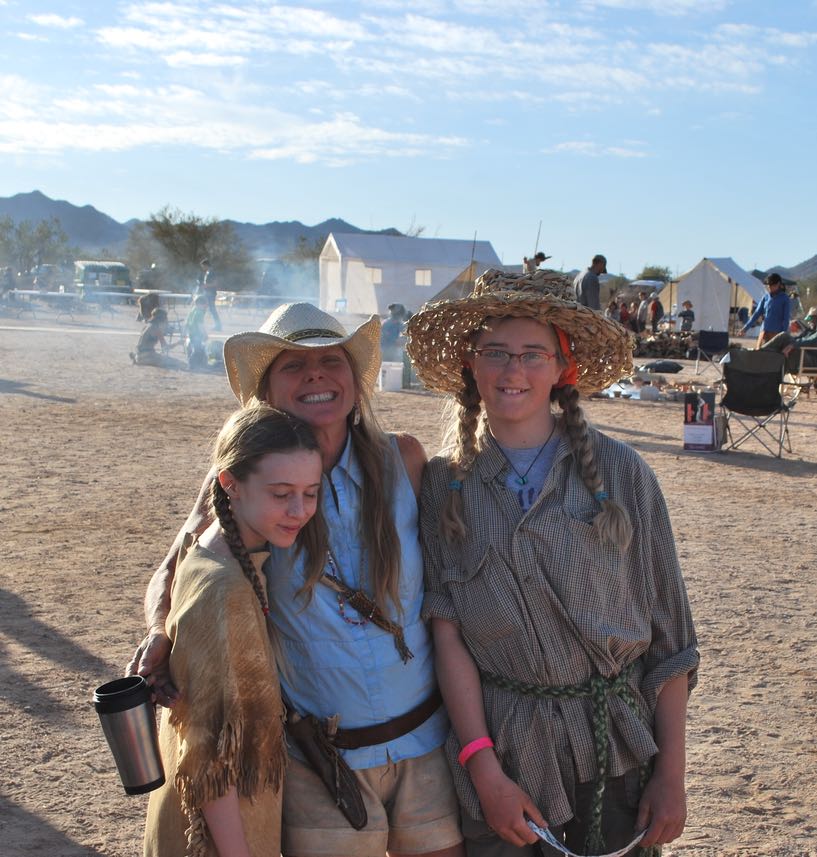
Modelling the yucca fiber skirt with her buckskin shirt. A monumental amount of yucca processing.
The intended descriptions have strayed into a hopelessly sentimental post, but anyway, enjoy some of my favorite photos I dug out recently.
Making fire in the Arizona desert 2009.
I leave you with this broad paraphrasing of Edward Abbey:
Give them the skills and encouragement to get out there and hunt and fish and mess around with friends. Let them ramble out yonder and explore the forests, climb the mountains, bag the peaks, run the rivers, breathe deep of that yet sweet and lucid air. And at the end of the day, sit quietly for a while with them and contemplate the precious stillness, the lovely, mysterious, and awesome space we call earth.
We are fed by those that surround us. Choose wisely.Blacksmithing her first knife.
I hope to see a few of you in the great outdoors very soon. And don’t forget to bring the family if you can.
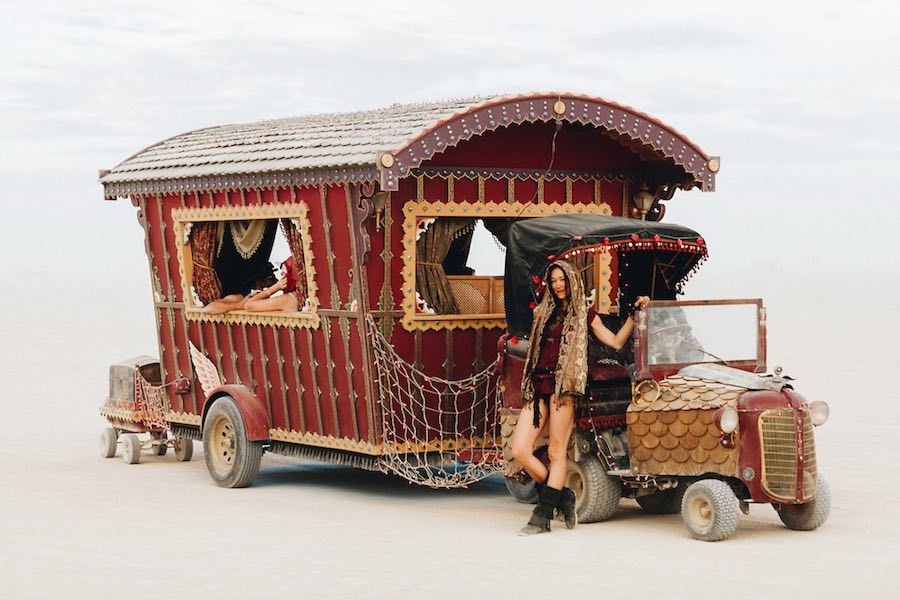
I don’t really know anything about this beautiful rig but I like what I see. A converted mower in front as a tow vehicle and it’s pulling a little trailer of it’s own behind. If anyone knows any more about this one please let me know! I found it on Tumblr but was able to image search it back to this source:
I always enjoy hearing from others who have built their own caravans, especially when accompanied by photos and descriptions. If you follow this blog you probably saw Kevin’s original photos here recently with a short post about his build. If not, you can read about it HERE.
Classic vardo layout with underbed storage, box bench seats, and slide out bed.
The perfect classic profile combining an arched roof and a beautiful dutch door.
The actual living space of a vardo is the great outdoors with the camper itself serving as a secure sleeping and foul weather quarters.
The promised follow-up is finally here as I have posted the images and text he sent. Honestly, this is my favorite kind of living wagon where old and new technologies are melded into a practical, yet affordable dwelling whether for long-term living or just overnight luxury travel. As shown here, there is a great use of fine woodworking and joinery combined with modern materials and hardware to create a rugged and practical living space that is road (and off-road) worthy.
Here is the rest of Kevin’s mighty fine vardo project (his original text in italics).
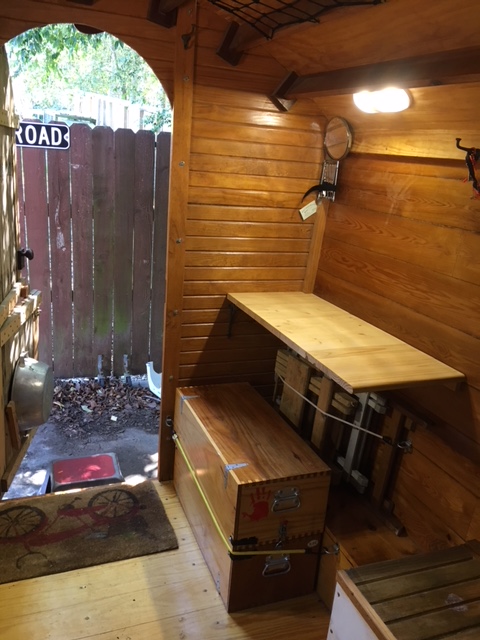
This shot offers a view of the short bench with built-in AC/Heat ducts, one for cooled/heated air (right), and one for return air (left). As well as accommodating air circulation, the bench provides handy storage. Also shown is a 110 volt outlet that provides power to the interior when the Vardo is attached to the generator or some other power supply. There are three interior outlets (the other two are hid pretty well), and three exterior outlets on the camper. There are also 12 volt power plugs inside the camper that are tied to the vardo’s battery. These are great for charging phones and running fans at night. It gets pretty hot along the Texas/Mexican border.
You can see a top view of the access doors to the under-bench storage provided in the long bench. You can also see the flip up section that turns this bench into a single bed. On the side of the door, if you look hard, you can see the hinged corbel that provides some of the support for the flip-up section. At the top of the photo you can catch a glimpse of the bungee net that provides overhead gear storage. This works very nice for carrying fishing poles and a broom.This is how the “chuck box” (cooking box) is stowed when traveling, or when not in use. The small counter top is very handy when brushing your teeth and emptying your pockets at bed time. Underneath, as can be seen, typically is stored a pickers stool, a larger folding camp table, and a folding chair.This wagon can haul a whole mess of Hunting gear. A trip to the desert requires a lot of ice and water. Everything is packed for travel, keeping the weight forward and the trailer stable on the road.A photo of our south Texas hunting camp, with the Vardo set-up. We always get a bunch of comments and compliments along the way. The wagon provides comfortable accommodations for 1-3 hunters.The chuck box gets unloaded and set up for use in camp.
This vardo looks very familiar to me and I think I’d be right at home in it. Thanks so much for sharing this with us and the community.
I love these things. I saw quite a few parked on ranches from Colorado to Idaho last week. I know they aren’t highway capable but it seems they could provide a real housing alternative for low-income minimalists. Way better than a housing complex or apartment for sure. The photos link to Ken Griswold’s Tiny House Blog. If you haven’t figured it out yet, I’m a fan of his site.
I took a fair amount of design inspiration from these wagons but added a bit of class along the way. I wouldn’t mind having a cook stove like this one though.
Off-the-shelf or build it yourself? I love these details in hand-built structures. This looks way better to me than the local hardware store option.
I always appreciate getting mail and comments on the blog; especially when someone is able to take information away and create something of their own. I recently received some fine photos from Kevin with his own Vardo build. I emailed back for more information but haven’t heard anything yet.
The wagon is a lovely and familiar design and it’s great to see it out in public alongside the more normal modern camp setting.Kevin also builds beautiful coolers that I hope to see more of in the near future. One is visible next to the vardo in the image above. Here’s the email I received and I hope to hear (and see) more from Kevin soon:
George:
Hello. I have been following your blog for a few years. I’m writing to you directly as I want to share some photos of the Vardo that I built, using yours (and a few others) for much of the inspiration. I wasn’t sure how to go about posting the photos to your blog, so I figured I would send them directly to you.
I live near Houston and own property in Buffalo Wyoming, home to a historical population of Basque sheepherders, and many currently rolling sheep wagons. Living in two extremes, I have had some issues with changes in humidity affecting the performance of the wagon and would likely do a few things differently, if I were to do it all over again (but wouldn’t we all).
I haven’t seen any updates on your Vardo-make-over in quite a while. Hopefully there’s more coming. I know the work on mine is never done. There are always items hanging around on the list of future improvements.
Let me know if you have any questions about the construction and performance of the wagon. I’m happy to carry on a discussion if your interested, and willing to send more photos if you request. You’ll notice in the photos some glimpses of one of my hand made coolers. They’re marine fiberglass coated wood on the inside, and out; built sort of like a cedar strip canoe. I built the chuck-box in the first photo as well. It travels in the rear of the wagon to be set out for camp cooking. I figured these were both items that might interest you.
“Camille Poirier patented the first back pack on Dec. 12, 1882 in Duluth, Minnesota (Patent No. 268,932). Initially called the Pack-Strap the pack is today referred to as the Duluth Pack.
The basic design of the Duluth Pack already existed in the blanket bag, or knapsack and had been in use for at least 100 years by the British Army prior to the patent, especially during the American Revolution. But Camille Poirier added a few improvements including a sternum strap, tumpline and an umbrella strap to hold an umbrella, or sunshade above the users head while hiking.
With a budding wilderness recreation movement in the USA, the Duluth Pack designed for ease of use went onto arguably become the first world’s first recreational backpack.”
“Incredibly today and over 130 years since its patent, the Duluth Pack is still is available and being made in Duluth, Minnesota, USA.
Which new products of 2012 will still be made in 2142? And what will be the determining factors for their longevity?”
A lonely life on the range. “Even if a herder does not particularly care for reading, he will be driven to it in self-defense”. This is a good story about sheepherding life. Gilfillan was a shepherd for 20 years and went on to become a humorist, author, and speaker.
“Archie Gilfillan was South Dakota’s sagebrush philosopher. His prairie wit entertained people in the ranching areas of Montana, North Dakota, Wyoming and South Dakota through the Great Depression.” The full article can be found here.

 I fully disassembled , repaired some problems, refinished, and did a full set-up on my Banjo. Not surprisingly, it was a bigger job than I hoped for but really paid off in the end. When I built this one several years ago it was something of a rush job while working and traveling so some details were never attended to as they should have been. The action now is great and the fretting couldn’t be better in my opinion and I already see some real improvements in playability. I’ve been happily sneaking in a little practice after breakfast on most days and even a little at lunch if I’m motivated. Finally, I’m coming back to becoming an actual player reviving skills from 30 years ago. I’m a little sad that I ever let music fall out of my daily life but better late than never I suppose.









 Preindustrial Craftsmanship