The other day, I was teaching a friend to sharpen his plane iron, and it got me thinking about sharpening. Of all the skills I have learned while working wood, sharpening has been the most life-changing. It started with chisels and plane irons, but then I began sharpening my kitchen knives and pocketknives. I had no idea that steel could get so sharp! It used to be that dull tools were merely inconvenient, but now I find a dull knife a heartbreaking disappointment.
I say this because I want to share a recent article on sharpening by Chris Schwarz, former editor at Popular Woodworking Magazine and current head of Lost Art Press. In it, Schwarz reflects (well, more like pontificates) on how few woodworkers actually know how to sharpen an edge tool. Even the some of the professionals who write for the big-name magazines often lack basic sharpening skills. He…
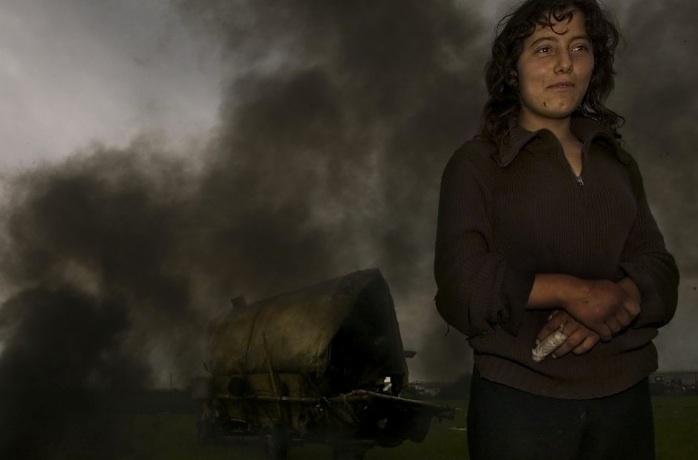
A mix of old and new technology. Horse power on modern running gear. Photo by Peter van Beek. Click the image to view the photo album.
Peter van Beek has documented the difficult life of nomads in a modernizing Europe. Fear, stereotypes, and unfamiliarity dominate their way of life and place them into a partially self-imposed, marginalized portion of society. Although there is terrible poverty, he documents family life and survival of these remarkable people.
Simple shelter as used by our ancestors since the beginning of time.It isn’t easy being a nomad in a modern technological world. There is easy place for this lifestyle.The world has changed but many traditions have not.
There are certainly exceptions to nomadism. Many Romany cling to their traditions and morph them into a new lifestyle. All of our people have done this.
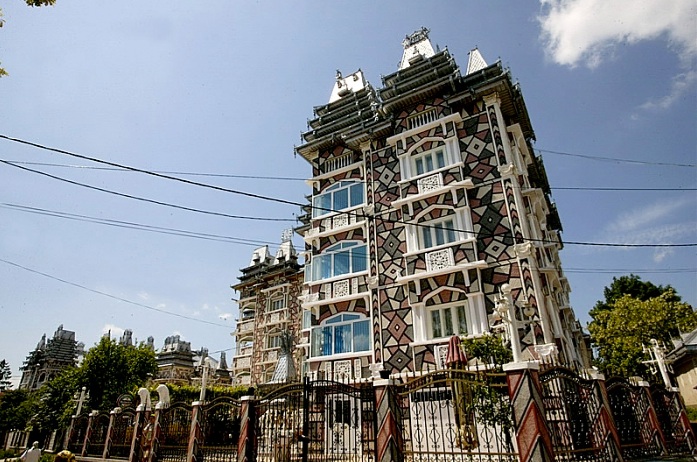
But it isn’t all oppressive poverty “By collecting and selling iron they get very rich and build their own village with huge palaces where they started living.” While settling down, the community keeps it’s own unique sense of style.
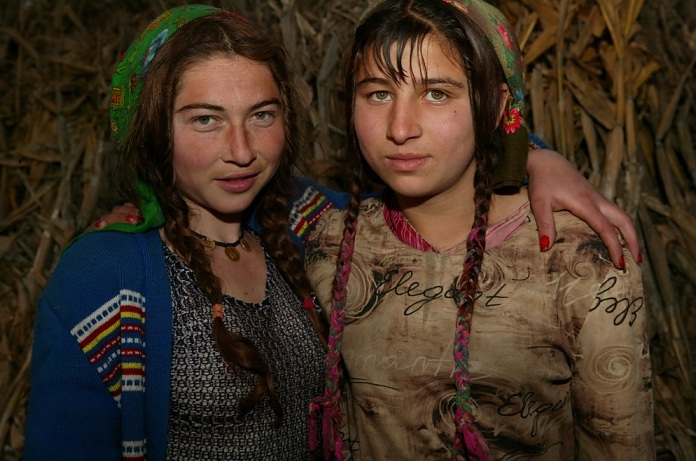
Hard work and some flexibility can make assimilation slightly easier.Ethnic identity shows in this vernacular style.Beautiful young women with a foot in both worlds.
“Many Kaldarash people (the coppersmiths) still wear colorful clothes, living in a beautiful traditional way. In some villages, time seems to stand still.”
From Peter van Beek’s website:
“The only nomadic gypsies in Europe live in Romania, the country that joined the European Union in 2007. Living a hard life in Romania these semi-nomadic people hold on to traditions and rituals. Amongst them are story-and fortunetellers, musicians and coppersmiths. Despite a law against nomadic life these gypsies still live in their harsh and remarkable way.”
Images found at Peter Van Beek Photography. Check out his beautiful work and consider buying his book about the Roma:
Scenes of life on the road and around the campsites.
October 1951: Mrs Robert Matthew, an MP’s wife, campaigning at a gypsy encampment.Kids at the campsite.A classic image of Traveller children.Modern gypsies (Romany) in their simple accommodation.I really love these little bender tents.A fine caravan for a successful traveller.
This is part of a series of images, mostly Romany, Irish, and Scottish Travellers collected from around the internet. Many of these historic images found on the web are without citation. When a clear link to a source is found, I try to include it. If a source is known, please pass it on and I will gladly include it or remove it if necessary.
A tiny accommodation, side entry single horse style. It is documented that the adults with this style wagon generally slept outdoors except in very bad weather. It was a good way to confine the children and the valuables.
This is part of a series of images, mostly Romany, Irish and Scottish Travellers collected from around the internet. Many of these historic images found on the web are without citation. When a clear link to a source is found, I try to include it. If a source is known, please pass it on and I will gladly include it or remove it if necessary.
Wonderful rolling home.
This is part of a series of images, mostly Romany, Irish and Scottish Travellers collected from around the internet. Many of these historic images found on the web are without citation. When a clear link to a source is found, I try to include it. If a source is known, please pass it on and I will gladly include it or remove it if necessary.
A painting by the Scottish artist John Burr (1831-1893). Tinkers were originally tinsmiths or “tinners”. One of many itinerant jobs pursued by a class of casual laborers. These were mostly skilled and specialized crafts like basket making, shoe repair, leather work, and metal work but many poorer workers were migrant farm labor picking hops and tending the market gardens during the peak harvest. The fellow in the image above appears to be a fairly well-off repairman mending a seam in a pot. This from a time when new items were a rare purchase.
I love deciphering images like this for the details of domestic life. Unlike most photos, there is real intention in what the artist chose to include or not in the painting. The house is clearly a poor one but a freshly killed chicken hangs from a nail on the wall by some dry roots. A handmade broom leans against the wall next to a basket that has the tradesman’s coat lying across it. The oldest daughter tends the infant while the mother stands by the laundry basin with a toddler behind. All the children look on while the novel worker plies his trade in a waistcoat and hobnail walking shoes.
Stitching Pony, Leather Worker’s Clamp, or Saddler’s Clam…
Whatever you call it, it is a handy device to own if you sew any leather. These are simple devices that just about anyone can make with little time or money invested. Although there are many varieties and models, the one shown in this tutorial by Harry Rogers of Bucklehurst Leather is the one I have most commonly seen. Is there no end to this man’s skill and diversity of talents?
The only comments I really have are:
YES, the jaws should be lined with thick, smooth leather and that the gap is necessary to keep the jaws as flat as possible against the work. It is also nice, but not necessary, to have a compression spring over the bolt to push the jaws apart when loosened. And finally (terrible way to open a sentence in writing I know), a recent comment from a friend suggested that the tightening nut could be replaced and a better system be devised from a bicycle quick release axle. Maybe on the next one.
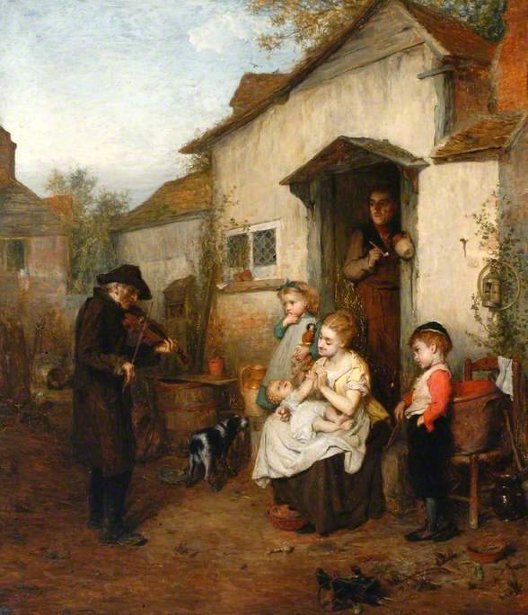
Here is a painting by the Scottish artist John Burr (1831-1893) of an itinerant fiddler playing for a family in a Scottish lane probably trying to make enough money to eat or maybe even receive some food for his entertainment. I can’t help but think the father looking out has a skeptical look; possibly wondering what this will cost in the end.
Music and storytelling were a very different commodity in an age of widespread illiteracy and 24 hour media. It’s hard to even imagine a time when all music was handmade and intimate and not an item to be mass marketed.
When teaching a leather craft or making an item for someone, I am often asked about the machine used to sew such thick leather or through so many layers in tight areas. People are often astounded when I explain that this is all hand sewn, with an awl and two needles.
Some earlier work. Good, but not great, stitching.
I learned saddle stitching before the internet was a thing and without a book. I was sewing leather bags, moccasins, and clothing in a relatively poor and untutored way. As I became more savvy over the years I was able to analyze older pieces and read an article or two about saddle stitching and cordwaining that began to make my work look more professional.
Saddle stitching is the only way to build a large, complex leather project without some ridiculously expensive machinery.
While I have considered making a video to give an introduction to saddle stitching I know there are many master craftsmen out there far more skilled to do this properly. One of them is Nigel Armitage of Armitage Leather. He is a member of the Guild of Master Craftsmen of Britain which I understand is nothing to sneeze at (I can hardly imagine the level of dedication most of these men and women have for their crafts).
On to the show…
This is probably the best and simplest tutorial I have seen online about learning the basics of saddle stitch. If you are new to this, remember, the pricking iron is not an absolute necessity for starting out but it will make you seams straight and beautiful. If you don’t own one, you can still mark and follow a line or even mark the stitches with a ruler and awl (I did this for a very long time).
I hope this answers some question for those getting interested in leather work and saves you some of the headaches I experienced without proper instruction.
I really love these family photos generally taken in front of the wagon.
Scottish Travellers is a loose term that covers many diverse peoples in Scotland and even beyond. Here, I’m primarily looking at the indigenous folk who seem to be descend from an in situ population of itinerant craftsmen and laborers.
Scottish Travellers, or the people termed loosely Gypsies and Tinkers in Scotland, consist of a number of diverse, unrelated communities, with groups speaking a variety of different languages and holding to distinct customs, histories, and traditions. There are three distinct communities that identify themselves as Gypsies or Travellers in Scotland: Indigenous Highland Travellers; Funfair Travellers, or Showmen; Romanichals (a subgroup of the Romani people) and Lowland Gypsies.
Indigenous Highland Travellers –In Scottish Gaelic they are known as the “Ceàrdannan” (the Craftsmen), or less controversially, “luchd siubhail” (people of travel) for travellers in general. Poetically known as the “Summer Walkers”, Highland Travellers are a distinct ethnic group and may be referred to as “traivellers”, “traivellin fowk'”, in Scots, “tinkers”, originating from the Gaelic “tinceard” or (tinsmith) or “Black Tinkers”. Mistakenly, the settled Scottish population may call all travelling and Romani groups tinkers, which is usually regarded as pejorative, and contemptuously as “tinks” or “tinkies”.Highland Travellers are closely tied to the native Highlands, and many traveller families carry clan names like Macfie, Stewart, MacDonald, Cameron, Williamson, and Macmillan. They follow a nomadic or settled lifestyle; passing from village to village and are more strongly identified with the native Gaelic speaking population. Continuing their nomadic life, they would pitch their bow-tents on rough ground on the edge of the village and earn money there as tinsmiths, hawkers, horse dealers or pearl–fishermen. Many found seasonal employment on farms, e.g. at the berry picking or during harvest. Since the 1950s, however, the majority of Highland Travellers have settled down into organized campsites or regular houses.
Origins and customs
The Highland Traveller community has a long history in Scotland going back, at least in record, to the 12th century as a form of employment and one of the first records of that name states a “James the Tinker” held land in the town of Perth from 1165-1214 and share a similar heritage, although are distinct from the Irish Travellers. As with their Irish counterparts, there are several theories regarding the origin of Scottish Highland travellers, one being they are descended from the Picts, excommunicated clergy, or exiles from the pre-Norman-Invasion. Highland travellers are distinct both culturally and linguistically from other Gypsy groups like the Romani, including the Romanichal, Lowland Scottish Travellers, Eastern European Romani, and Welsh Kale groups. Several other Continental European groups are related to the Scottish Highland Travellers, and share similarities to other non-Romany groups across Europe, namely the Yeniches, Woonwagenbewoners in Holland, and Landfahrer in Germany. As with Norwegian and Swedish Travellers, Highland travellers origins may be more complex and difficult to ascertain and left no written records of their own. As an indigenous group Highland Travellers have played an essential role in the preservation of traditional Gaelic culture. Travellers’ outstanding contribution to Highland life has been as custodians of an ancient and vital singing, storytelling and folklore tradition of great importance. It is estimated that only 2,000 Scottish travellers continue to lead their traditional lifestyle on the roads.








 Preindustrial Craftsmanship