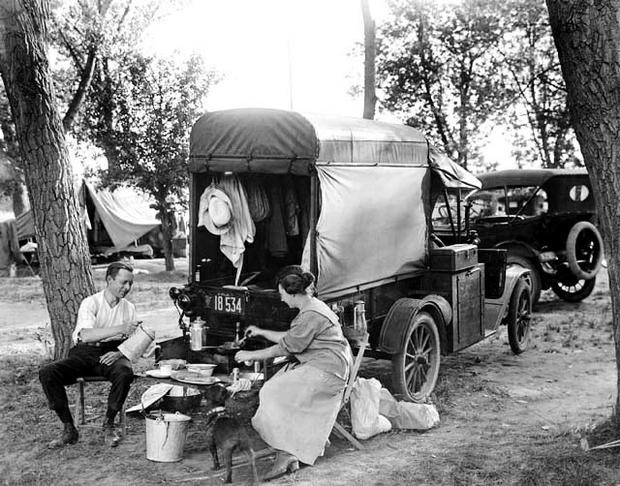
A little car camping in 1918. No attribution found.
In the heady days of 1918 while the German threat was being finished off in Europe Americans began to take leisure time in a new direction. Automobiles were almost commonplace and Yankee ingenuity was applying itself to this new platform of creativity. Patents were being filed to sell improvements on the original designs while pioneer camping technology was far from lost. Money was tight for the average person and the economy was devastated world-wide encouraging frugal holidays.
There is a little stove on the pull-out, a hurricane lamp on the side shelf, and just enough of the comforts of home under the wagon cover to make for an easy vacation.
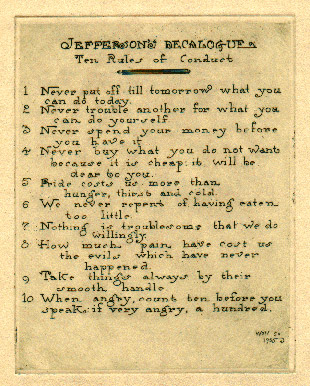
Thomas Jefferson wrote reams of good advice, important political philosophy, the Declaration of Independence, and many other things (which is why we know so much about him). To some of his younger relations he sent his favorite “Rules of Conduct” to help the people he cared for better and more insightful humans. These thoughts evolved over time so versions vary slightly depending upon the source. Here is a facsimile of the ten point “rules” with a slightly different version spelled out below.
Thomas Jefferson’s Advice.
Never put off to tomorrow what you can do to-day.
Never trouble another with what you can do yourself.
Never spend your money before you have it.
Never buy a thing you do not want, because it is cheap, it will be dear to you.
Take care of your cents: Dollars will take care of themselves.
Pride costs us more than hunger, thirst and cold.
We never repent of having eat too little.
Nothing is troublesome that one does willingly.
How much pain have cost us the evils which have never happened.
Take things always by their smooth handle.
Think as you please, and so let others, and you will have no disputes.
When angry, count 10 before you speak; if very angry, 100.
Portrait of Thomas Jefferson by Charles Peale, 1791.
Despite some obvious flaws that glare in the light historic hindsight, Jefferson was steeped in classical philosophy and was a great thinker in his own right. If we all could live by these rules the world would be a better place.
And finally, while providing an outline for his daughters’ education he suggested while he was away on business:
“With respect to the distribution of your time, the following is what I should approve:
From 8. to 10. o’clock practise music. From 10. to 1. dance one day and draw another. From 1. to 2. draw on the day you dance, and write a letter next day. From 3. to 4. read French. From 4. to 5. exercise yourself in music. From 5. till bedtime, read English, write, &c.
..I expect you will write me by every post. Inform me what books you read, what tunes you learn, and inclose me your best copy of every lesson in drawing. Write also one letter a week either to your Aunt Eppes, your Aunt Skipworth, your Aunt Carr, or the little lady from whom I now enclose a letter. . . . Take care that you never spell a word wrong. Always before you write a word, consider how it is spelt, and, if you do not remember it, turn to a dictionary. It produces great praise to a lady to spell well…
If you love me, then strive to be good under every situation and to all living creatures, and to acquire those accomplishments which I have put in your power, and which will go far towards ensuring you the warmest love of your affectionate father,
Th. Jefferson”
He was known, like most of us, as a far-from-perfect father but his advice was sound. Three hours of music per day, be good to all living creatures, draw, dance, and read. Obviously, this advice applies to the wealthy and elite who do not toil all day but even in the modern world there are worse ways to spend an idle day.
I’m just going to stretch the imagination and say this is Clark Gable and Joan Crawford just prior to christening this little home (or maybe just after, he does look a little sweaty).
Here is a wonderful tiny home with Clark Gable and Joan Crawford eyeing each other up on the front porch. It appears to be strapped to a regular flatbed trailer, presumably for delivery to its final destination. There is nothing new under the sun.
Anthelme Trimolet (Anthelme Claude Honoré Trimolet, born 8 May 1798, Lyon – died 17 December 1866, Lyon) from the Musée des Beaux-Arts de Lyon.
I have stared at this painting for quite some time. There is a lot to unpack from this one if you have any interest in hand tools. This image is of a very organized workshop of a master craftsman plying his trade in the early 19th century. I feel he is consulting with a client about a commission they are undertaking and discussing the finer details. Click the image for a larger version and enjoy.
This is the prototype saw I used for teaching a bushcraft class at Echoes in Time in 2014. Unfortunately, a split in the original wood spread last winter and I had to rebuild it. Actually though, that is a beautiful thing when you can make your own tools. I didn’t spend any abstract money for a new one, I didn’t have to trow away some sort of useless and polluting garbage, and I could readily improve the design based on several year’s use and observation. I’ve sold about 20 of these now so the pattern is firmly ingrained in my brain and sinews while tweaking each batch to make them more pleasing to use and efficient to make. without losing the aesthetic of this ancient design.
Saw ready for assembly.
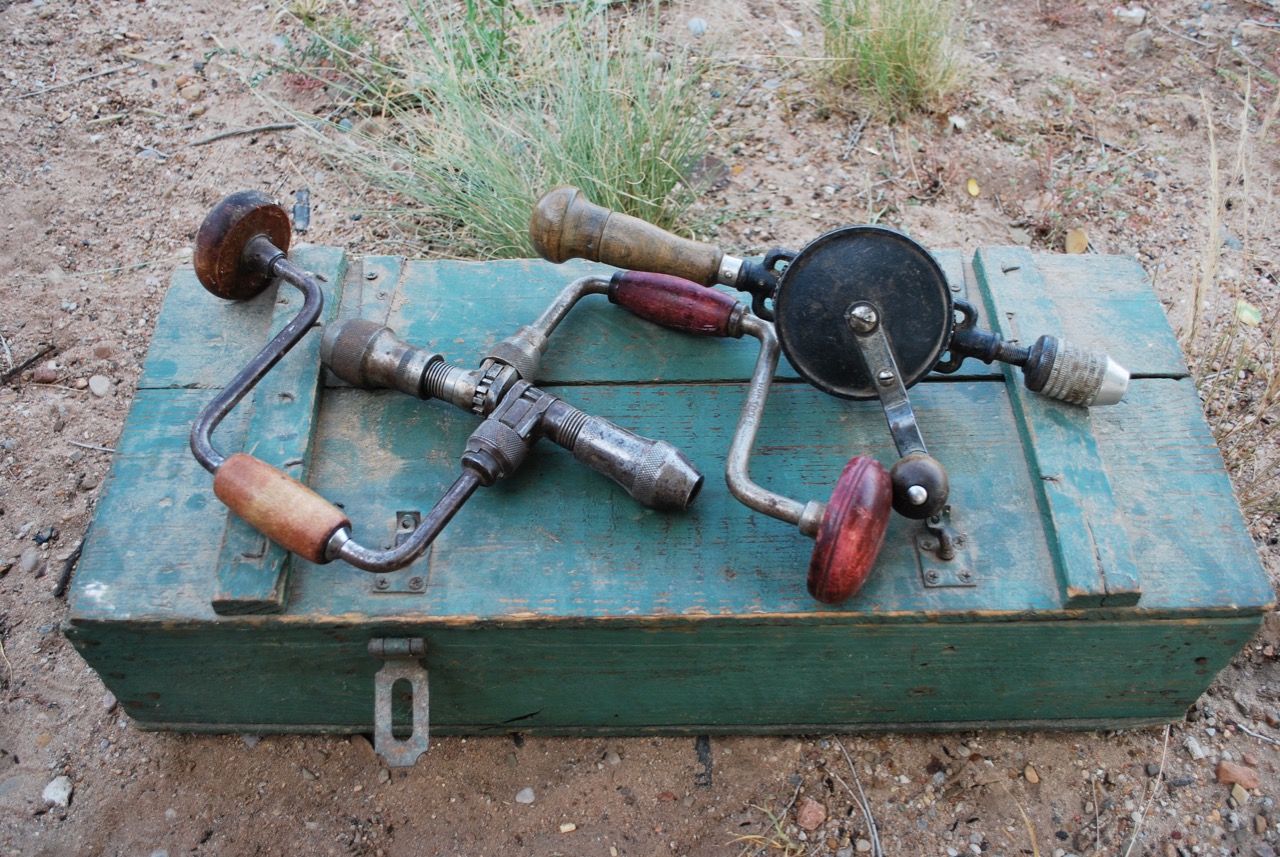
It has been a very successful class for me at both Winter Count and Rabbitstick over the years and I’ve honed the teaching so that each student can really get them most out of it. Not only is there basic shaping and carving, but also learning to make a simple blind mortise and tenon joint, drill holes by hand-power, and think about design options. I hope to be teaching this one-day class again soon as it is a great introduction to hand woodworking while building a manageable and extremely useful tool.
In my internet sleuthing I have gathered literally thousands of images, plans, and patterns of things I would like to make or have for reference. Government documents, like the scans below, are invaluable resources for the maker when they are made public. Who would know how to better and more efficiently make a pair of riding gloves than the U.S. Cavalry. This design is the culmination of more than 110 years in the business.
Click the pattern for the full-sized image. Scale to fit the dimensions shown for the standard sizing or scale them to fit your hand, be it a tiny little paw or oversized ham (note the three sizes on the pattern).Part of the fun is learning the names of the parts; I had no idea there was even such a thing as a quirk in a glove.
I hope to get around to making a pair soon myself but please let me know if you have any success when you try these. Thanks for reading and please click “Like” or leave a comment if you have one.
I’ve been out of circulation this past week due to an accident that has laid me low. I am physically out of commission, and may be for some time, but look forward to the coming weeks and months as I recover this unforeseen setback. Down but not out yet!
This thought feels more pertinent than ever right now. Instead of just finding faults in others, I think it wise to examine who else stands on the side you are on. Are these the people you want to be?
The object of life is not to be on the side of the majority, but to escape finding oneself in the ranks of the insane. ~Marcus Aurelius







 Preindustrial Craftsmanship