Making Tools

Back to the beginnings.  Larry Kinsella is a great flint knapper and an all-around talented guy who, amongst other things, recreates stone-age technologies from his home near Cahokia Mounds State Historic Site (one of the great cities of the prehistoric world) in Illinois.

archymo-2
A 6.35 kilogram (14 US pound) nodule of Burlington chert.

Back in 2008, Larry, prompted by Tim Baumann, created a great lithic experiment for a Missouri Archaeology Month poster.

On May 28th,2008, Larry received an e-mail from Dr. Tim Baumann:
Larry, “I still need your help with the Missouri Archaeology Month Poster.
The theme for 2008 is prehistoric lithic resources in Missouri. The back of the poster will have unmodified samples of chert and other lithic resources used by Native Americans in Missouri. I am working with Jack Ray and utilizing his new book on Ozarks lithic resources. Jack is also organizing the fall symposium on this same topic, which will be held on Saturday, Sept.27 at Meramec State Park in Sullivan, MO. If you would like to give a presentation at this event, please contact Jack.

For the front of the poster, I would like to show the entire assemblage of lithic debitage and tools made from a single Burlington chert cobble or similar light colored chert. I was hoping that you and/or some of your friends at the Devil’s hole knap-in would be willing to supply the raw material and muscle to create this assemblage. I will then take the debitage and tools and arrange them with a computer design program into a spiral pattern with a background of obsidian or another dark colored lithic source.”
Since this original contact, a few things were changed. Pete Bostrom was asked to do the layout and photography, for one.
As with any project, unexpected hurdles arise and it’s up to the participants to modify their strategies and adapt to those hurdles.
 
First:
     After Larry blanked out the nodule, it became apparent that he was producing much more debitage and many more tools than he had anticipated. That’s when he decided to stick with only a Late Archaic Assemblage. The wide variability in point sizes, shapes, and chert, along with the occurrence of many different types of chert tools, during the Late Archaic, seemed to gravitate toward that time period. Also, the tools could have been heat-treated if the stone had not worked as well as it did.
Second:
   It also became apparent that this project presented a unique opportunity to try to understand the amount of material needed to produce certain point types. So, after the initial photograph of the raw nodule was taken by  Pete Bostrom, and at the suggestion of Dr. Baumann, Larry saved all debitage, from all the point-making attempts, separately. This provided the opportunity to not only see what type of point could be made from a single spall but also, the other tools could be isolated to their specific spalls.
Third:
The sheer amount of material produced during the project, presented Pete Bostrom with problems too. How could he possibly display all that material and make it interesting to the general public? After all,  that’s what the poster’s supposed to do, get the general public interested in archaeology.
So:
1) It was decided to keep all debitage, from each spall, separate.
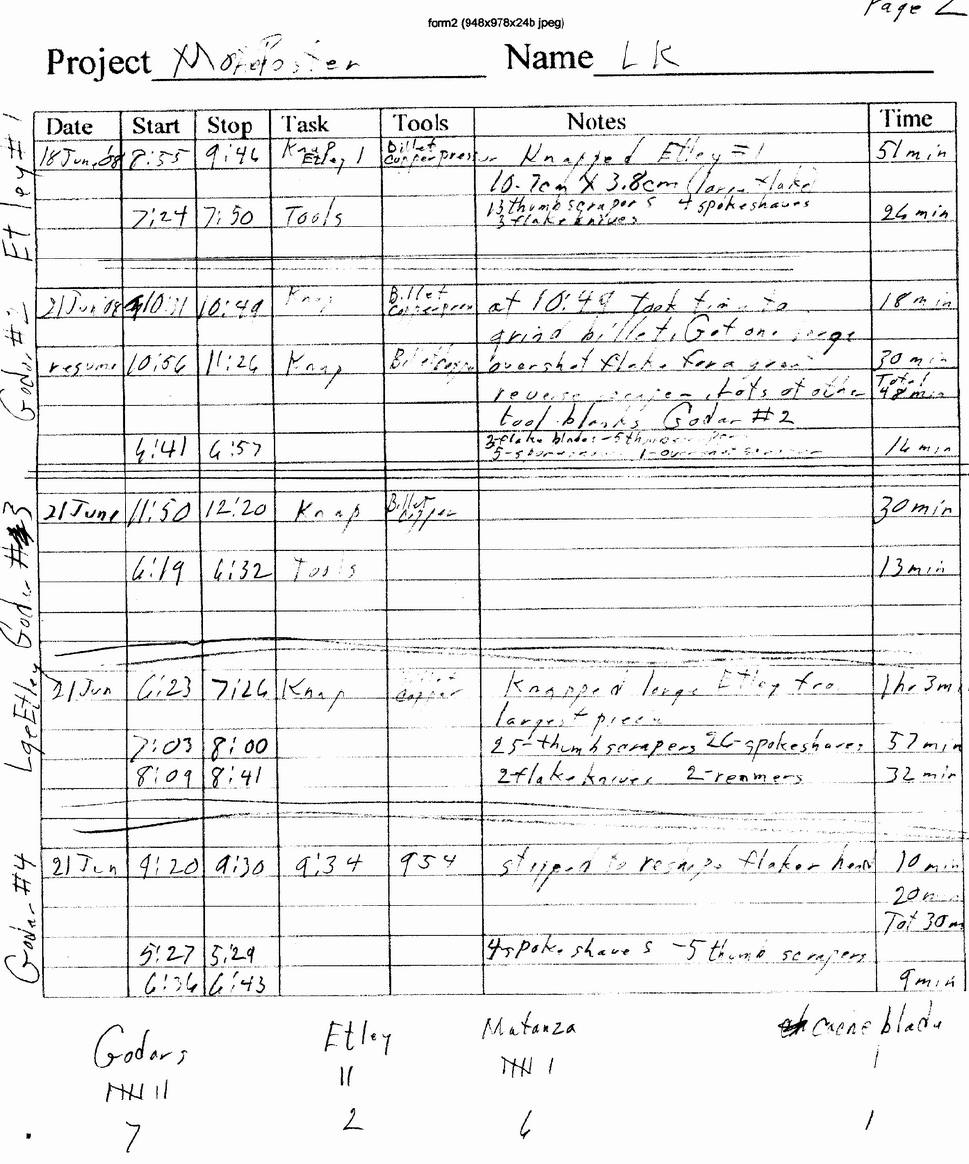
2) Keep separate notes and times on each spall using Larry’s pre-printed forms. Like this:
3) Photograph the resulting point types with their debitage.
4) Use the debitage from each point to make additional tools.
5) Photograph each point type, its additional tools, and debitage, together.
6) Screen all debitage, from each spall, through window screen, to determine how much chert grit would have been available to do core-drilling for other projects, such as, drilling bannerstones.
7) Weigh all materials. (Dr. Bauman weighed all the material, in Larry’s absence, due to surgery).
8) Present Pete Bostrom with all the material so he could lay out and take the photographs for the poster.
9) Present the photos to the printer so the posters could be made.
 
Moposter-1
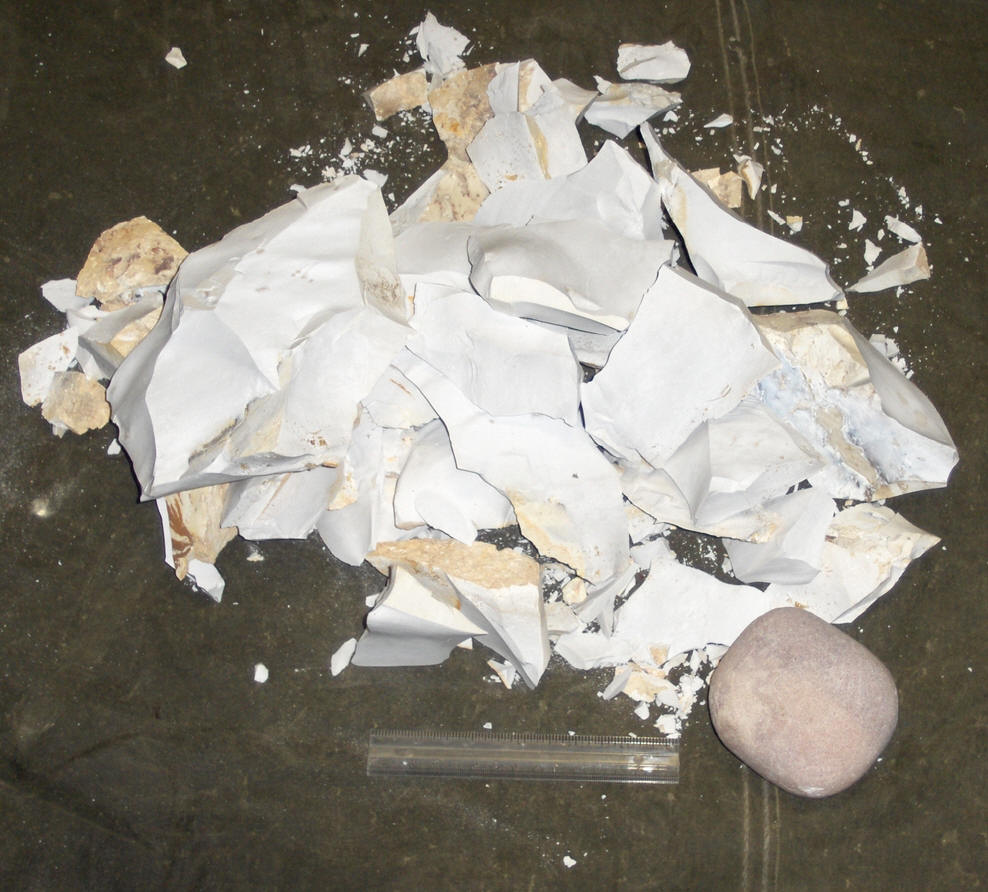
Initial reduction from core to useful materials.

After reduction, each piece took it own trajectory and became a projectile point, other tool, or was cast away as debitage.  Students of archaeology (and some professionals I know) can learn much from this type of experiment by examining the range and number of flaking debris generated in a single reduction episode.

nodule14lbgrouplargeAfter Pete received the materials, he created this excellent poster which is a remarkable work of art in its own right.  Have a look at Larry’s pages explaining the process and learn something of the universal human technology that put us, for better or worse, in the place we are today.

Henry Miller, a fine young man

Definitely watch this if you believe in a real handcrafted lifestyle.  He has obviously been given the right encouragement and access to knowledge.  Many parents would scoff at these things or actively discourage some of these activities.  I’m glad to know there are other parents out there with an open mind and encouraging this thirst for knowledge.  It’s a fire waiting to be fanned.

Handcrafts

Some craftsmanship seen at Winter Count 2014.  Moving a little closer to a hand-made life, one skill at a time.

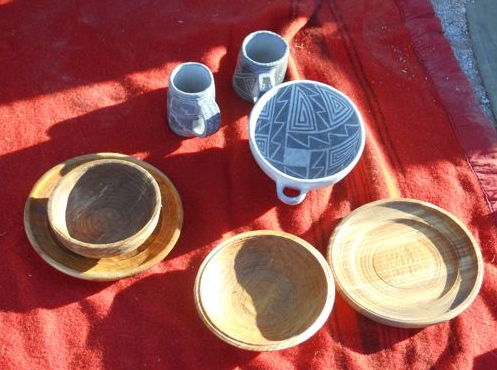
Ceramics by Roger Dorr, Woodwork by Mick Robins.

Hand made pottery made by artisans who collect the raw clays, slips, and paints make for greatly loved cookware and cups.  Wood turned on a foot-powered lathe from cleared alder trees make for intimate dinnerware.

Pots
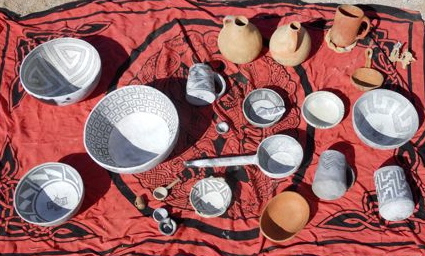
The wares of just one of the many great craftspeople associated with Backtracks and the Society of Primitive Technology.

Many cultures are represented at the gatherings but in the Southwest, the black-on-white ceramics dominate the fancy wares.

Packbasket
Packbasket

Packbaskets are found worldwide but only in small sectors of the western population.  This one is particularly beautiful.

Making a bowl by burning and scraping.
Making a bowl by burning and scraping.  Delicious ducks roasting in the background.

Even a simple bowl can be a satisfying accomplishment when it holds it’s first meal.

Fresh deer skins being turned into buckskin.

A lot of time and labor goes into dressing a fresh deer hide but the payoff is immense.  Buckskin clothing will last for many many years.

Perfectly tanned hides by "Digger".
Perfectly tanned hides by “Digger”.

Skilled artisans and craftsmen can make the best customers as they know and understand the care and effort that goes into a handcrafted project.

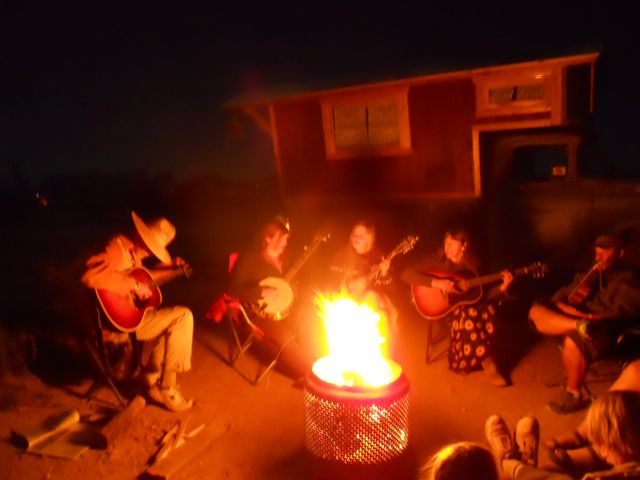
musicThe talent doesn’t end with the crafting of artifacts.  People who “Make” have skills that reach far beyond the world of modern consumption.  The primitive technology crowd brims over with artists and musicians of many types and genres.

More making, less taking.

Ghillie Making at Winter Count 2014

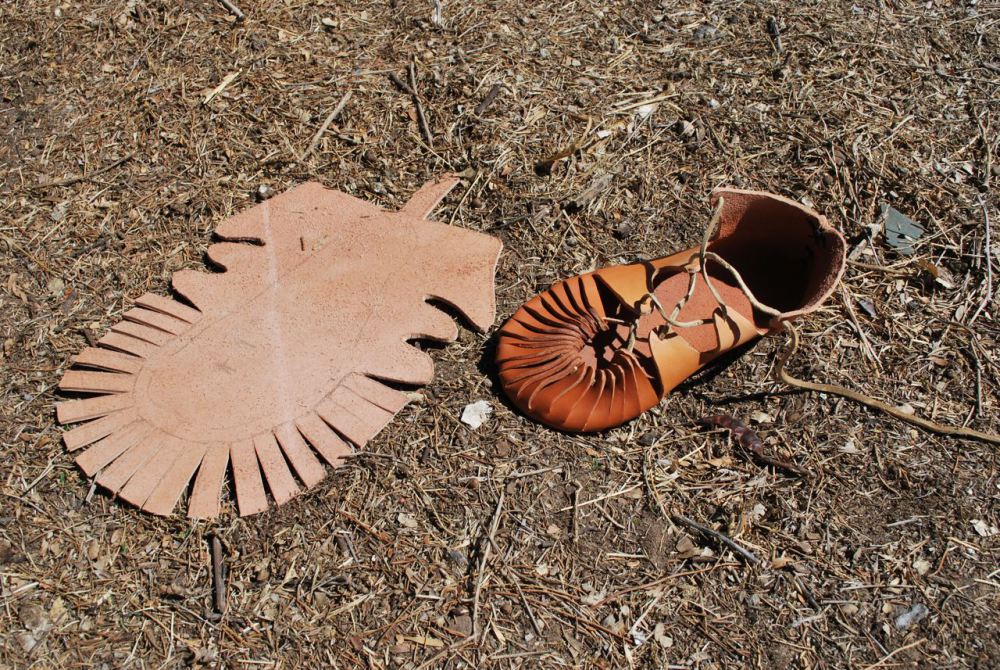
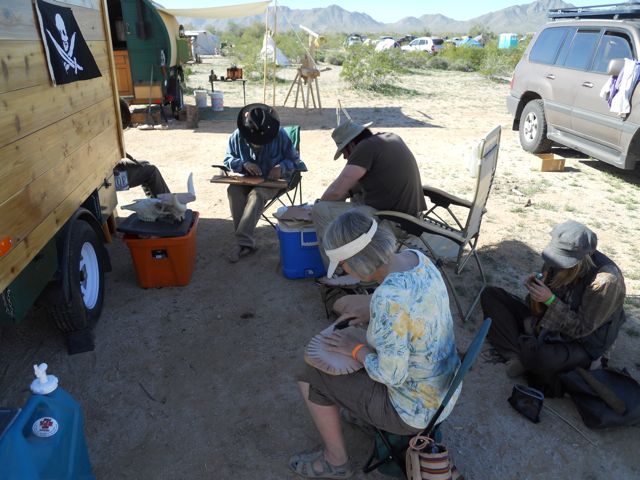
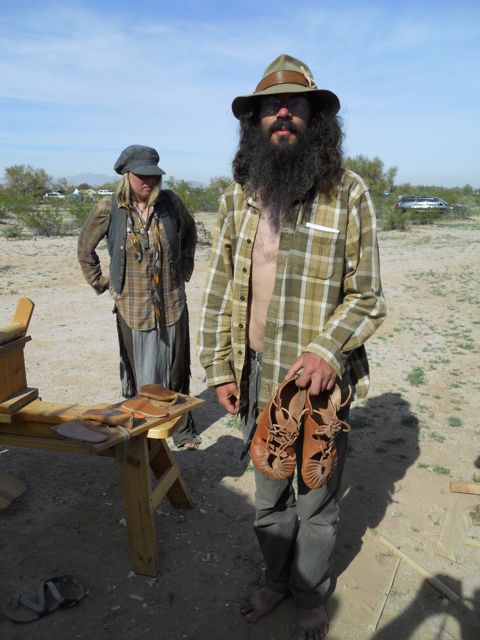
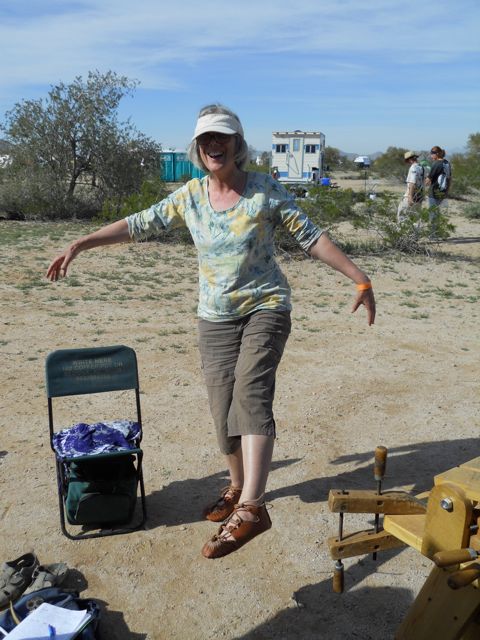
One of the many things taught at Winter Count this year was shoe making in the form of carbatina or ghillies.  These are relatively simple shoes notable for their one piece construction and generally involve very little sewing.  I am interested in how things are learned and for me, the process is more important than any other aspect.  Hopefully, students take away some knowledge that they can apply beyond the class setting and in an afternoon can learn something that they can use for life.

ghillieHistorical examples vary widely but tend to have a lot of similarity in the complex toe-cap.  Shoes are a difficult piece of clothing and protection because the fit is critical and even minor problems with the shoe will impact the feet in a negative way.

Marx-Etzel2The toe cap is formed by strips of leather overlapping which gives flexibility and room for expansion.  The simplest forms are one piece but better versions are found with insoles and outer soles to extend the life and create a sturdier shoe.

DSCN4029 DSCN4030 DSCN4031 DSCN4033 DSCN4034These were all made from premium oak tanned leather (ca. 8 oz. or 3.2 mm) which proves to be tough to cut but provides a long lasting shoe.  It was a great set of students in the classes and I think we ended up with 17 pair of shoes in the end.

An earlier post describing my journey into Ghillies can be found HERE.

Ultra Minimalists, Part 1

Learning a thing or two from the past…Part 1, 21st century americans are not the first to minimalize.

kylixdonkey
How much stuff do we really need to lug through life?

This is a lengthy ramble.  So long in fact, that I have broken it into several posts to be trickled out over the coming days, weeks, or months.  Skip on to the fun stuff if you aren’t interested in Minimalist* philosophy.  There’s a lot of recent talk about Minimalism as a social movement.  Not long ago, it was associated with artists and aesthetes, wanderers, mystics, and philosophers.  That is to say, the fringe element, outsiders, and weirdos.  These things come in cycles and I think, as a backlash against generations of sell-out philosophy and the creation of a professional consumer class, many people are reaching for something new.

We come to learn that everything old is new again.

I’ve been looking into history and prehistory on a full-time basis for many decades now.  As hard to believe as it may be, I even get paid a salary to do it.  One of my professional interests involves tools, tool-kits, and strategies for surviving that various people have come up with for dealing with the world.  As a primitive skills-survival instructor and full-time frugalist I think it important to not reinvent a lifeway when we have millennia of ancestors who dealt with most of the same issues we do today.

San
A San bushman demonstrating fire-making.  Ostrich egg canteen in the foreground.

For most humans, for most of our history, owning too much stuff has never really been an issue.  We had what we needed and either made what we needed or did without the things we didn’t have.  It brings a smile to my face to know that more than 2,400 years ago, well-to-do people in China, India, and the Middle East were contemplating the nature and evils of acquiring Stuff; even writing about it.  That’s not to say that I have immediate plans to become a wandering mendicant like a medieval friar (as appealing as that might sound to some) but I do have an interest in lightening my material load and some very specific goals for the coming year.

mendicant

My foundation as a minimalist – I have been thinking about what stuff a person needs to survive since I was a teenager.  Like virtually every young boy, I had grand ideas of escaping the family and traveling unhindered across the world.  I devoured Jack London and Mark Twain stories as a kid.  I loved the extensive and well-thought out gear lists provided in the Boy Scout Handbook, the Explorer’s Handbook, and the Philmont Guides.  I read Larry Dean Olsen’s great book of Outdoor Survival Skills and Colin Fletcher’s The Complete Walker.  I read about the mountain men of the fur trade, and always, took note of what they carried or didn’t seem to need.  I would copy lists into a notebook and ponder them while sitting in some boring high school class, making my own lists of what I have, what I need, and what I want.  This thinking encouraged me to work and save money to buy a better knife, backpack, or stove.  I was probably the only kid I knew who wanted, and got, a file and whetstone for Christmas one year (my grandpa was good that way).  My friends and I spent our teens and early twenties hiking and camping year round, mostly in the woods of the Ozarks in southern Missouri testing our mettle at that time in life time when all teenagers know they are invincible.  Some of us even made it to Europe, Asia, Africa, and beyond.

BooksIn a modern sense of survivalist, many people look to the military or the loonies of teh mainstream media.  Often, military service is the time when young men and women are introduced to such things for the first and only time.  Realistically however, the military itself acknowledges it’s shortcomings on a personal basis as (with the exception of a few special operations units) its entire system is dependent on lengthy and complex supply lines, support chains, and de-emphasis of the individual and personal decision making.  Military survival is therefore, approached as a means of keeping alive until help arrives.  Great for fighting a war, but not always so good when you are turned loose into the world.

Coming up next…Ultra Minimalists Part2.   Let’s look at a military example anyway: Romans.

legionary

* here are a few links to modern Minimalists of various ilks and philosophical merit.  A journey through these links will hint at the breadth and depth of people on different paths but moving in the same direction.

Read, research, think, and enjoy!

Go to Part 2