Building Your Own Vardo

I began version one of my Vardo Caravan eleven years ago this month.  As I published updates and details along the way people have for a detailed “how to” for building a vardo.  Since everyone’s needs, skills, and resources are different, I will leave the task to others.  My suggestions are this.  Decide on your basic design wants.  Traditional or modern construction?  Consider size and weight (I went for the minimum of both).  Consider materials.  This will determine construction technique.  As for traditional or modern?  Go look at some used RVs for sale and see how flimsy they are built; not to mention probable issues from toxins in the plywood, pressboard, adhesives, plastic veneers, etc.

Drink in as many details as possible about other wagons.  Are they for show or can they take the hammering of bad roads?  How do you think they will hold together in a wreck?  What kind of long-term maintenance are you prepared to perform?  This is why modern RVs are covered in sheet metal or plastic.  If you convince yourself that you want to use materials others don’t, then ask yourself why.  Are you building an RV that looks “old fashioned” or are you deciding to build with traditional techniques?  (Neither is bad, but it may not be practical to mix and match).

Final sketch that built the Vardo.

Above is the written plan I used to create the Vardo.  This is obviously not exactly how it turned out as changes were made based upon availability of materials and constant reconsidering of different options.  The essentials didn’t change.  This is how the arc of the roof was calculated and overall dimensions worked out.  I chose to use traditional techniques and plywood only in the ceiling (for ease of building and stiffening the structure).  Although glue is used in some areas, the structure depends upon screws and bolts in all critical areas.  I decided I was willing to maintain my wagon so the exterior finish is simple oil paint over wood.

Sketch, sheet 2.

The second sheet of the plan was mostly used as a way to gauge sizes, raw materials, and habitable space.  I didn’t really build from the sheet.

Figuring it all out.

This is just one of many sketches used to figure out space and arrangements.  I looked at Irish Open Lots, Vardos, Bow Tops, and Sheepherder wagons.  With so much experience out there, the best arrangements have been worked out many times over.  Here’s the link to the rest of the photos from the build: https://paleotool.wordpress.com/plans-projects-and-patterns/the-vardo/

Study and read as much as you can about what you want to build.  Make many sketches and plans.  Cut out little scale paper dolls to measure out spaces if it helps. 

Make a model.

Take a deep breath. 

Dive in.

Moccasin upgrade time again

DSC_0003

These ratty old moccasins have spent a lot of time in the woods.  These have been my winter moccasins for over two decades.  I can’t remember exactly when I made them but it was a quick and dirty sewing job.  They have been re-soled at least twice and need it again.  The uppers are an oil-tanned leather I bought from a saddle and boot maker supply house I found while driving through north Texas.  As can be seen, the tops can be worn up or down.  They aren’t beauties but they are definitely ME.

Happiness in Simplicity

A LITTLE CARAVANNING HISTORY

At the end of the first decade of the twentieth century, the young artist Frances Jennings became a semi-invalid and was advised by her doctor to spend as much time as she could in the open air.  Being a Victorian lady at loose ends, the obvious choice was to take to the open road.  Her simple rig and a good spirit served her well.  As described by J. Harris Stone:

She is extremely delicate, partially paralysed, and her doctor told her that she should practically live in the open air. Being of an active and practical mind she set to work to see how she could, within her means, carry out the drastic requirements of her medical adviser.  She joined the Caravan Club, and all the assistance, in the way of pitches and introductions, was of course afforded her. Her desire was to take to the road and live altogether in the open air in rural parts of the country. Her cart—it can scarcely be called a caravan—she describes as “strange and happy-looking.”  It is four-wheeled, rather like a trolley, and painted bright blue, with a yellow oilskin hood—something like a brewer’s dray in shape.

caravanningcampi00stonrich_0087 - Version 2
Beauty in a caravan is in the eye of the beholder.

“I carry,” she tells me in one of her letters from a pitch in a most out-of-the-way spot in rural Gloucestershire, ”a hamper of food, and one of soap and brushes and tools, etc., and a box of books, a small faggot of wood for emergencies and a gallon can of water.  I have a covering of sheepskins with the wool on them, and a sack of oats, bran, chaff, hay, or something to feed my little ass upon.  Also I keep in a sack the donkey’s brush and comb and chain, etc., and the harness when not in use.  I do not generally travel after dark, but if overtaken by dusk I hang out my candle lantern.”

caravanningcampi00stonrich_0087
Cooking over a campfire with the ubiquitous fire hook.

“…I build immense fires. That constitutes a great happiness to me. I have a kettle-hook and hanging pot, and I buy food in the villages.  At the farms I find a plentiful supply of milk, fruit, honey, nuts and fresh vegetables. I build the fire just by the cart, with the donkey near at hand.”

Described in her first year on the road, she “sleeps in the covered cart, and she carries a few straight rods with her to drive into the ground on her pitch, on which she hangs squares of sacking across as a screen to keep off the gaze of curious watchers when she wants to sit by the fire ” and dream, and not be the object of their gaze.”

In her own Walden experience, things were not always easy or perfect.  “I find great excitement, in the winter, in hearing the storms raving around me in the black of night… I feel my present outfit and way of getting along is very far short of perfection!… at present it is rather by the skin of my teeth that I manage to exist amid the elements of wind and rain and cold and space.”

campfireandpipeSpeaking of her time with the more traditional travellers, she says: “They have spoken like poets, worn silver rings on their copper hands and rosy beads around their necks; and their babies have round little twigs of hazel-nuts in their red hands.  And perhaps the roof of their cart has been on the sea—the sail of a ship.”

ProtoStoga

I want to re-share this camper I posted about back in 2010.  I would still like to know more about it but love what I’ve seen so far.

I see some definite similarities to my own concept of a vardo but I really like to metal sheathing as a modern, low maintenance exterior.  Also, the rounded front was a long consideration in my plans but in the end I chose a more “old-timey” look.

You can just about see the evolution of the Airstream design in this construction.  They also have a nice Tiny House that’s worth checking out here: http://www.protohaus.moonfruit.com/

For those who don’t follow the Tiny House Blog, check out the ProtoStoga here:

http://tinyhouseblog.com/tiny-house-concept/protostoga/#more-12243

Romanian Gypsies

By Peter van Beek
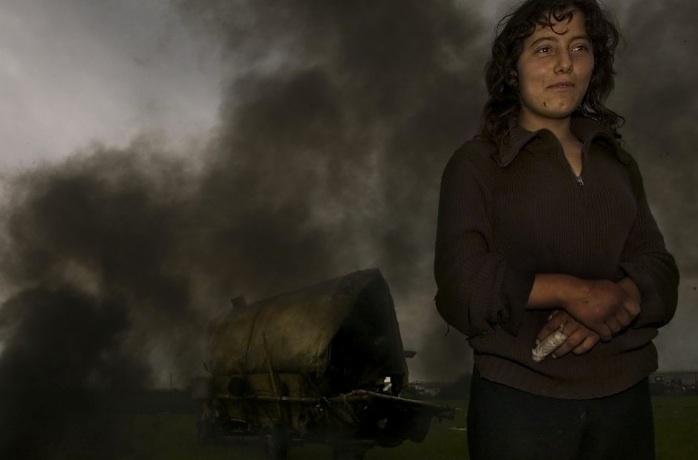
A mix of old and new technology.  Horse power on modern running gear.  Photo by Peter van Beek.  Click the image to view the photo album.

Peter van Beek has documented the difficult life of nomads in a modernizing Europe.  Fear, stereotypes, and unfamiliarity dominate their way of life and place them into a partially self-imposed, marginalized portion of society.  Although there is terrible poverty, he documents family life and survival of these remarkable people.

Untitled
Simple shelter as used by our ancestors since the beginning of time.

Untitled 2
It isn’t easy being a nomad in a modern technological world. There is easy place for this lifestyle.

Untitled 3
The world has changed but many traditions have not.


Untitled 4
There are certainly exceptions to nomadism. Many Romany cling to their traditions and morph them into a new lifestyle. All of our people have done this.

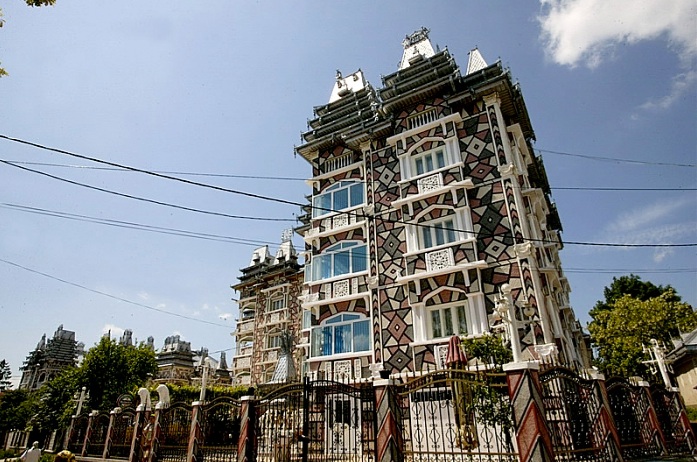
But it isn’t all oppressive poverty “By collecting and selling iron they get very rich and build their own village with huge palaces where they started living.”  While settling down, the community keeps it’s own unique sense of style.

Untitled 5
Hard work and some flexibility can make assimilation slightly easier.

Palace
Ethnic identity shows in this vernacular style.

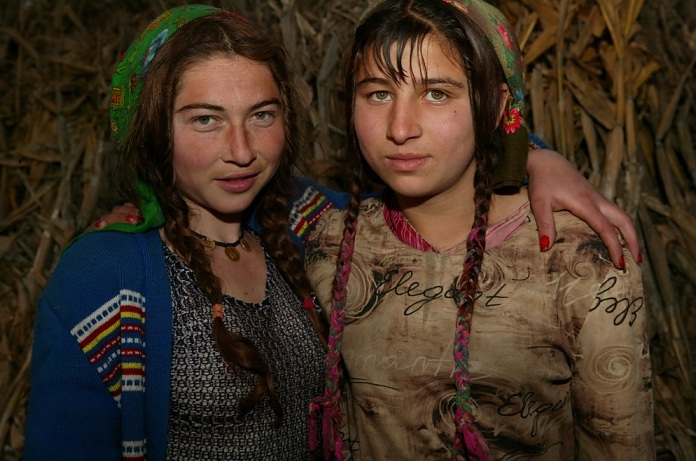
Kalderash
Beautiful young women with a foot in both worlds.

“Many Kaldarash people (the coppersmiths) still wear colorful clothes, living in a beautiful traditional way.  In some villages, time seems to stand still.”

From Peter van Beek’s website:

“The only nomadic gypsies in Europe live in Romania, the country that joined the European Union in 2007. Living a hard life in Romania these semi-nomadic people hold on to traditions and rituals. Amongst them are story-and fortunetellers, musicians and coppersmiths. Despite a law against nomadic life these gypsies still live in their harsh and remarkable way.”

Images found at Peter Van Beek Photography.  Check out his beautiful work and consider buying his book about the Roma:

140105_Metropolis_Roma_adv.indd

Paris Travellers

Paris, around 1900.
Paris, around 1900.

A tiny accommodation, side entry single horse style.  It is documented that the adults with this style wagon generally slept outdoors except in very bad weather.  It was a good way to confine the children and the valuables.

This is part of a series of images, mostly Romany, Irish and Scottish Travellers collected from around the internet.  Many of these historic images found on the web are without citation.  When a clear link to a source is found, I try to include it.  If a source is known, please pass it on and I will gladly include it or remove it if necessary.

Dugald Semple and a Simple Life

I would like to re-share this older post I wrote about a caravaner, scholar, and philosopher I am quite intrigued by – Dugald Semple

Dugald Semple was a Scottish philosopher of the early 20th Century and an advocate for simple living.  After becoming and engineer he took to the woods and, for a period, a life on the road, living in a tent and in various caravans in order to write and travel and avoid the enslavement of increasingly urban society.

Semple on the beach.

His major question was always “How ought we to live?” an ancient subject for thinkers the world-over and a very important topic in Asian philosophy as well.  His teachings are interesting and he still has a serious following of vegans, fruitarians, and Christian Phlosophers around the world.  He apparently never ate meat, eggs, or cheese, and subsisted on a mostly fruit diet.  It clearly worked well-enough, as he died at the age of 79 in 1964.  Not bad, but think of all the bacon he missed!

DugaldSemple

Of course, my interest in Dugald lies primarily in his simple lifestyle and his fondness for caravans and living in the open.  He married well.  Cathie, his wife was a widow who was independently wealthy, owning a large house and grounds.  This certainly contributed to the success of the life-long experiment in simple living.  Even as he settled down, he still philosophized and associated with his old friends who roamed the countryside and set up guilds of craftsmen (Nerrissa Wilson, Gypsies and Gentlemen).  He envisioned a new generation of skilled travelers who could pack up their trades and families and move to where the work was, thus alleviating some of the new stress of urban life.

Semple
Semple in his summer camp.

I love this camp.  This wagon seems perfectly suited for summertime use with the fully opening sides.  Too bad his dream didn’t catch on, but he admitted that life on road could be stressful and difficult.  At least we can give it a try; even if in a limited capacity.

Joy-in-Living

As an end note, here’s a quote he is well known for on his philosophy of a vegan lifestyle:

Personally, I began rather drastically over 50 years ago by cutting out not only all meat or flesh foods, but milk, eggs, butter, tea and coffee. Cheese I have never eaten; indeed I hate the very smell of this decayed milk. Next, I adopted a diet of nuts, fruit, cereals and vegetables. On this Edenic fare I lived for some ten years, and found that my health and strength were greatly improved. Probably this was also because I lived more in the fresh air and closer to Nature. (Emphasis added by the ed.).

I just don’t know if I can fully trust a man who won’t eat cheese…

Vardo – Topper Makeover

Because there’s always room for improvement.  In my case, a lot of improvement. snail2
Rehung siding, new paint, fresh varnish, little fixes, and lots of cleaning.  We’re hooked up to get out of town for a bit.

snail1Dietz lanterns, Kelly kettle, fuel, and lamp oil packed away in the pan box.  The steel disk serves as a heat shield to minimize ground scarring under the fire.

snail8A view from the bed.  Still more to pack up but things are looking good and nearly ready to go.

snail7The new windows are great and really perk the place up.  Bright and airy makes for a pleasant space.

snail3Still, the little Snail is far from perfect; made on a shoestring budget during snatches of time between work and bad weather.  Although I don’t live in it full-time currently I have come to see this as my home.

Update from the vault: Vardo and Sheepherder Links

After several requests for information, here is my short list of inspirational sites found on the web.  Culling the web for Vardo style so you don’t have to.  I will try to morph this into it’s own page soon as a place to add more links as they become available.

Romany and Traditional Style

GypsyWaggons
Great Historical Resource

Roth
Gypsy Vans by Roth. Beautiful traditional waggons with loads of information about types and styles. Amazing stuff here.

Nice, garden variety caravans.  These make wonderful retreats and getaway spaces.
Nice, garden variety caravans. These make wonderful retreats and getaway spaces.

Solid, permanent and towable vardos from Windy Smithy.

Ingham & Fallon, restoration, new and used.  The images alone make this one worthwhile.
Ingham & Fallon, restoration, new and used. The images alone make this page worthwhile.

Sheepherder Wagons

Plan to spend some time on this website.  Anvil Wagon Works in Livingston, Montana makes all types of traditional Chuckwagons, Sheepwagons, and Buggys.  Lot's of great photos.
Plan to spend some time on this website. Anvil Wagon Works in Livingston, Montana makes all types of traditional Chuckwagons, Sheepwagons, and Buggies. Lot’s of great photos inside and out.


This image links to their Sheepwagon page but there is so much more here.  Serious craftsmen of all things traditional Wagon and Wheel related.
This image links to their Sheep wagon page but there is so much more here. Serious craftsmen of all things traditional Wagon and Wheel related.

The Lazy AA Guest Ranch and Builders of towable Woolywagons.

Idaho Sheep Camp.  You can't be more authentic than this.  I want one!  Pages of images to inspire the builder of tiny homes.
Idaho Sheep Camp. This is the interior of just one of their many featured wagons.  You can’t be more authentic than this. I want one! Pages of images to inspire the builder of tiny homes.

Old Western Wagons are builders of Sheep Wagons, Vardos, Freight Wagons, and other horse drawn vehicles.  Located in Seattle, Washington.
Old Western Wagons are builders of Sheep Wagons, Vardos, Freight Wagons, and other horse-drawn vehicles. Located in Seattle, Washington.

Engel's Coach Shop  Joliet, Montana.  Master Wheelwright and makers of horse drawn vehicles.
Engel’s Coach Shop Joliet, Montana. Master Wheelwright and makers of horse-drawn vehicles.

Plankbridge Shepherd Huts from Dorset, England.  Traditional huts, not for long distance travel but fine for short moves.  Nice designs.
Plankbridge Shepherd Huts from Dorset, England. Traditional huts, not for long distance travel but fine for short moves. Nice designs.

bshtrippictransnoshadow850
Blackdown Shepherd Huts. Handcrafted in Somerset, England. Posh and spiffy little cabins with lots of style.

Shepherd
Everything you need to know about historic Shepherd Huts.

Ranch Willow Wagon Co. builds and restores wagons to the highest quality standards. Company owner Lynn Sedar has been in the wagon business for over 20 years and is also an acclaimed artist, design consultant and furniture designer. Wagons designed by Ranch Willow Wagon Co. are the ultimate blend of history and art.

French Style

ImageTitreIndex

In French. The website contains some good old images as well as information about various types of travelers’ wagons (a.k.a. Roulottes).

An Interesting mix of Hippie vehicles from Britain and Europe:

travellerhomes-head

MORE TO COME