The modern banjo has ancient roots and shares much with it’s African antecedents. Its connection to the lute family along with the whole array of drum-headed cousins crossed many lost cultural boundaries in ancient times. This makes it the perfect candidate for bridging musical genres and styles, from the Sub-Saharan and Arabic music the banjo, with it’s almost ever-present drone string, morphed into creature we know today. Most non-players only know it from the post-war music known as Bluegrass or maybe even Old-Time Country but there is, and always has been, a broad range of music brought to life on this bright and varied instrument.
Cowboy Singing – Thomas Eakins
I read somewhere long ago the real instrument of the American Cowboy was the banjo due, in part, to the timing and population of the very people who became cowboys. Forget the 1950s movie stereotype, most cowboys were freed slaves, their offspring, or poor younger sons of Euro-Americans looking for a job and adventure. Those who were not were likely caballeros from old Mexico or the west in general; they brought most of the guitarras to the scene.
Thomas Eakins, Home Ranch 1888
Where I was going with this ramble was that the humble little banjo can do more than Mumford and Sons or Yonder Mountain String Band patterned rolls. Nifty and tight as they may be, some of us want to reach beyond and find the real soul in our hands. Don’t get me wrong, these are fine musicians, but really just one narrow style in a giant spectrum of sound.
Here’s a great example. What could be better than Bach and banjo?
I suggest checking out more of Mr. Raphaelson’s videos if you want to add a little novelty to your listening lineup. Whatever your instrument, love it, learn it, and expand upon it.
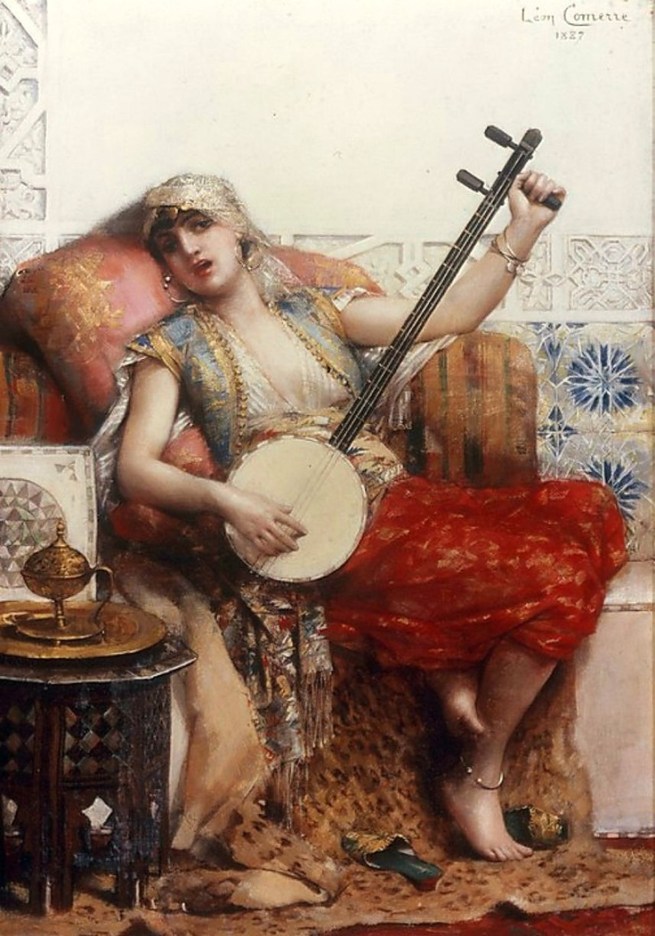
Since we opened the post with a banjo beauty shot, it seems appropriate to end with one as well. I love this inlay, by the way.
By Léon François Comerre, French Academic School. I think this familiar looking instrument comes from Africa via the Arabic world and is generally called a tanbūr. A sort of distant uncle to the modern banjo, America’s African instrument.
Danger, geek stuff ahead as I share a little story from last week…
Recently, on my occasional foray into our local charity shop I saw something mysterious. I’m not much of a shopper but before I was even certain as to what this fellow was, I was pretty sure I needed to possess it. Knowing nothing about this entire class of antiquity, I also had no idea what a good price would be but I knew that the listed amount would be worth my entertainment. The tag asked for about the price of a decent dinner out in small town rural New Mexico. And they say it goes to a charity, right?
A black box ready to be explored. What could be inside?
I find about one thing per year in this store that actually piques my interest. This slightly battered black box was pushed back on a bottom shelf mixed in with some old-style slide projectors and video recorders. I thought maybe it was a film camera or possibly a projector. Whatever it was, the case appeared to be from a better era of construction, and judging by the battered handle and nicks in the covering, it was well-loved and was much carried around. The fact it had a key and functioning lock gave me hope.
So What Is It? A Clockwork Ipod? An Early Laptop?
Some of you savvy collector-types who know antiques probably spotted it for what it is immediately.
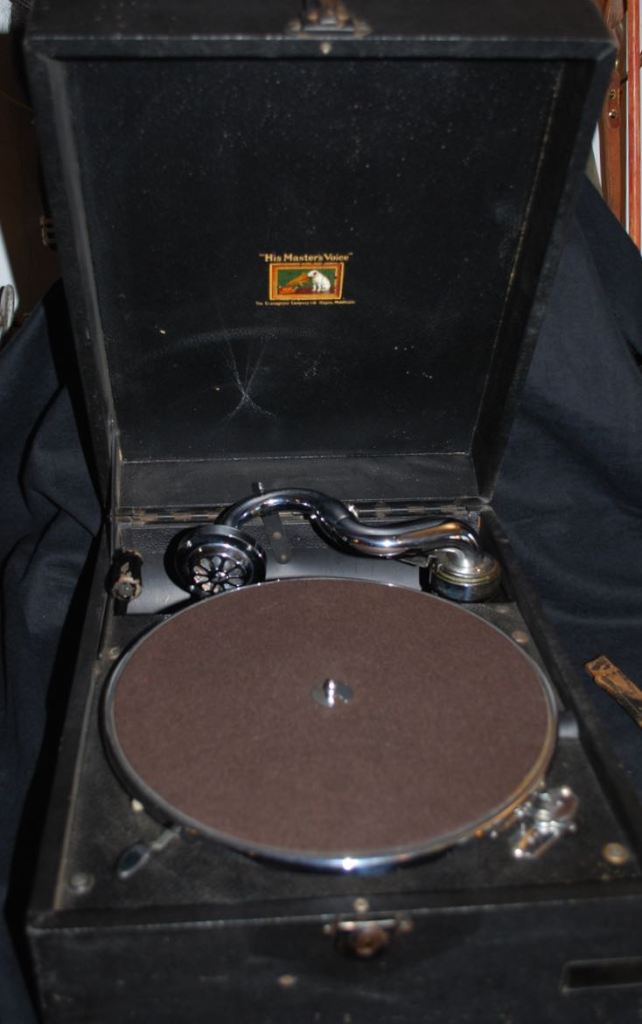
An inexcusably poor photo of this mechanical marvel. A 1939 mechanical gramophone.
Opening it up, I was excited to see it was a 78 RPM gramophone. I honestly had very little hope that this thing would work or that all the parts would even be present much less in working order. My experience is that thrift store patrons are a rough lot whose goal it is to disassemble and loot as much of the merchandise as possible; merely for the entertainment. Nevertheless, I was intrigued.
I honestly had no experience with this sort of contraption but, lacking any sort of electrical motor or plug, and having a crank handle stowed inside, I quickly deduced that this was an escapement clockwork mechanism. The moving parts still moved. The solid bits remained solid. Better yet, there was a small, hand-written note inside reading: “We purchased this in England in the 1930s. Brought it over here in 1970.”
Only this, and nothing more.
Under the watchful glare of the shop attendant, I examined every part, figured out what moved where, felt out the spring by cranking it up, testing the stop and start mechanism, fondled the styluses, and generally examined this little beast like a dairy cow at a county fair. No part went untouched, if you know what I mean.
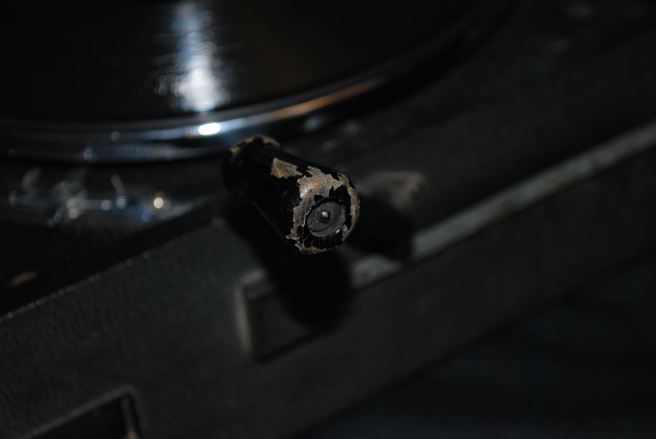
The hand crank in it’s storage cradle.Crank engaged with winding mechanism showing chipped enamel paint over hardwood (beech?).
Cranking it for the first time, I felt for any oddity in turning. It felt smooth and tightened slowly. I had no idea if it should turn five or one hundred times.
Diaphragm assembly; heart and soul of a gramophone.
I inserted a needle and brushing it with my finger I could tell it had plenty of sound. There’s some use for calloused skin I suppose.
If nothing else, this was a work of art.“Made in England.”
I think they used to make some good stuff in England.
Speed adjustment. 78 RPM, Slow to Fast.Although the outside showed signs of care-worn travel, the interior was immaculate.
Being, in the words of Shakespeare, one of those people known as the rude mechanicals, I was able to figure out the basic functions of the machine with just a little experimentation. They were spectacular. Appealing to my somewhat Luddite, but also slightly retro-futuristic aesthetic, I desired to possess this creature. It turned when cranked. The stop mechanism stopped. It had all the right parts (I thought). It was a beauty to behold.
However…
I decided, in accordance with my Minimalizing lifestyle, to close it up, put it back on the shelf, and walk away… I issued the nolle prosequi for the moment. I let that train sail from the station. If it was still there in two weeks, I would reconsider.
For the moment, I let this sleeping dog lie.
I thought long and hard about this. It was nearly perfect.
Not long ago, I would have snatched it up just because it was fun and cheap; even just as a novelty. Nowadays, I don’t make purchases without a lot of consideration. Do I need this? Not really. Do I think it will bring some pleasure? Hell yeah. Is it expensive? Not really. In fact, I partially justified it to myself that I could always re-sell it on Ebay, at more than ten times the asking price judging by others I found online. So, of course,
I bought it.
A little Internet research taught me a lot about this type of instrument. Here’s some model-specific information I came up with:
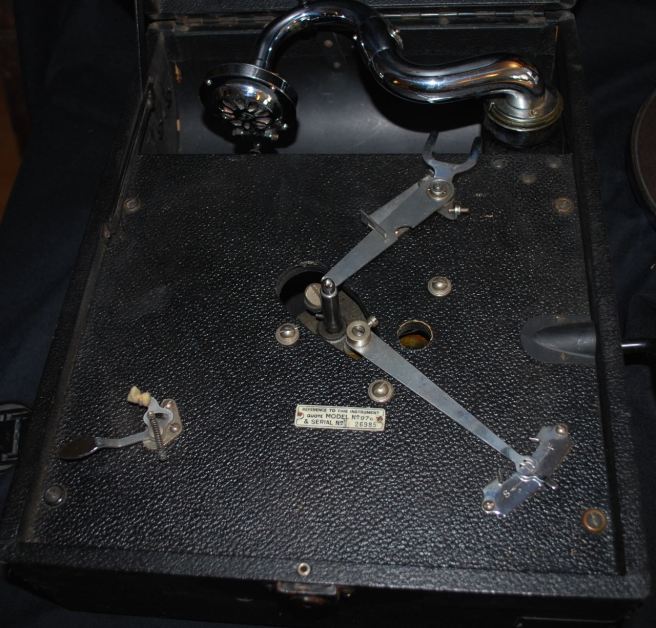
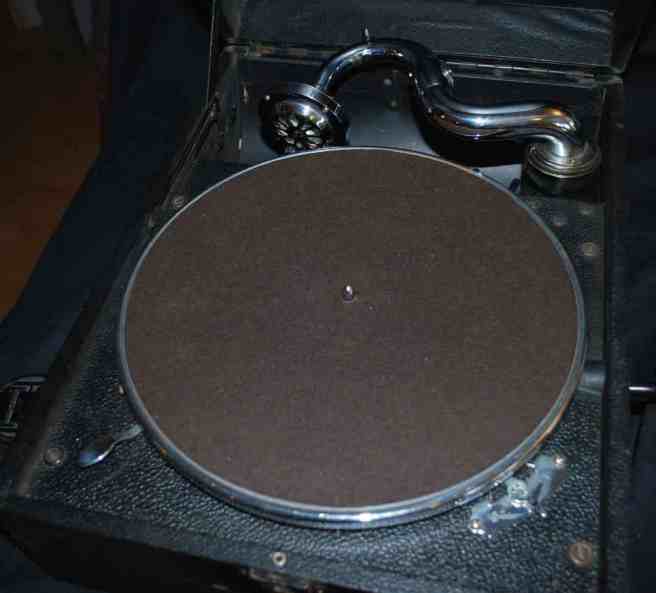
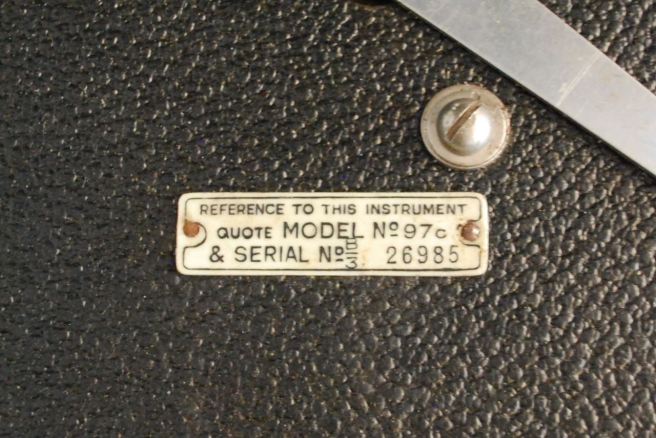
HMV Model 97c – The “c” is a year designation for the 1939 model although one collector site thought it might be a 1938 model. This makes little difference to me as it’s still 76 years old. The Model 97 was designed as a cheaper alternative to the ever popular HMV Model 102 costing £2-£3 in the mid 1930’s compared to the £5-£6 price-tag of the 102 (I’m told this is about £395.00 and £795.00 in today’s economy). It has a 10” turntable, HMV No.21 sound box, automatic and manual brakes, a pivoted front corner needle bin and it originally came with a record carrying tray (now sadly missing). It is finished in a black Rexine® (fabric comprised of cellulose nitrate, camphor oil, pigment, and alcohol, embossed to look like leather) cloth-covered case with a steel-reinforced leather handle.
Clarence “Pinetop” Smith’s groundbreaking music seemed an appropriate piece to test the little machine. A fellow Midwesterner.
Of course, I remember 78s being around in my elder’s record collections as a kid but I am definitely of the age of vinyl and now electrons in some sort of cloud. Fortunately, there are loads of reasonably priced 78 RPM records and replacement needles out there so providing some sustenance for the HMV was for me, but the work of a moment (and an exercise in PayPal). Here’s a rather dull video I made of the little box in action (my first YouTube upload) just to show how well it works.
Pulling the arm out to the right kick-starts the motor by unlocking the turntable, and it stops by triggering the lock again as the arm reaches the inner radius. Needles need to be replaced after every use so there is a small expense involved. The little box is remarkably loud and the old adage from the Victrola era “put a sock in it” rings true unless you happen to be hosting a dance. I understand that these were popular for picnics and outdoor soirées as they made plenty of noise and required no external power. A sort of boom box of their day. Anyone having unwanted 78s lying around feeling neglected can send them my way as I think this will be a novel little device for the long winter evenings in the Vardo.
Thanks for tolerating this journey into a geeky toy. I hope you enjoy it.
I saw this link this morning on C.B, Gitty’s music crafters’ supply blog. A video of Led Zeppelin’s Stairway to Heaven arranged and played by Charles Atchison. Atchison is a remarkably talented musician and general polymath. Definitely worth checking out.
If you are looking for a resource on instrument building he also has an interesting looking book out as well.
As if traditional bagpiping weren’t enough, here are the Royal Scots Dragoon Guards going all Pachelbel for your listening enjoyment.
A view of the amazing Scottish country of Scotland. All these photo’s were taken by friends on the Isle Of Skye.
Accompanied by the music Canon by The Royal Scots Dragoon Guards.
Music Available @itunes.
Since it has been some time since my last bagpiper post I thought this one was in perfect order. A piper standing under the great Saltire in the sky. Enjoy!









 Preindustrial Craftsmanship