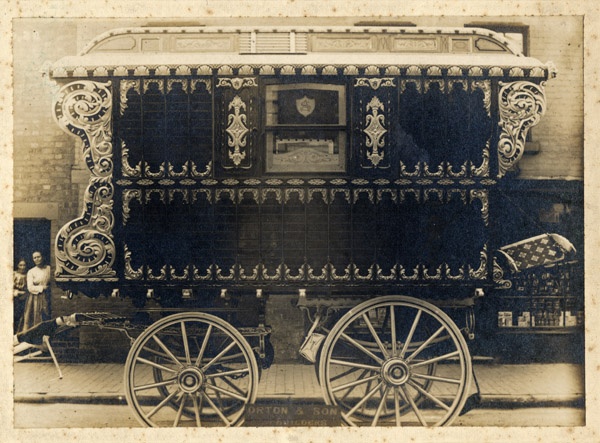
Remodel and Rebirth of the Little Green Vardo

It just seems right.

The timing,

the monetary investment,

the effort.

This is a requested repost of a series I did almost five years ago when I took my eight foot single-axle vardo caravan and reconstructed it into a 12 foot body on a robust tandem trailer.

After adding up the mileage from the log book I keep with the Vardo, I see we have clocked over 21,000 miles since she was first put to the road in February of 2010.  I have, no doubt, missed some small side trips and there are excursions I know I forgot to record, but this is, more-or-less, where we stand.  The trailer frame itself was high-mileage but well-maintained when I acquired it back around 2002 having first been owned by a university, then by a private individual before coming to me.

DSC_0080
My “before” photo. Rated at 2,000 lb. gross vehicle weight. It was solid and well-built but already showing some signs of age and life in the salt air of the Pacific Coast.

The real beauty of this trailer is the square tube construction and heavy-duty hitch.  Starting small was wise for me as it constrained the build and forced me to squeeze every inch out of the design.

On the way to becoming the "after" photo. The full box body nearly done.
On the way to becoming the “after” photo. The full box body nearly done.

I eventually replaced the original jack with a more heavy-duty model and replaced the jack wheel with a large foot for stability.  For safety, the tires were replaced when the trailer was re-purposed due to age, not wear.  If you missed it and want to read more about the construction of the micro house we call a vardo, GO HERE.

The Vardo; Where are we now? What do we want?

This little living wagon is great and serves it’s function well.  It’s a little beat up and showing it’s miles; living and traveling in all weather, a lot like it’s owner.  But still, it’s a little homey shelter from the elements, providing all the necessary comforts, and making travel a breeze.  With about 49.5 square feet of living space inside (4.6 sq. meters) it is spacious for one and comfortable enough for two adults who do most of their activities outdoors.  However, I have long pondered placing my vardo on a longer trailer, either to gain cargo space for tools and the like OR to extend our living space.  Sticking with the Minimalist thinking, I  decided long ago that 12 feet was about the maximum I want in a trailer.  With a standard 4 foot hitch that makes for 16 feet (4.9 meters) dragging behind the truck or about the length of a second truck.  I did the math on the new space and I liked it.

So back to it.  What do we really need?

Thinking of the many scenarios we find ourselves in, some added amenities could be handy in certain situations.  From wilderness areas in Utah to posh campgrounds in San Diego, highway rest areas in the Midwest and museum parking lots in Santa Fe, or even stealth camping on a city street, our needs are varied.  Although the vardo was built as a wilderness base camp, sometimes it feels like a miniature fortress or space station or temple of solitude.  When we’re camping in the remote west, beyond the confines of civilization and snooping gawkers, it’s not a problem spending most of our time outdoors, using a campfire or cook stove to fry up some bacon and boil some coffee, but try that in a grocery store parking lot in the city and you will only find trouble.  But we still essentially live outdoors.  We don’t need a dance floor inside.

Two thing we want that this space can supply:

  1. A simple kitchen.  By this I don’t mean a Martha Stewart style, butcher block countertop with rotating spice racks, dual ovens and a six burner ceramic-top range.  We need a dedicated space to store our cookware and food, do some prep-work, and make simple meals in any weather, beyond the prying eyes of the local gendarmerie.
  2. Secondly, we want more storage space for our personal belongings when we finally hit the long open road and don’t look back.  Tools for making things and raw materials alone take up a lot of our space.  Leather, wood, sewing supplies, fasteners, etc. all require more space than we have.  On top of this, a large, flat work surface would be a nice addition indoors.

After several (many) sketches and mock-ups… Voila!  I think we nailed it, the vardo formerly known as the Snail reborn as Nautilus 78.  Even though we know that nothing comes from nothing, our minds like to think of things as having a beginning, middle, and end.

So in that sense, here’s to our new beginning.

DSC_0001 (6)
The new foundation. Tandem wheels, brakes, breakaway safety system, LED lights and 7,000 GVWR. Let’s hope we’ll never need this much trailer.
DSC_0002 (2)
Too many badges, certificates and insignia. Still, and excellent buy I think.
DSC_0003 (3)
First things first. The heavy wooden floor must go.

On to PART 2

Caravan Family

During the heyday of Caravan living it is important to remember that these were rarely the dwelling of a loner. The Caravan was the hub of the nuclear family and groups of wagons represented larger, extended family groups and allies.

We are social creatures that thrive in community.

Interview Time

Well this is exciting. I got interviewed at winter count near Florence, Arizona back in February.

It’s heavily edited from a much longer discussion but I don’t think I sound too stupid here talking about the Vardo.  The interview is very close-up and tight but you can get a feel for the interior layout. There is a lot of good stuff on the Cheap RV Living website and I’ve been a reader for a very long time.  Check it out.


https://youtu.be/ktkXcXmR96Q

ProtoStoga

I want to re-share this camper I posted about back in 2010.  I would still like to know more about it but love what I’ve seen so far.

I see some definite similarities to my own concept of a vardo but I really like to metal sheathing as a modern, low maintenance exterior.  Also, the rounded front was a long consideration in my plans but in the end I chose a more “old-timey” look.

You can just about see the evolution of the Airstream design in this construction.  They also have a nice Tiny House that’s worth checking out here: http://www.protohaus.moonfruit.com/

For those who don’t follow the Tiny House Blog, check out the ProtoStoga here:

http://tinyhouseblog.com/tiny-house-concept/protostoga/#more-12243

Paris Travellers

Paris, around 1900.
Paris, around 1900.

A tiny accommodation, side entry single horse style.  It is documented that the adults with this style wagon generally slept outdoors except in very bad weather.  It was a good way to confine the children and the valuables.

This is part of a series of images, mostly Romany, Irish and Scottish Travellers collected from around the internet.  Many of these historic images found on the web are without citation.  When a clear link to a source is found, I try to include it.  If a source is known, please pass it on and I will gladly include it or remove it if necessary.

Community of Wanderers

Nomads are not loners.  In fact, humans do not do well alone in any setting.  We have always been communal people, depending upon one another for help and support.  Many hands make light work and it is essential to be near others you can depend on.

1930sI have been collecting images of Traveller communities for many years and I really enjoy the gritty, homespun feel of the old encampments with peeling paint and makeshift tarpaulin shelters.  I’m sure this image was not welcome in settled communities around Europe and the shiftless nature of these wanderers led to many suspicions, both unfounded and real.

4203n Woonwagenkamp, een draaiorgel komt langsThese are not the rolling home of the wealthy showmen of idle rich but the best compromise for families destined to live on the road.

FamilyVardoThe vardos bear many differences but within fairly tight physical contraints of size, weight, needs, and technology.  It’s important to remember as well that historic travellers of most varieties didn’t design or build their own accommodations but often modified or improved that which they acquired.

Dutch1940Even though they show few relevant details of the caravans themselves these are some of my favorite images; they give us a glimpse of the people who called them home.

Although Traveller families lived (and live) on the margins of “normal” society they were (are) more like their neighbors than not.

I hope you enjoy the photos as we head into the season of Thanksgiving here in North America and give thanks for what we have.

We are at our best and worst in groups, whether that is family or friends.  Humans are social animals.